

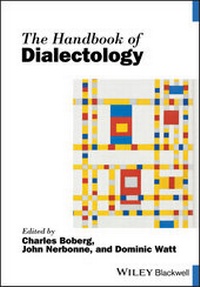
The Handbook of Dialectology
Description

The Handbook of Dialectology provides an authoritative, up-to-date and unusually broad account of the study of dialect, in one volume. Each chapter reviews essential research, and offers a critical discussion of the past, present and future development of the area.
- The volume is based on state-of-the-art research in dialectology around the world, providing the most current work available with an unusually broad scope of topics
- Provides a practical guide to the many methodological and statistical issues surrounding the collection and analysis of dialect data
- Offers summaries of dialect variation in the world's most widely spoken and commonly studied languages, including several non-European languages that have traditionally received less attention in general discussions of dialectology
- Reviews the intellectual development of the field, including its main theoretical schools of thought and research traditions, both academic and applied
- The editors are well known and highly respected, with a deep knowledge of this vast field of inquiry
More details
Other editions
Additional editions
Persons
Charles Boberg is Associate Professor in the Department of Linguistics at McGill University in Montreal, Canada. His research focuses on variation and change in North American English, particularly Canadian English and accents in film and television. He is the author of The English Language in Canada: Status, History and Comparative Analysis (2010) and a co-author of the Atlas of North American English (with William Labov and Sharon Ash, 2006).
John Nerbonne worked at HP Labs, the German AI Center, and the University of Groningen, where he was head of Digital Humanities. He is currently an honorary professor in Freiburg. Nerbonne works in quantitative linguistics, using computational and statistical methods. He is a member of the Royal Netherlands Academy of Arts and Sciences, was president of the Association for Computational Linguistics in 2002, and a Humboldt prize winner in 2013.
Dominic Watt is Senior Lecturer in Forensic Speech Science at the University of York, UK. His research interests are in forensic phonetics and linguistics, speech perception, sociophonetics, and language and identity studies. He is co-author of English Accents and Dialects (with Arthur Hughes and Peter Trudgill, 2012), and co-editor of Language and Identities (with Carmen Llamas, 2010) and Language, Borders and Identity (2014).
Content
List of Contributors viii
Introduction 1
Charles Boberg, John Nerbonne, and Dominic Watt
Section 1: Theory (section editor: Dominic Watt) 17
Section Introduction
Dominic Watt
1 Dialectology, Philology, and Historical Linguistics 23
Raymond Hickey
2 The Dialect Dictionary 39
Jacques Van Keymeulen
3 Linguistic Atlases 57
William A. Kretzschmar, Jr.
4 Structural Dialectology 73
Matthew J. Gordon
5 Dialectology and Formal Linguistic Theory: The Blind Man and the Lame 88
Frans Hinskens
6 Sociodialectology 106
Tore Kristiansen
7 Dialectometry 123
Hans Goebl
8 Dialect Contact and New Dialect Formation 143
David Britain
9 Dialect Change in Europe-Leveling and Convergence 159
Peter Auer
10 Perceptual Dialectology 177
Dennis R. Preston
11 Dialect Intelligibility 204
Charlotte Gooskens
12 Applied Dialectology: Dialect Coaching, Dialect Reduction, and Forensic Phonetics 219
Dominic Watt
Section 2: Methods (section editor: John Nerbonne) 233
Section Introduction
John Nerbonne
13 Dialect Sampling Methods 241
Ronald Macaulay
14 The Dialect Questionnaire 253
Carmen Llamas
15 Written Dialect Surveys 268
J.K. Chambers
16 Field Interviews in Dialectology 284
Guy Bailey
17 Corpus-Based Approaches to Dialect Study 300
Benedikt Szmrecsanyi and Lieselotte Anderwald
18 Acoustic Phonetic Dialectology 314
Erik R. Thomas
19 Computational Dialectology 330
Wilbert Heeringa and Jelena Prokic
20 Dialect Maps 348
Stefan Rabanus
21 Identifying Regional Dialects in On-Line Social Media 368
Jacob Eisenstein
22 Logistic Regression Analysis of Linguistic Data 384
John C. Paolillo
23 Statistics for Aggregate Variationist Analyses 400
John Nerbonne and Martijn Wieling
24 Spatial Statistics for Dialectology 415
Jack Grieve
Section 3: Data (section editor: Charles Boberg) 435
Section Introduction
Charles Boberg
25 Dialects of British and Southern Hemisphere English 439
Kevin Watson
26 Dialects of North American English 450
Charles Boberg
27 Dialects of German, Dutch, and the Scandinavian Languages 462
Sebastian Kürschner
28 Dialects of French 474
Damien Hall
29 Dialects of Italy 486
Tullio Telmon
30 Dialects of Spanish and Portuguese 498
John M. Lipski
31 Dialects of the Slavic Languages 510
Vladimir Zhobov and Ronelle Alexander
32 Dialects of Arabic 523
Enam Al-Wer and Rudolf de Jong
33 Dialects in the Indo-Aryan Landscape 535
Ashwini Deo
34 Dialects of Chinese 547
Chaoju Tang
35 Dialects of Japanese 559
Takuichiro Onishi
36 Dialects of Malay/Indonesian 571
Alexander Adelaar
Index 582
Introduction
CHARLES BOBERG, JOHN NERBONNE, AND DOMINIC WATT
DIALECTOLOGY is the study of dialect, or regional variation in language, a subfield of linguistics. This handbook presents a comprehensive survey of that subfield, including the theory of dialect variation; the methods of collecting, analyzing, and interpreting dialect data; and the facts of dialect variation in many of the world's most widely spoken languages. Before proceeding with our survey, we offer by way of introduction the following reflections on some of the most basic issues in the field, as well as an explanation of the approach we have taken in planning this book and an outline of what is to follow.
1 The Origins of Dialect Variation and the Status of Dialectology
Dialect differences are caused by two forces operating in tandem: language change and the expansion of speech communities. Language change is of course a constant, on-going process in all speech communities: one of the axioms of historical linguistics is that all languages change all the time. As long as communities remain small, language changes are adopted or rejected by the community as a whole, or show only social differentiation. When a speech community expands sufficiently across a territory, however, the network of interpersonal communication that diffuses changes among its members is disrupted: sheer distance, or physical barriers like mountains and bodies of water-and sometimes also cultural, economic, or social divisions-make it impossible for change to diffuse evenly across the entire community. Eventually, an accumulation of undiffused or partially diffused changes causes community members in one region to recognize that people in other regions speak a different version of their language: what we would call a dialect.
Given enough time, this process of differentiation can cause dialects to diverge to the point where they are no longer wholly mutually intelligible, in which case we begin calling them separate but historically related languages. Such divergence lies at the heart of how historical linguists conceive of the development of families of related languages, like the Indo-European languages spoken across most of Europe and the Americas today, which hypothetically began their individual existence as dialects of a common ancestral language. In other cases, dialect differences can persist in a stable relationship for centuries, without leading to language divergence, or can decline and disappear, as the communication barriers that produced them are overcome by social or technological change. All normal languages, except those spoken in single, restricted locations, display regional variation and have always done so: accounts of dialect differences are as old as written language itself, appearing two millennia ago in Ancient Greece and China. Given its universality, dialect variation should be seen as a fundamental aspect of human language and dialectology an important branch of linguistics, the scientific study of language. A linguistics that did not include dialectology would be incomplete.
Languages vary in many ways: across time and space, as just discussed, as well as across social categories. Today, dialectology is often seen as part of a larger sub-discipline of linguistics dealing with all of these types of variation, collectively called language variation and change (see, e.g., Chambers and Schilling 2013, another handbook in this series). This integrative approach reflects the many ways in which these types of variation have been shown to interact, first brought into clear focus in the work of William Labov (see below). Much of the variation we observe in speech communities is in fact the synchronic manifestation of diachronic processes, or changes in progress: newer forms, before being uniformly adopted, compete for dominance with older forms, in patterns that reflect an intersection of regional and social influences. Nevertheless, as difficult as it can be to isolate regional from other types of variation, the primary focus of this book will be on regional variation.
2 Defining Dialects
We shall begin our discussion of regional variation with just this problem, by exploring the meaning of the word dialect, which cannot be properly understood without reference to social variation as well. As linguistic variation arises in speech communities, it usually reflects social differences: different ways of speaking, like different ways of dressing or eating or having fun, come to be associated with groups arrayed on a socio-economic hierarchy involving wealth, power, education, ethnic or social identity, and other factors. Varieties of speech associated primarily with social groups are properly called sociolects rather than dialects and are the main focus of the allied subfield of sociolinguistics, but this type of variation also has an important place in dialectology, since regional varieties of a language-the definition of dialects given above-often develop social attributes. In particular, one variety, usually that spoken by the social, economic, and political élite in a nation's capital city or other great metropolis, normally comes to be seen as the "correct" form of the language. In many cases, this evaluation is shared not only by its own speakers, who use it as a symbol and even a justification of their higher social position, but also by others in the community, who accept that their own speech is by comparison inferior, or "incorrect." Because of its perceived social superiority, the élite variety is promoted to the status of a regional or national "standard" variety, which is preferred or even required in domains like broadcasting, education, government, journalism, the law, literature, liturgy, and science. It often serves these functions not only in its city or region of origin but across the entire linguistic territory, at higher social levels. This establishes a nationwide diglossia between the pan-regional "standard" variety, which comes to be seen not as just another dialect but as the unmarked form of the language itself (for instance, the form taught to foreigners who want to learn the language), and the regionally restricted and socially inferior "dialects," which continue to be the language of everyday life for peasants or farmers in the countryside and for factory workers and trades people in the towns and cities. Rural and urban dialects often receive distinct social evaluations. Rural dialects are frequently seen as quaint and musical, if also unsophisticated and somewhat comic, and are associated with idyllic notions of traditional country life. Urban dialects are more often seen as lazy, ignorant, and linguistically and morally degenerate, since they are associated (at least in many middle-class minds) with the social problems of the lower-class sections of large cities.
An amusing instantiation of this ideology can be seen in the animated adaptation of Kenneth Grahame's children's story The Wind in the Willows that was made in the 1980s for Thames Television in the U.K. Though all of the characters are animated figures of animals, the heroes of the story, Rat, Mole, and Badger, speak with subtly different versions of standard British English, or "Received Pronunciation"; the sympathetic minor characters, like a plainspoken otter and a benign cow, have rural, West Country dialects, but the local gang of criminals, the weasels, are given working-class dialects from London ("Cockney") and the urban industrial North. That said, the great fool of the piece, Mr. Toad, the lord of the local manor and a sort of upper-class twit, has the poshest accent of all, reminding us that the correspondence between high-class speech and positive social attributes is not always simple or direct (indeed, not only fools but cads and villains often have upper-class accents in popular entertainment). Nevertheless, the fact that this is a children's program-and a delightful and brilliantly produced one at that, it should be admitted-emphasizes the extent to which dialect ideologies are inculcated in children at a young age by schools, media, and other institutions.
Even more problematic than negative attitudes about dialects is the transfer of such attitudes to the speakers themselves: people who speak what some think of as "lazy" or "ignorant" dialects are thought of as lazy or ignorant themselves, a stereotype that can be used to justify denying them educational, occupational, or social opportunities. Conversely, speakers of standard varieties may be given unfair advantages in the same contexts, a fact that has encouraged many ambitious people from working-class social backgrounds to try to "improve" their speech, often with measurable benefits. This, indeed, is the main justification for teaching standard varieties in schools, whose main purpose is to maximize the socio-economic opportunities of their students. Defenders of the exalted status of standard varieties might argue that they are, in fact, democratizing (or at least meritocratizing) instruments, since they can be learned in school or by other means, thereby conferring socio-economic benefits on the ambitious and becoming a symbol of individual achievement rather than of inherited privilege. Sociolinguists have argued passionately-and correctly-that these notions of superior and inferior dialects are based purely on social prejudice rather...
