

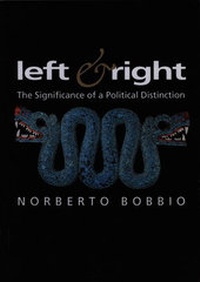
Left and Right
Description

In this book - which was a tremendous success in Italy - Norberto Bobbio challenges these views, arguing that the fundamental political distinction between Left and Right, which has shaped the two centuries since the French Revolution, has continuing relevance today.
Bobbio explores the grounds of this elusive distinction and argues that Left and Right are ultimately divided by different attitudes to equality. He carefully defines the nature of equality and inequality in relative rather than absolute terms.
Left and Right is a timely and persuasively argued account of the basic parameters of political action and debate in the modern world - parameters which have remained constant despite the pace of social change. The book will be widely read and, as in Italy, it will have an impact far beyond the academic domain.
More details
Other editions
Additional editions
Person
Norberto Bobbio is Emeritus Professor of Legal and Political Philosophy at the University of Turin.
Content
Preface to the First Italian Edition.
A Challenge to the Distinction.
Extremists and Moderates.
The Left/Right Distinction Survives.
In Search of the Criterion which Governs the Distinction.
Other Criteria.
Equality and Inequality.
Freedom and Authoritarianism.
The Polar Star.
A Reply to Critics (1995).
Notes.
1
A Challenge to the Distinction
1 'Left' and 'right' are two antithetical terms which for more than two centuries have been used habitually to signify the contrast between the ideologies and movements which divide the world of political thought and action. As antithetical terms, they are mutually exclusive, and together they are exhaustive within that eminently conflict-riven universe. They are exclusive in the sense that no doctrine or movement can be both left-wing and right-wing at the same time. They are exhaustive in the sense that a doctrine or movement can only be either left-wing or right-wing, at least as far as the more rigid application of the twin definition is concerned, as we shall see later.
The antithetical pair, left and right, can be put to descriptive, axiological or historical use, as I have often said of what I call the 'great dichotomies' which divide up every field of knowledge. They are descriptive in that they can summarize two sides of a conflict, evaluative in that they can express a positive or negative value-judgement of one side or the other, and historical in that they can indicate the passage from one phase to another in the political life of a nation. Their historical use can, in turn, be either descriptive or evaluative.
The opposition between left and right represents a typically dyadic way of thinking, which has been variously explained in psychological, sociological, historical and even biological terms. There are examples in all fields of thought; the all-inclusive distinction or dyad dominates every discipline. In sociology it is society/community, in economics market/planned, in law public/private, in aesthetics classical/romantic, and in philosophy transcendent/immanent. Left/right is not the only distinction in the political sphere, but it is encountered everywhere.
There are distinctions in which the two constituent terms are antithetical, and others in which they are complementary. The former interpret a universe as a composition of divergent entities which oppose each other, whereas the latter interpret a harmonious universe composed of convergent entities which tend to fuse into a superior whole. The left/right pair belongs to the first type. Given that triadic thought is often generated from dyadic thought or represents, as it were, a development from it, the transition from one to the other will differ according to whether the dyad one starts from consists of antithetical or complementary terms. In the first case the transition occurs through a dialectical synthesis or negation of the negation, in the second case through composition.
The following reflections arise from the assertion that there is no longer any relevance to the distinction between left and right which, over the two centuries since the French Revolution, has been used to divide the political universe into opposing camps, an assertion which has been made repeatedly in recent years, to the point of becoming a cliché. It is now de rigueur to quote Sartre who, it appears, was one of the first to argue that left and right were empty vessels. They are no longer supposed to have any heuristic or classificatory value, and emphatically no evaluative application. Often they are referred to with a certain irritation, as though they represent one of the many linguistic traps which political debate can fall into.
2 There are various reasons for this opinion which is gaining increasing currency, and countless examples could be produced every day. Let us look at a few.
The first doubts about whether the distinction had disappeared, or at least ceased to have the same descriptive force, arose from the so-called crisis of ideology, and therefore the pointlessness of contrasting the ideologies involved. The objection which can easily be raised is that ideologies have not disappeared at all, but are still very much with us. The ideologies of the past have merely been replaced by others which are new or claim to be new. The ideological tree is always green. Besides, it has been shown repeatedly that there is nothing more ideological than declaring the demise of ideologies. Then again 'left' and 'right' are not just ideologies. To reduce them to purely ideological expressions would be an unjustifiable simplification: they indicate opposing programmes in relation to many problems whose solution is part of everyday political activity. These contrasts concern not only ideas, but also interests and judgements on which direction society should be moving in; they exist in all societies, and it is not apparent how they could disappear. Naturally, one could reply that such contrasting positions exist, but they are not the same as those encountered when the distinction was created, and during the period of its success these positions have changed so much as to make the old names anachronistic and therefore misleading.
Recently it has been argued that, since the concept of a left wing has been so drastically emptied of its descriptive powers as to be one of the least informative expressions in political usage, the time has come to replace the old pair of terms with a more appropriate one: that of progressives and conservatives.1 But some have taken a more radical stance, rejecting any residual dichotomy in their vision, and arguing that this last dichotomy is one of those 'follies' of political jargon, which we must free ourselves from in order to form new groupings, based not on positions, but on problems.2
3 Secondly, it is argued that the division into two distinct and opposing political camps has become inappropriate, and the resulting political spectrum insufficient, in the increasingly complex political world of large-scale societies, particularly large-scale democratic societies which tolerate and indeed presuppose the existence of a multitude of pressure groups and interest groups which compete with each other (and which on occasion oppose each other, and on other occasions make common cause with each other; they converge on some points and diverge on others, like dancers joining together and then turning their backs in an elaborate choreography). Basically, the objection is that in a multi-faceted democratic society, in which many forces are at play, which agree on some points and not on others, and permit a great variety of alliances, problems cannot be posed in antithetical form as one thing or another: either left or right, and if it is not left-wing, it must be right-wing, or vice versa.
This objection strikes home, but it is not decisive. The distinction between left and right does not at all preclude, even in everyday language, the existence of a continuous spectrum which joins the left and the right, or of intermediate positions where the left meets the right. These positions make up a central area between the extremes which is well known as the 'centre'. If one wanted to flirt a little with the terminology of logic, one could say that while the dyadic concept of politics can be defined as the excluded middle, according to which politics is divided into just two parts, which are mutually exclusive, with nothing in between them, a triadic concept can be defined as the 'included middle', according to which there is an intermediate space between the left and the right which is neither one nor the other. In the first case, the two terms, which have an 'either . or .' relationship, are contradictory; whereas in the second case, in which the intermediate area can be expressed as 'neither . nor .', they are opposites. No problem then: black and white are divided by grey, and day and night are divided by dusk. Grey takes nothing away from the distinction between black and white, and dusk takes nothing away from the distinction between day and night.
4 The fact that in many democratic systems with high levels of pluralism the 'included middle' can become so all-embracing as to relegate the left and the right to the extreme margins of the political system does not in any way invalidate the original antithesis. As the centre is defined as neither left-wing nor right-wing and cannot be defined in any other way, its very existence and raison d'être are based on this antithesis. The duration of dusk varies according to the season and the latitude, but its duration in no way affects the fact that its definition depends on the definition of day and night.3
Identification of this intermediate space allows for a more graduated interpretation of the political system, as the centre which is closer to the left, the centre-left, can be distinguished from the centre which is closer to the right, the centre-right. Equally, on the left, one can distinguish between a moderate left which tends towards the centre and an extreme left which is opposed to the centre, and on the right, a right wing which is attracted towards the centre and a right wing which distances itself so much from the centre as to be equally opposed to the centre as to the left. If it is then considered that whatever way the centre is divided up there is still a centre which remains intact and could be defined as the centre of the centre, a spectrum emerges with a range of positions.
It need hardly be said that fragmentation of the political system is assisted by the adoption of proportional representation. This fragmentation can be clearly seen in a chamber of deputies shaped like an amphitheatre, in which the various positions are represented, moving from the extreme right to the extreme left. However, the distinction which divides the elected...
