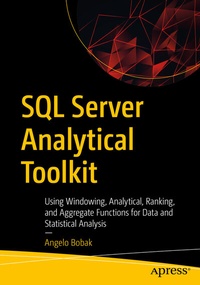
SQL Server Analytical Toolkit
Description

Learn window function foundational concepts through a cookbook-style approach, beginning with an introduction to the OVER() clause, its various configurations in terms of how partitions and window frames are created, and how data is sorted in the partition so that the window function can operate on the partition data sets. You will build a toolkit based not only on the window functions but also on the performance tuning tools, use of Microsoft Excel to graph results, and future tools you can learn such as PowerBI, SSIS, and SSAS to enhance your data architecture skills.
This book goes beyond just showing how each function works. It presents four unique use-case scenarios (sales, financial, engineering, and inventory control) related to statistical analysis, data analysis, and BI. Each section is covered in three chapters, one chapter for each of the window aggregate, ranking, and analytical function categories.
Each chapter includes several TSQL code examples and is re-enforced with graphic output plus Microsoft Excel graphs created from the query output. SQL Server estimated query plans are generated and described so you can see how SQL Server processes the query. These together with IO, TIME, and PROFILE statistics are used to performance tune the query. You will know how to use indexes and when not to use indexes.
You will learn how to use techniques such as creating report tables, memory enhanced tables, and creating clustered indexes to enhance performance. And you will wrap up your learning with suggested steps related to business intelligence and its relevance to other Microsoft Tools such as Power BI and Analysis Services.
All code examples, including code to create and load each of the databases, are available online.
What You Will Learn- Use SQL Server window functions in the context of statistical and data analysis
- Re-purpose code so it can be modified for your unique applications
- Study use-case scenarios that span four critical industries
- Get started with statistical data analysis and data mining using TSQL queries to dive deep into data
- Study discussions on statistics, how to use SSMS, SSAS, performance tuning, and TSQL queries using the OVER() clause.
- Follow prescriptive guidance on good coding standards to improve code legibility
Who This Book Is For
Intermediate to advanced SQL Server developers and data architects. Technical and savvy business analysts who need to apply sophisticated data analysis for their business users and clients will also benefit. This book offers critical tools and analysis techniques they can apply to their daily job in the disciplines of data mining, data engineering, and business intelligence.
More details
Other editions
Additional editions