

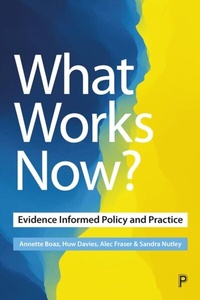
What Works Now?
Evidence-Informed Policy and Practice
1st Edition
Published on 27. March 2019
418 pages
978-1-4473-4549-7 (ISBN)
Description

Building substantially on the earlier, landmark text, What Works? (Policy Press, 2000), this book brings together key thinkers and researchers to provide a contemporary review of the aspirations and realities of evidence-informed policy and practice. The text is clearly structured and provides sector-by-sector analysis of evidence use in policy-making and service delivery. It considers some cross-cutting themes, including a section of international commentaries, and concludes by looking at lessons from the past and prospects for the future.
This book will be of interest to a wide range of social science researchers, students and practitioners as well as those interested in supporting more evidence-informed policy and practice.
This book will be of interest to a wide range of social science researchers, students and practitioners as well as those interested in supporting more evidence-informed policy and practice.
Reviews / Votes
"... timeliness, breadth and clarity are its essential strengths". LSE Review of Books "This optimistic yet deeply practical book shares many insights on how evidence can be used to promote better policy and better public services. The authors rightly reaffirm the importance of evidence but don't shy away from the practical difficulties in the way of using it. An indispensable resource." Geoff Mulgan, Nesta "An important and authoritative analysis of the state of evidence-informed policy and practice, across key domains and countries, by an impressive line-up of leading scholars in the field." Steve Martin, Cardiff University "From stakeholder engagement to impact assessment, 'What Works Now?' is the new seminal review of the state of the art (and science) of evidence use." David Phipps, York University "A long anticipated follow-up on What works? and an authoritative text on evidence-informed policy-making." Enrico Reuter, University of York "Excellent as an introduction to evidence-based policy and practice and its evolution across sectors and countries. This is a fascinating and novel set of scholarly and practical reflections on infrastructure, debates and solutions." Kathryn Oliver, London School of Hygiene & Tropical MedicineMore details
Edition
First Edition
Language
English
Place of publication
Bristol
United Kingdom
Publishing group
Bristol University Press
Target group
Professional and scholarly
Illustrations
7 s/w Tabellen
7 Tables, black and white
File size
2,75 MB
ISBN-13
978-1-4473-4549-7 (9781447345497)
Copyright in bibliographic data and cover images is held by Nielsen Book Services Limited or by the publishers or by their respective licensors: all rights reserved.
Schweitzer Classification
Other editions
Additional editions
Book
03/2019
1st Edition
Policy Press
€106.00
Shipment within 15-20 days
Book
03/2019
1st Edition
Policy Press
€43.80
Shipment within 15-20 days
E-Book
03/2019
1st Edition
Policy Press
€7.99
Available for download
Persons
Annette Boaz is Professor of Health Care Research in the Faculty of Health, Social Care and Education, Kingston University and St George's University of London.
Huw Davies is Professor of Health Care Policy & Management at the University of St Andrews, and co-founder of the Research Unit for Research Utilisation (RURU).
Alec Fraser is a Lecturer in Government & Business at King's Business School, Kings College London.
Sandra Nutley is Emeritus Professor at the University of St Andrews, and a specialist in using evidence to inform public policy and practice.
Huw Davies is Professor of Health Care Policy & Management at the University of St Andrews, and co-founder of the Research Unit for Research Utilisation (RURU).
Alec Fraser is a Lecturer in Government & Business at King's Business School, Kings College London.
Sandra Nutley is Emeritus Professor at the University of St Andrews, and a specialist in using evidence to inform public policy and practice.
Content
What Works Now? An introduction ~ Annette Boaz, Huw Davies, Alec Fraser and Sandra Nutley;
Section one: Policy and practice as arenas for evidence;
Evidence and policy making ~ Paul Cairney;
Evidence and service delivery ~ Graham P. Martin and Oli Williams;
Section two: Fields of policy and practice intervention;
Using evidence in health and healthcare ~ Paul Wilson and Trevor A. Sheldon;
Using evidence in social care ~ Deborah Ghate and Rick Hood;
Using evidence in criminal justice ~ Nicholas R. Fyfe and Gloria Laycock;
Using evidence in education ~ Julie Nelson and Carol Campbell;
Using evidence in environmental and sustainability issues ~ Mark Reed and Laura Meagher;
Using evidence in international development ~ Ruth Stewart;
Section three: Knowing and doing: some cross-cutting themes;
Systematic approaches to generating evidence ~ Alec Fraser and Huw Davies;
Assessing and labelling evidence ~ Sandra Nutley, Huw Davies and Judith Hughes;
Using evidence ~ Annette Boaz and Sandra Nutley;
Section four: International comparison and commentary;
Using evidence in the UK ~ Jonathan Breckon & David Gough;
Using evidence in Australia and New Zealand ~ Brian Head and Michael Di Francesco;
Using evidence in Scandinavia ~ Anne Mette Moller, Kari Tove Elvbakken and Hanne Foss Hansen;
Using evidence in Canada ~ Bev Holmes and Sharon Straus;
Using evidence in the US ~ Vivian Tseng and Cynthia Coburn;
Conclusions: lessons from the past; prospects for the future ~ Huw Davies, Annette Boaz, Sandra Nutley, Alec Fraser.
Section one: Policy and practice as arenas for evidence;
Evidence and policy making ~ Paul Cairney;
Evidence and service delivery ~ Graham P. Martin and Oli Williams;
Section two: Fields of policy and practice intervention;
Using evidence in health and healthcare ~ Paul Wilson and Trevor A. Sheldon;
Using evidence in social care ~ Deborah Ghate and Rick Hood;
Using evidence in criminal justice ~ Nicholas R. Fyfe and Gloria Laycock;
Using evidence in education ~ Julie Nelson and Carol Campbell;
Using evidence in environmental and sustainability issues ~ Mark Reed and Laura Meagher;
Using evidence in international development ~ Ruth Stewart;
Section three: Knowing and doing: some cross-cutting themes;
Systematic approaches to generating evidence ~ Alec Fraser and Huw Davies;
Assessing and labelling evidence ~ Sandra Nutley, Huw Davies and Judith Hughes;
Using evidence ~ Annette Boaz and Sandra Nutley;
Section four: International comparison and commentary;
Using evidence in the UK ~ Jonathan Breckon & David Gough;
Using evidence in Australia and New Zealand ~ Brian Head and Michael Di Francesco;
Using evidence in Scandinavia ~ Anne Mette Moller, Kari Tove Elvbakken and Hanne Foss Hansen;
Using evidence in Canada ~ Bev Holmes and Sharon Straus;
Using evidence in the US ~ Vivian Tseng and Cynthia Coburn;
Conclusions: lessons from the past; prospects for the future ~ Huw Davies, Annette Boaz, Sandra Nutley, Alec Fraser.
