

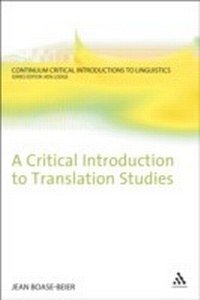
A Critical Introduction to Translation Studies
1st Edition
Published on 7. April 2011
200 pages
978-1-4411-8345-3 (ISBN)
Description

Jean Boase-Beier's Critical Introduction To Translation Studies demonstrates a keen understanding of theoretical and practical translation. It looks to instances where translation might not be straightforward, where stylistics play an important role. Examples are discussed from works of literature, advertisements, journalism and others, where effects on the reader are central to the text, and are reflected in the style.
It begins by setting out some of the basic problems and issues that arise in the study of translation, such as: the difference between literary and non-literary translation; the role of language, content and style; the question of universals and specifics in language and the notion of context. The book then goes on to focus more closely on style and how it enables us to characterise literary texts and literary translation. The final part looks at the translation of poetry. Throughout, it is conscious of the relationship between theory and practice in translation.
This book offers a new approach to translation, grounded in stylistics, and it will be an invaluable resource for undergraduates and postgraduates approaching translation studies.
It begins by setting out some of the basic problems and issues that arise in the study of translation, such as: the difference between literary and non-literary translation; the role of language, content and style; the question of universals and specifics in language and the notion of context. The book then goes on to focus more closely on style and how it enables us to characterise literary texts and literary translation. The final part looks at the translation of poetry. Throughout, it is conscious of the relationship between theory and practice in translation.
This book offers a new approach to translation, grounded in stylistics, and it will be an invaluable resource for undergraduates and postgraduates approaching translation studies.
Reviews / Votes
"Boase-Beier marshalls and interprets a vast body of translation theory with an admirable and luminous pragmatism offering excellent examples and a very clear sense of the options open to the contemporary translator." 'The ideal introduction to the study of literary translation. Completely at home in modern stylistics and cognitive science as well as in literary theory and translation studies, Jean Boase-Beier writes lucidly and authoritatively about complex issues. While the numerous and diverse examples make this a disarmingly accessible book, it addresses fundamental questions of meaning, form and interpretation. Enjoyment and instruction guaranteed.'More details
Series
Edition
1. Auflage
Language
English
Place of publication
New York
United States
ISBN-13
978-1-4411-8345-3 (9781441183453)
Copyright in bibliographic data and cover images is held by Nielsen Book Services Limited or by the publishers or by their respective licensors: all rights reserved.
Schweitzer Classification
Other editions
Additional editions
Jean Boase-Beier
A Critical Introduction to Translation Studies
Book
06/2011
Continuum Publishing Corporation
€55.70
Shipment within 15-20 days
Person
Jean Boase-Beier is Professor of Literature and Translation at the University of East Anglia, UK.
Content
Preface \ Acknowledgements \ Part I: Translation, text, mind and context \ 1. What does translation involve? \ 2. Possible and impossible in translation \ 3. Faithfulness, allegiance, and creativity \ 4. The Translated text \ 5. Theories and practices \ Part II: A Poetics of Translation \ 6. Literary translation as the translation of mind \ 7. Translating the special shape of poems \ 8. Ambiguity, mind-games and searches \ 9. Thinking and doing translation \ Bibliography \ Index
