

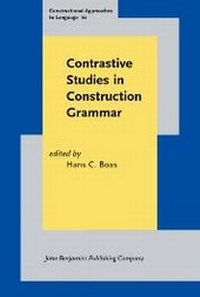
Contrastive Studies in Construction Grammar
1st Edition
Published on 11. November 2010
VII, 244 pages
978-90-272-8760-1 (ISBN)
Description

The papers in this volume provide a contrastive application of Construction Grammar. By referencing a well-described constructional phenomenon in English, each paper provides a solid foundation for describing and analyzing its constructional counterpart in another language. This approach shows that the semantic description (including discourse-pragmatic and functional factors) of an English construction can be regarded as a first step towards a "tertium comparationis" that can be employed for comparing and contrasting the formal properties of constructional counterparts in other languages. Thus, the meaning pole of constructions should be regarded as the primary basis for comparisons of constructions across languages - the form pole is only secondary. This volume shows that constructions are viable descriptive and analytical tools for cross-linguistic comparisons that make it possible to capture both language-specific (idiosyncratic) properties as well as cross-linguistic generalizations.
More details
Other editions
Additional editions
Hans C. Boas
Contrastive Studies in Construction Grammar
Book
11/2010
John Benjamins Publishing Co
€95.40
Shipment within 10-15 days
Person
Content
- Contrastive Studies in Construction Grammar
- Editorial page
- Title page
- LCC dat
- Table of contents
- Acknowledgments
- Comparing constructions across languages
- 1. Introduction
- 2. Language-specific constructions
- 3. Step by step cross-linguistic constructional generalizations: From meaning to form
- 4. Different approaches to comparing and contrasting constructions
- 5. Conclusions
- References
- Comparing comparatives
- 1. Introduction
- 2. Comparative constructions in English
- 3. Comparing the comparatives of English and Swedish
- 3.1 Phonology
- 3.2 Morphology
- 3.3 Syntax
- 3.4 Semantics
- 4. Conclusion
- References
- Appendix
- Contrasting constructions in English and Spanish
- 1. Introduction
- 2. The subjective-transitive construction in English and Spanish
- 3. The subjective-within-objective transitive construction in English
- 4. The role of information structure and syntactic processing factors in the subjective-within-objective transitive construction
- 5. Towards a constructionist characterization of the subjective within-objective transitive construction after verbs of cognition and communication in present-day (Castilian) Spanish
- 7. Closing remarks and outlook
- References
- Conditional constructions in English and Russian
- 1. Introduction
- 2. English and Russian conditionals: Parallels
- 3. Epistemic distance in English conditionals
- 4. Viewpoint in Russian conditionals
- 4.1 Overview
- 4.2 Differences in viewpoint
- 4.3 Other properties that coincide with viewpoint shift
- 4.4 Formalization
- 5. Conclusions
- References
- Results, cases, and constructions
- 1. Introduction
- 2. Some three-place ASCs in English and Finnish
- 2.1 The English ditransitive construction and its Finnish counterpart
- 2.2 The English caused-motion construction and its Finnish counterpart
- 2.3 The English resultative construction and its Finnish counterpart
- 3. Constructions, correspondence, and contrast
- 4. Conclusion: On the correspondence of constructions
- References
- A contrastive study of the caused-motion and ditransitive constructions in English and Thai
- 1. Introduction
- 2. English caused-motion and ditransitive constructions
- 2.1 Semantic constraints: Forced motion and transfer of possession
- 2.2 The fusion of the construction's meaning and the verb's meaning
- 2.3 Pragmatic constraint: The end-weight principle
- 3. Thai caused-motion and ditransitive constructions
- 3.1 Semantic constraint: Transfer of possession
- 3.2 Pragmatic constraints: Heavy constituents and light constituents
- 4. Contrastive analysis of the constructions in English and Thai
- 4.1 Relation between meaning and syntactic distribution
- 4.2 Pragmatic strategies easing production and comprehension
- 5. Conclusion
- References
- On expressing measurement and comparison in English and Japanese
- 1. Introduction
- 2. English patterns
- 2.1 Measurement
- 2.2 Schwarzschild's work on measurement
- 2.3 Comparison
- 2.4 Measured difference
- 3. The Comparison frame
- 4. Japanese patterns
- 4.1 Measurement
- 4.2 Comparison
- 4.3 Measured difference
- 5. Alternative accounts of the Japanese Magnitude-comparative construction
- 5.1 Lexical polysemy account
- 5.2 Sawada and Grano's account
- 6. Conclusions
- References
- Revising Talmy's typological classification of complex event constructions
- 1. Introduction
- 1.1 Motion events: Manner-incorporating and path-incorporating
- 1.2 Complex events: Satellite framing and verb framing
- 2. Symmetric coding strategies for event and frame
- 3. Variation and universals of language types with respect to Talmy's typological classification
- 3.1 English
- 3.2 Icelandic
- 3.3 Bulgarian
- 3.4 Japanese
- 4. Universals in linguistic variation: The coding of complex events
- 5. Event integration and grammaticalization in the Talmy typological classification
- 5.1 From coordination to verb-satellite fusion
- 5.2 From coordination to verbal compounding
- 6. Conclusions
- Abbreviations
- References
- Index of constructions
- Index of languages
- Author index
- Subject index
- the series Constructional Approaches to Language
