

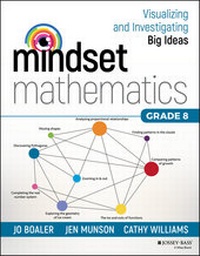
Mindset Mathematics
Description

The most challenging parts of teaching mathematics are engaging students and helping them understand the connections between mathematics concepts. In this volume, you'll find a collection of low floor, high ceiling tasks that will help you do just that, by looking at the big ideas at the eighth-grade level through visualization, play, and investigation.
During their work with tens of thousands of teachers, authors Jo Boaler, Jen Munson, and Cathy Williams heard the same message--that they want to incorporate more brain science into their math instruction, but they need guidance in the techniques that work best to get across the concepts they needed to teach. So the authors designed Mindset Mathematics around the principle of active student engagement, with tasks that reflect the latest brain science on learning. Open, creative, and visual math tasks have been shown to improve student test scores, and more importantly change their relationship with mathematics and start believing in their own potential. The tasks in Mindset Mathematics reflect the lessons from brain science that:
* There is no such thing as a math person - anyone can learn mathematics to high levels.
* Mistakes, struggle and challenge are the most important times for brain growth.
* Speed is unimportant in mathematics.
* Mathematics is a visual and beautiful subject, and our brains want to think visually about mathematics.
With engaging questions, open-ended tasks, and four-color visuals that will help kids get excited about mathematics, Mindset Mathematics is organized around nine big ideas which emphasize the connections within the Common Core State Standards (CCSS) and can be used with any current curriculum.
More details
Other editions
Additional editions
Persons
JEN MUNSON is an assistant professor of learning sciences at Northwestern University, a professional developer, and a former classroom teacher. She received her PhD in teacher education and mathematics education from Stanford University. Her research focuses on responsive, equitable mathematics instruction and coaching.
CATHY WILLIAMS is the co-founder and the executive director of youcubed at Stanford University. Before working at youcubed, she was a high school math teacher and worked in mathematics curriculum and administration at the county and district levels in California.
Content
Low-Floor, High-Ceiling Tasks 2
Youcubed Summer Camp 3
Memorization versus Conceptual Engagement 4
Mathematical Thinking, Reasoning, and Convincing 5
Big Ideas 9
Structure of the Book 9
Note on Materials 17
Manipulatives and Materials Used in This Book 18
Activities for Building Norms 21
Encouraging Good Group Work 21
Paper Folding: Learning to Reason, Convince, and Be a Skeptic 22
Big Idea 1: Moving Shapes 27
Visualize: What Does It Mean to Be the Same? 29
Play: Pixel Puzzles 35
Investigate: Slide It, Flip It, Turn It 45
Big Idea 2: Zooming In and Out 53
Visualize: What is Similarity? 55
Play: Find the Fakes 60
Investigate: Growing on a Grid 65
Big Idea 3: Analyzing Proportional Relationships 71
Visualize: Dropping the Altitude 73
Play: Seeing Triangles under the Line 79
Investigate: Stairway to Eleven 85
Big Idea 4: Comparing Patterns of Growth 91
Visualize: Squared Squares 93
Play: Skip-Counting Arrays 100
Investigate: Stacking Pennies 107
Big Idea 5: The Ins and Outs of Functions 117
Visualize: Growing Functions 120
Play: Getting Warmer! 134
Investigate: The Functions of Near Squares 140
Big Idea 6: Finding Patterns in the Clouds 149
Visualize: What's Going On in This Graph? 151
Play: What's the Story Here? 158
Investigate: Creating Data Visualizations 166
Big Idea 7: Completing the Real Number System 177
Visualize: Square Sides 179
Play: Between 4 × 4 and 5 × 5 187
Investigate: The Hypotenuse Hypothesis 193
Big Idea 8: Discovering Pythagoras 201
Visualize: Unpacking Pythagoras 204
Play: Pythagorean Triples 209
Investigate: Approximating Square Roots 214
Big Idea 9: Exploring the Geometry of Ice Cream 221
Visualize: Building Intuition about Volume 223
Play: Comparing Cylinders 227
Investigate: Scooping Up Volume 233
Appendix 239
Centimeter Grid Paper 240
Grid Paper 241
Isometric Dot Paper 242
Dot Paper 243
About the Authors 245
Acknowledgments 247
Index 249
BIG IDEA 1
Moving Shapes
In this book, we focus on a set of big ideas that extend across the eighth-grade curriculum, bringing in a greater focus on geometrical thinking. Geometry has been a neglected part of the eighth-grade curriculum for some time.
Ginsberg, Cooke, Leinwand, Noell, and Pollock (2005) investigated US students' geometrical experiences, looking at the international tests TIMSS and PISA, and found that US students spend 50% less time on geometry than students in other countries. Not surprisingly given this lack of attention, students' achievement in these areas was also significantly lower than students in other countries (Driscoll, DiMatteo, Nikula, & Egan, 2007).
Many teachers and students associate geometry with rules, remembering their high school years reproducing two-column proofs. This is the unfortunate outcome of a misguided approach to mathematics, when important ideas are lost as mathematical thinking is reduced to a set of rules. What is more critical to geometry is reasoning and adaptability. In this big idea, we introduce the ideas of congruence and similarity. Rather than just learning definitions for these, students look at cases and consider deeply the question, How do we know if two shapes are congruent or similar? Definitions play a part, but the most important act is reasoning; students should be encouraged to consider such questions as, What do we know now about this shape? What else do we need to know? Can I move or adapt my shape to give me more information? Can I convince someone else that my shapes are similar or congruent? What would I use to convince them? A great starting discussion for this sequence of lessons would be the question, What does it mean to be the same? Transformational geometry, congruence, and similarity are key ideas. We have chosen to focus our attention on triangles, the building blocks of geometric shapes and the coordinate plane, an important visual space for algebra.
In the Visualize activity, students are asked to consider the question, How do we know when two figures are the same? We ask students to study triangles where their vertices are provided. As students plot the points and connect the vertices with segments, they are asked to determine which triangles are congruent. We have created triangles that are congruent but may not appear so because they have been rotated and flipped. Others combine to make a triangle. Students can hone their detective skills by investigating each set. Students explore the key ideas visually.
In the Play activity, students are asked to transform shapes, rotating and reflecting them. We think that students will enjoy working out how one shape turns into another, developing patterns that explain the transformations. This is the work of computer animation, which has been important to the cartoon filmmaking industry for many years. Students will be given the opportunity to create their own puzzle transformations, which they can share with each other.
The Investigate activity provides students the experience of continuous transformations that are repeated over and over again. Students will be invited to design their own shape and think about what happens when they repeat the same transformation on the shape. In doing so, they will become pattern creators, which we hope they will find exciting. The work will help them understand what happens when transformations happen continuously, and the patterns that can result.
Jo Boaler
References
- Driscoll, M. J., DiMatteo, R. W., Nikula, J., & Egan, M. (2007). Fostering geometric thinking: A guide for teachers, grades 5-10. Portsmouth, NH: Heinemann.
- Ginsburg, A., Cooke, G., Leinwand, S., Noell, J., & Pollock, E. (2005). Reassessing U.S. international mathematics performance: New findings from the 2003 TIMSS and PISA. Washington, DC: American Institutes for Research and Department of Education.
What Does It Mean to Be the Same?
Snapshot
Using a set of coordinate pairs that describe triangles, students explore what makes two figures the "same" and develop a shared definition of congruence.
Connection to CCSS
8.G.1, 8.G.2
Agenda
Activity Time Description/Prompt Materials Launch 10 min Show students the sets of coordinate pairs on the Point-by-Point Triangle sheet and ask them how they might figure out which of these triangles are the same. Discuss some initial ideas. Point-by-Point Triangle sheet, to display Explore 30 min Partners map the triangle set onto a coordinate plane and explore which triangles they think are the "same." Partners develop a working definition of same for geometric figures and gather evidence to support which shapes are the same and which are not.
- Point-by-Point Triangle sheet, per partnership
- Coordinate Plane sheet, per partnership
- Make available: patty paper, rulers, and angle rulers or protractors
To the Teacher
The core idea of this activity is congruence. We introduce students to geometric transformations by posing the question, How do we know when two figures are the same? The conventional definition says that two figures are congruent if you can obtain one from the other through a series of translations (slides), rotations (turns), or reflections (flips). That is, if you can slide, flip, or turn a shape and then lay it on top of another, such that the sides and angles align, then the two shapes are congruent. This excludes shapes that must be dilated to align; shapes that must be shrunk or expanded to align with one another are not congruent. We will return to dilations in Big Idea 2, which focuses on similarity.
This activity is designed to provoke discussion about what it means for two shapes to be the "same" and to provide an opportunity for the class to develop a definition of congruence. As part of gathering evidence for two triangles being the "same," we invite students to consider the corresponding points or vertices, or the related parts of two triangles being compared. The concept of corresponding sides and vertices of geometric figures reappears throughout geometry and is useful for decomposing the triangles in this activity to determine congruence. This may trigger the need to have names for the different parts of the triangles. We have given letter labels to the coordinate pairs that locate the vertices, and you can encourage students to use these to describe corresponding vertices. Students may not know how to describe the sides; if they are searching for ways to name these, you can tell them that it is a convention in mathematics to name sides by the two vertices that form the endpoints. For example, side AB () is between points A and B. It is not necessary for students to use formal language, but if they are struggling to describe their observations with precision, your providing language and teaching conventions can be useful.
Activity
Launch
Launch the activity by showing the Point-by-Point Triangle sheet. Tell students that the coordinate pairs in this table make triangles and that today their task is to figure out which of these triangles are the same. Ask, How could you do that? Give students a chance to turn and talk to a partner about a plan.
Invite students to share some initial ideas, but keep the conversation brief so that students still have plenty to think about. Point out that they will need to make a convincing argument for any shapes they believe are the same. If students raise questions about the meaning of same, you might tell them that deciding what it means to be the same is one of the goals for today's work and that they should think with their partner about what their definition of same will be.
Explore
Provide partners with the Point-by-Point Triangle sheet and the Coordinate Plane sheet. Make available patty paper, scissors, and angle rulers or protractors. Partners work together to map the triangles onto the plane and explore the following questions:
- Which shapes are the same?
- How could you prove it?
- If you find two shapes that are the same, which points (vertices) correspond?
- Which shapes are not the same? What is your evidence?
- What does it mean for two shapes to be the same?
As you talk with students, press them to develop a precise working definition of sameness that the class can discuss.
Discuss
Gather the class and discuss the following questions:
- Which shapes are the same?
- How can you convince us that two shapes are the same?
- Which shapes are not the same? What is your evidence?
- What does it mean for two shapes to be the same?
When you...
