

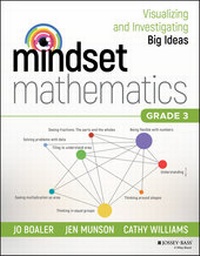
Mindset Mathematics
Description

The most challenging parts of teaching mathematics are engaging students and helping them understand the connections between mathematics concepts. In this volume, you'll find a collection of low floor, high ceiling tasks that will help you do just that, by looking at the big ideas at the third-grade level through visualization, play, and investigation.
During their work with tens of thousands of teachers, authors Jo Boaler, Jen Munson, and Cathy Williams heard the same message--that they want to incorporate more brain science into their math instruction, but they need guidance in the techniques that work best to get across the concepts they needed to teach. So the authors designed Mindset Mathematics around the principle of active student engagement, with tasks that reflect the latest brain science on learning. Open, creative, and visual math tasks have been shown to improve student test scores, and more importantly change their relationship with mathematics and start believing in their own potential. The tasks in Mindset Mathematics reflect the lessons from brain science that:
* There is no such thing as a math person - anyone can learn mathematics to high levels.
* Mistakes, struggle and challenge are the most important times for brain growth.
* Speed is unimportant in mathematics.
* Mathematics is a visual and beautiful subject, and our brains want to think visually about mathematics.
With engaging questions, open-ended tasks, and four-color visuals that will help kids get excited about mathematics, Mindset Mathematics is organized around nine big ideas which emphasize the connections within the Common Core State Standards (CCSS) and can be used with any current curriculum.
More details
Other editions
Additional editions
Content
Low-Floor, High-Ceiling Tasks 2
Youcubed Summer Camp 3
Memorization versus Conceptual Engagement 4
Mathematical Thinking, Reasoning, and Convincing 5
Big Ideas 9
Structure of the Book 10
Activities for Building Norms 17
Encouraging Good Group Work 17
Paper Folding: Learning to Reason, Convince, and Be a Skeptic 21
Big Idea 1: Solving Problems with Data 23
Visualize: Tongues, Tails, and in Between 25
Play: Inspector Graph-It 36
Investigate: Data Tells Us about Ourselves 41
Big Idea 2: Thinking around Shapes 51
Visualize: Get Your Arms around It 53
Play: 36-Unit Walk 59
Investigate: Shapes on a Plane 65
Big Idea 3: Thinking in Equal Groups 75
Visualize: Sharing Crackers 78
Play: Dozens of Dice 85
Investigate: Playing with Pairs 91
Big Idea 4: Tiling to Understand Area 99
Visualize: Cover Up 101
Play: A Whole New Alphabet 111
Investigate: Sharing an Area 119
Big Idea 5: Seeing Multiplication as Area 125
Visualize: Rods Around 127
Play: Squares and Near-Squares 132
Investigate: Connecting Area and Perimeter 142
Big Idea 6: Understanding 1 2 149
Visualize: I Spy 1 2 151
Play: Spotting 1 2 160
Investigate: The Many Shapes of 1 2 171
Big Idea 7: Seeing Fractions: The Parts and the Wholes 183
Visualize: Seeing Parts and Wholes 185
Play: Cover, Cut, and Sort 191
Investigate: Taking a Fractional Walk 202
Big Idea 8: Being Flexible with Numbers 209
Visualize: How Many Do You See? 211
Play: How Close to 100? 217
Investigate: Tile and Table Patterns 222
Appendix 231
¿¿¿ Grid Paper 232
Grid Paper 233
1¿¿ Grid Paper 234
¿¿¿ Dot Paper 235
Centimeter Dot Paper 236
Isometric Dot Paper 237
Hundred Grids 238
About the Authors 239
Acknowledgments 241
Index 243
Big Idea 1
Solving Problems with Data
We begin this grade 3 book with a topic that is extremely important to the 21st century but that is often left out because of time constraints. Textbook publishers often place measurement and data at the end of books, but we have chosen to open with this topic to acknowledge its importance. The activities in this big idea give students opportunities to explore and understand their world-inviting them to ask their own questions and discuss the relevance of data. There can be few more critical activities in which students engage as they learn to be mathematically literate citizens.
In the Visualize activity, we invite students to wonder about the lengths of animal tongues, which should be interesting and engaging. Students are also asked to read a bar graph and work to interpret what it is telling them. We have chosen some animals we think students may be curious about. We encourage you to allow students time to investigate and find out more about the animals. As students work to make sense of graphs and data, they will develop quantitative literacy, which is an extremely important attribute. As students read the graph and work to understand what it is telling them, they will need to pay careful attention to the way the vertical axis is numbered. Later in the activity, we provide students with tables of data and ask them to create visual images that communicate the data. This lesson is inspired by a book by Steve Jenkins, Animals by the Numbers. Having this book available for students would be a nice addition to the lesson.
The Play activity provides students an opportunity to use what they learned in the previous lesson as they inspect a graph that has some mistakes. One of the most debilitating ideas for learners is the myth that they always have to be right. Our Youcubed team has worked hard to dispel this myth by communicating the neuroscience which shows that when students are struggling and making mistakes, brain growth occurs. This lesson is a good time to celebrate the value of mistakes and communicate the brain science information that we also share here: https://www.youcubed.org/resource/brain-science/. Students in this lesson are again encouraged to develop quantitative literacy by reading graphs that display data, and noticing and discussing the mistakes in the graph. It is important to embrace the mistakes and talk about mistakes in playful rather than pejorative tones. Students then get the opportunity to make their own mischievous graph where they can try to mislead their peers with a display that contains mistakes. We think students will love playing Inspector Graph-It.
In the Investigate activity, students investigate a real question about the most common car color in their area. They will pose the question and determine together a data collection plan. Later they will take the data and interpret it to answer the question about car color. This provides an opportunity for students to think about a real question and also consider together why this could be useful information. The extension in this activity is worth the extra days. Students have an opportunity to ask their own questions and collect data. An important goal for us as mathematics educators is to give students opportunities to act with agency-to use their own thoughts and ideas as they work mathematically. It is very helpful to give students opportunities to ask their own questions-instead of only answering questions that have been given to them. When students ask their own questions of data, we achieve both of these goals.
Jo Boaler
Tongues, Tails, and in Between
Snapshot
Students investigate a graph of the lengths of different animals' tongues to develop ways of interpreting data displays, with a focus on reading a scaled axis. Then students choose a set of animal measurement data and create their own data displays to compare and discuss.
Connection to CCSS
3.MD.3
3.NBT.2, 3.NF.1, 3.OA.3
Agenda
Activity Time Description/Prompt Materials Launch 5-10 min Show students the Animal Tongue Lengths graph on a projector and ask what the graph shows. Collect students' observations and the reasoning behind them. Animal Tongue Lengths graph, to display Explore 20-25 min Partners record their observations of the data in the Animal Tongue Lengths graph. Using these interpretations, partners may construct alternative data displays.
- Copies of the Animal Tongue Lengths graph, one per partnership
- Optional: 1" grid paper (see appendix)
- Animal Data Tables, copied and cut into quarters to provide choices for partners
- Make available: 1" grid paper (see appendix), colors
To the Teacher
In this lesson, which can extend across two days, students begin to think about how data can be visual, and the relationship between data and displays. As adults we often have a great deal of comfort with the kinds of data displays used in third grade, and understanding these images comes quickly. But for children, these images don't immediately make data obvious; it takes experience interpreting data displays to become fluent in this visual form of reading. This lesson is designed to give students the opportunity to read displays without the need to answer particular questions imposed from the outside. Instead, we hope to inspire wonder. The bar graph we've constructed to launch this lesson, based on the beautiful data in Steve Jenkins's book Animals by the Numbers, is intended to be intriguing and to get students wondering about the data and the unusual animals it represents. If students want to find pictures of these animals or investigate in other ways, we encourage you to support their curiosity. If you have access to Animals by the Numbers, we encourage you to make this book available to students to explore the many creative ways Jenkins displays and communicates data.
The graph poses a mathematical challenge important for students to grapple with. The vertical axis is scaled in increments of 5, rather than one, and not all of the data falls neatly into multiples of 5. Students need to attend to these increments to measure the length of a bar, and they will need to think proportionately to estimate how long a tongue might be that falls between two increments. Encourage students to make their thinking about these estimates public and discuss which inferences are reasonable and which are not convincing. Several mathematical concepts intersect when students are doing this work, and it is useful to bear in mind all that students are working to integrate. Students need to think in terms of equal groups and skip counting to interpret (and construct) the scaled axis; they need to be thinking about differences on a scale to interpret comparisons; they need to interpret the axis as a number line and think fractionally about the values between increments. Any one of these concepts could provide productive struggle for students as they work first to interpret and then to construct graphs.
Activity
Launch
Launch this lesson by showing students the Animal Tongue Lengths graph on a projector. Ask students what they notice in the graph, or, What does this image show? Give students a few moments to turn and talk to a partner about the graph. Collect from students a few of their observations about the graph. Encourage students to come up to the graph to point out the specific features or data points they notice. Press students to explain any inferences they have made. For instance, students might infer that one animal's tongue is longer than another. You'll want to ask students to point out the specific feature of the graph that communicates that idea. Students might connect a bar with an animal's name or with a measure on the vertical axis. Be sure to probe how they made this connection. Use this brief discussion to encourage students to notice details and make their reasoning public before sending them off to make observations with a partner. Tell students that today they will be exploring this graph and trying to figure out all it is telling us.
Animal Tongue Lengths
Explore
Students work in partners to make observations about the Animal Tongue Lengths graph. Provide each partnership with a copy of the graph. Students record their observations directly on...
