

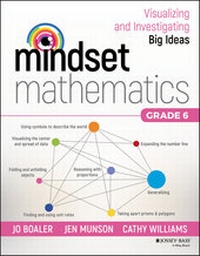
Mindset Mathematics
Visualizing and Investigating Big Ideas, Grade 6
1st Edition
Published on 9. January 2019
272 pages
978-1-119-35877-0 (ISBN)
Description

Engage students in mathematics using growth mindset techniques
The most challenging parts of teaching mathematics are engaging students and helping them understand the connections between mathematics concepts. In this volume, you'll find a collection of low floor, high ceiling tasks that will help you do just that, by looking at the big ideas at the sixth-grade level through visualization, play, and investigation.
During their work with tens of thousands of teachers, authors Jo Boaler, Jen Munson, and Cathy Williams heard the same message--that they want to incorporate more brain science into their math instruction, but they need guidance in the techniques that work best to get across the concepts they needed to teach. So the authors designed Mindset Mathematics around the principle of active student engagement, with tasks that reflect the latest brain science on learning. Open, creative, and visual math tasks have been shown to improve student test scores, and more importantly change their relationship with mathematics and start believing in their own potential. The tasks in Mindset Mathematics reflect the lessons from brain science that:
* There is no such thing as a math person - anyone can learn mathematics to high levels.
* Mistakes, struggle and challenge are the most important times for brain growth.
* Speed is unimportant in mathematics.
* Mathematics is a visual and beautiful subject, and our brains want to think visually about mathematics.
With engaging questions, open-ended tasks, and four-color visuals that will help kids get excited about mathematics, Mindset Mathematics is organized around nine big ideas which emphasize the connections within the Common Core State Standards (CCSS) and can be used with any current curriculum.
The most challenging parts of teaching mathematics are engaging students and helping them understand the connections between mathematics concepts. In this volume, you'll find a collection of low floor, high ceiling tasks that will help you do just that, by looking at the big ideas at the sixth-grade level through visualization, play, and investigation.
During their work with tens of thousands of teachers, authors Jo Boaler, Jen Munson, and Cathy Williams heard the same message--that they want to incorporate more brain science into their math instruction, but they need guidance in the techniques that work best to get across the concepts they needed to teach. So the authors designed Mindset Mathematics around the principle of active student engagement, with tasks that reflect the latest brain science on learning. Open, creative, and visual math tasks have been shown to improve student test scores, and more importantly change their relationship with mathematics and start believing in their own potential. The tasks in Mindset Mathematics reflect the lessons from brain science that:
* There is no such thing as a math person - anyone can learn mathematics to high levels.
* Mistakes, struggle and challenge are the most important times for brain growth.
* Speed is unimportant in mathematics.
* Mathematics is a visual and beautiful subject, and our brains want to think visually about mathematics.
With engaging questions, open-ended tasks, and four-color visuals that will help kids get excited about mathematics, Mindset Mathematics is organized around nine big ideas which emphasize the connections within the Common Core State Standards (CCSS) and can be used with any current curriculum.
More details
Other editions
Additional editions
Jo Boaler | Jen Munson | Cathy Williams
Mindset Mathematics: Visualizing and Investigating Big Ideas, Grade 6
Book
08/2019
1st Edition
Jossey-Bass
€25.50
Shipment within 15-20 days
Content
- Cover
- Title Page
- Copyright
- Contents
- Introduction
- Low-Floor, High-Ceiling Tasks
- Youcubed Summer Camp
- Memorization versus Conceptual Engagement
- Mathematical Thinking, Reasoning, and Convincing
- Big Ideas
- Structure of the Book
- References
- Note on Materials
- Manipulatives and Materials Used in This Book
- Activities for Building Norms
- Encouraging Good Group Work
- Paper Folding: Learning to Reason, Convince, and Be Skeptical
- Paper Folding: Learning to Reason, Convince, and Be a Skeptic
- Big Idea 1 Taking Apart Prisms and Polygons
- How Big Is the Footprint?
- Reference
- Shards of a Shape
- Rising from the Footprint
- Big Idea 2 Folding and Unfolding Objects
- Folding Cubes in Your Mind
- Folding Nets in Your Mind
- Filling Our Nets
- Big Idea 3 Expanding the Number Line
- Reference
- Folding around Zero
- Bouncing around the Number Line
- Going 2-D
- Big Idea 4 Finding and Using Unit Rates
- Seeing Unit Rates
- Seeing the Best Deal
- How Fast Do You Walk?
- Big Idea 5 Reasoning with Proportions
- Jump! Jump!
- Reference
- Seeing Animals in a New Way
- A Seat at the Table
- Big Idea 6 Visualizing the Center and Spread of Data
- The Shape of Data
- What Does Mean Mean?
- When Does Mean?=?Median?=? Mode?=?Range?
- Big Idea 7 Using Symbols to Describe the World
- Cuisenaire Rod Equivalents
- Math Mobiles
- Reference
- Radial Patterns
- Big Idea 8 Generalizing
- Generalizing Number Patterns
- Generalizing Strategy
- Reference
- Generalizing Visual Patterns
- Appendix
- Centimeter Grid Paper
- Grid Paper
- 1" Grid Paper
- Isometric Dot Paper
- Dot Paper
- About the Authors
- Acknowledgments
- Index
- EULA
