

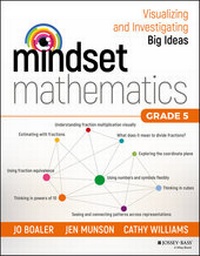
Mindset Mathematics
Description

The most challenging parts of teaching mathematics are engaging students and helping them understand the connections between mathematics concepts. In this volume, you'll find a collection of low floor, high ceiling tasks that will help you do just that, by looking at the big ideas at the fifth-grade level through visualization, play, and investigation.
During their work with tens of thousands of teachers, authors Jo Boaler, Jen Munson, and Cathy Williams heard the same message-that they want to incorporate more brain science into their math instruction, but they need guidance in the techniques that work best to get across the concepts they needed to teach. So the authors designed Mindset Mathematics around the principle of active student engagement, with tasks that reflect the latest brain science on learning. Open, creative, and visual mathematics tasks have been shown to improve student test scores, and more importantly change their relationship with mathematics and start believing in their own potential. The tasks in Mindset Mathematics reflect the lessons from brain science that:
- There is no such thing as a math person - anyone can learn mathematics to high levels.
- Mistakes, struggle and challenge are the most important times for brain growth.
- Speed is unimportant in mathematics.
- Mathematics is a visual and beautiful subject, and our brains want to think visually about mathematics.
With engaging questions, open-ended tasks, and four-color visuals that will help kids get excited about mathematics, Mindset Mathematics is organized around nine big ideas which emphasize the connections within the Common Core State Standards (CCSS) and can be used with any current curriculum.
More details
Other editions
Additional editions
Persons
JO BOALER is a professor of mathematics education at Stanford University and co-founder and faculty director of youcubed. She serves as an advisor to several Silicon Valley companies and is a White House presenter on girls and STEM (Science, Technology, Engineering, and Math). The author of seven books, including Mathematical Mindsets, and numerous research articles, she is a regular contributor to news and radio in the United States and England.
JEN MUNSON is a doctoral candidate at Stanford University, a professional developer, and a former classroom teacher. She works with teachers and school leaders across the United States to develop responsive, equitable mathematics instruction.
CATHY WILLIAMS is the co-founder and the executive director of youcubed at Stanford University. Before working at youcubed, she was a high school math teacher and worked in mathematics curriculum and administration at the county and district levels in California.
Content
Introduction 1
Low-Floor, High-Ceiling Tasks 2
Youcubed Summer Camp 3
Memorization versus Conceptual Engagement 4
Mathematical Thinking, Reasoning, and Convincing 5
Big Ideas 9
Structure of the Book 10
Activities for Building Norms 17
Encouraging Good Group Work 17
Paper Folding: Learning to Reason, Convince, and Be a Skeptic 21
Big Idea 1: Thinking in Cubes 23
Visualize: Solids, Inside and Out 25
Play: City of Cubes 33
Investigate: A Box of Boxes 44
Big Idea 2: Estimating with Fractions 53
Visualize: Making Snowflakes 55
Play: Fraction Blizzard 61
Investigate: Wondering with Fractions 67
Big Idea 3: Using Fraction Equivalence 81
Visualize: Picking Paintings Apart 83
Play: Make a Fake 94
Investigate: Squares with a Difference 101
Big Idea 4: Exploring the Coordinate Plane 115
Visualize: Getting around the Plane 118
Play: Ship Shape 124
Investigate: Table Patterns 133
Big Idea 5: Seeing and Connecting Patterns across Representations 143
Visualize: Two-Pattern Tango 145
Play: Pattern Carnival 153
Investigate: Seeing Growth on a Graph 159
Big Idea 6: Understanding Fraction Multiplication Visually 169
Visualize: Fractions in a Pan 172
Play: Pieces and Parts 180
Investigate: The Sum of the Parts 187
Big Idea 7: What Does It Mean to Divide Fractions? 199
Visualize: Creating Cards 201
Play: Cuisenaire Trains 209
Investigate: Fraction Division Conundrum 217
Big Idea 8: Thinking in Powers of 10 223
Visualize: The Unit You 225
Play: Filling Small and Large 233
Investigate: Museum of the Very Large and Small 239
Big Idea 9: Using Numbers and Symbols Flexibly 247
Visualize: Seeing Expressions 250
Play: Inside Pascal's Triangle 261
Investigate: The 1492 Problem 268
Appendix 279
Centimeter Dot Paper 280
Isometric Dot Paper 281
About the Authors 283
Acknowledgments 285
Index 287Introduction
I still remember the moment when Youcubed, the Stanford center I direct, was conceived. I was at the Denver NCSM and NCTM conferences in 2013, and I had arranged to meet Cathy Williams, the director of mathematics for Vista Unified School District. Cathy and I had been working together for the past year improving mathematics teaching in her district. We had witnessed amazing changes taking place, and a filmmaker had documented some of the work. I had recently released my online teacher course, called How to Learn Math, and been overwhelmed by requests from tens of thousands of teachers to provide them with more of the same ideas. Cathy and I decided to create a website and use it to continue sharing the ideas we had used in her district and that I had shared in my online class. Soon after we started sharing ideas on the Youcubed website, we were invited to become a Stanford University center, and Cathy became the codirector of the center with me.
In the months that followed, with the help of one of my undergraduates, Montse Cordero, our first version of youcubed.org was launched. By January 2015, we had managed to raise some money and hire engineers, and we launched a revised version of the site that is close to the site you may know today. We were very excited that in the first month of that relaunch, we had five thousand visits to the site. At the time of writing this, we are now getting three million visits to the site each month. Teachers are excited to learn about the new research and to take the tools, videos, and activities that translate research ideas into practice and use them in their teaching.
Low-Floor, High-Ceiling Tasks
One of the most popular articles on our website is called "Fluency without Fear." I wrote this with Cathy when I heard from many teachers that they were being made to use timed tests in the elementary grades. At the same time, new brain science was emerging showing that when people feel stressed-as students do when facing a timed test-part of their brain, the working memory, is restricted. The working memory is exactly the area of the brain that comes into play when students need to calculate with math facts, and this is the exact area that is impeded when students are stressed. We have evidence now that suggests strongly that timed math tests in the early grades are responsible for the early onset of math anxiety for many students. I teach an undergraduate class at Stanford, and many of the undergraduates are math traumatized. When I ask them what happened to cause this, almost all of them will recall, with startling clarity, the time in elementary school when they were given timed tests. We are really pleased that "Fluency without Fear" has now been used across the United States to pull timed tests out of school districts. It has been downloaded many thousands of times and used in state and national hearings.
One of the reasons for the amazing success of the paper is that it does not just share the brain science on the damage of timed tests but also offers an alternative to timed tests: activities that teach math facts conceptually and through activities that students and teachers enjoy. One of the activities-a game called How Close to 100-became so popular that thousands of teachers tweeted photos of their students playing the game. There was so much attention on Twitter and other media that Stanford noticed and decided to write a news story on the damage of speed to mathematics learning. This was picked up by news outlets across the United States, including US News & World Report, which is part of the reason the white paper has now had so many downloads and so much impact. Teachers themselves caused this mini revolution by spreading news of the activities and research.
How Close to 100 is just one of many tasks we have on youcubed.org that are extremely popular with teachers and students. All our tasks have the feature of being "low floor and high ceiling," which I consider to be an extremely important quality for engaging all students in a class. If you are teaching only one student, then a mathematics task can be fairly narrow in terms of its content and difficulty. But whenever you have a group of students, there will be differences in their needs, and they will be challenged by different ideas. A low-floor, high-ceiling task is one in which everyone can engage, no matter what his or her prior understanding or knowledge, but also one that is open enough to extend to high levels, so that all students can be deeply challenged. In the last two years, we have launched an introductory week of mathematics lessons on our site that are open, visual, and low floor, high ceiling. These have been extremely popular with teachers; they have had approximately four million downloads and are used in 20% of schools across the United States.
In our extensive work with teachers around the United States, we are continually asked for more tasks that are like those on our website. Most textbook publishers seem to ignore or be unaware of research on mathematics learning, and most textbook questions are narrow and insufficiently engaging for students. It is imperative that the new knowledge of the ways our brains learn mathematics is incorporated into the lessons students are given in classrooms. It is for this reason that we chose to write a series of books that are organized around a principle of active student engagement, that reflect the latest brain science on learning, and that include activities that are low floor and high ceiling.
Youcubed Summer Camp
We recently brought 81 students onto the Stanford campus for a Youcubed summer math camp, to teach them in the ways that are encouraged in this book. We used open, creative, and visual math tasks. After only 18 lessons with us, the students improved their test score performance by an average of 50%, the equivalent of 1.6 years of school. More important, they changed their relationship with mathematics and started believing in their own potential. They did this, in part, because we talked to them about the brain science showing that
- There is no such thing as a math person-anyone can learn mathematics to high levels.
- Mistakes, struggle, and challenge are critical for brain growth.
- Speed is unimportant in mathematics.
- Mathematics is a visual and beautiful subject, and our brains want to think visually about mathematics.
All of these messages were key to the students' changed mathematics relationship, but just as critical were the tasks we worked on in class. The tasks and the messages about the brain were perfect complements to each other, as we told students they could learn anything, and we showed them a mathematics that was open, creative, and engaging. This approach helped them see that they could learn mathematics and actually do so. This book shares the kinds of tasks that we used in our summer camp, that make up our week of inspirational mathematics (WIM) lessons, and that we post on our site.
Before I outline and introduce the different sections of the book and the ways we are choosing to engage students, I will share some important ideas about how students learn mathematics.
Memorization versus Conceptual Engagement
Many students get the wrong idea about mathematics-exactly the wrong idea. Through years of mathematics classes, many students come to believe that their role in mathematics learning is to memorize methods and facts, and that mathematics success comes from memorization. I say this is exactly the wrong idea because there is actually very little to remember in mathematics. The subject is made up of a few big, linked ideas, and students who are successful in mathematics are those who see the subject as a set of ideas that they need to think deeply about. The Program for International Student Assessment (PISA) tests are international assessments of mathematics, reading, and science that are given every three years. In 2012, PISA not only assessed mathematics achievement but also collected data on students' approach to mathematics. I worked with the PISA team in Paris at the Organisation for Economic Co-operation and Development (OECD) to analyze students' mathematics approaches and their relationship to achievement. One clear result emerged from this analysis. Students approached mathematics in three distinct ways. One group approached mathematics by attempting to memorize the methods they had met; another group took a "relational" approach, relating new concepts to those they already knew; and a third group took a self-monitoring approach, thinking about what they knew and needed to know.
In every country, the memorizers were the lowest-achieving students, and countries with high numbers of memorizers were all lower achieving. In no country were memorizers in the highest-achieving group, and in some high-achieving countries such as Japan, students who combined self-monitoring and relational strategies outscored memorizing students by more than a year's worth of schooling. More detail on this finding is given in this Scientific American Mind article that I coauthored with a PISA analyst: https://www.scientificamerican.com/article/why-math-education-in-the-u-s-doesn-t-add-up/.
Mathematics is a conceptual subject, and it is important for students to be thinking slowly, deeply, and conceptually about mathematical ideas, not racing through methods that they try to memorize. One reason that students need to think conceptually has to do with the ways the brain processes mathematics. When...
