

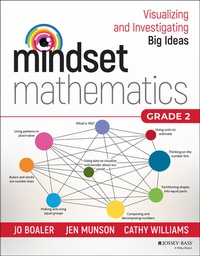
Mindset Mathematics
Description

The most challenging parts of teaching mathematics are engaging students and helping them understand the connections between mathematics concepts. In this volume, you'll find a collection of low-floor, high-ceiling tasks that will help you do just that, by looking at the big ideas in second grade through visualization, play, and investigation.
During their work with tens of thousands of teachers, authors Jo Boaler, Jen Munson, and Cathy Williams heard the same message--that they want to incorporate more brain science into their math instruction, but they need guidance in the techniques that work best to get across the concepts they needed to teach. So, the authors designed Mindset Mathematics around the principle of active student inquiry, with tasks that reflect the latest brain science on learning. Open, creative, and visual math tasks have been shown to support student learning, and more importantly change their relationship with mathematics and start believing in their own potential. The tasks in Mindset Mathematics reflect the lessons from brain science that:
* There is no such thing as a math person and anyone can learn mathematics to high levels.
* Mistakes, struggle, and challenge are opportunities for brain growth.
* Speed is unimportant, and even counterproductive, in mathematics.
* Mathematics is a visual and beautiful subject, and our brains want to think visually about mathematics.
With engaging questions, open-ended tasks, and four-color visuals that will help kids get excited about mathematics, Mindset Mathematics is organized around nine big ideas which emphasize the connections within the Common Core State Standards (CCSS) and can be used with any current curriculum.
More details
Other editions
Additional editions
Persons
JEN MUNSON is an assistant professor of learning sciences at Northwestern University, a professional developer, and a former classroom teacher. She received her PhD in mathematics education from Stanford University. Her research focuses on responsive, equitable mathematics instruction.
CATHY WILLIAMS is the co-founder and the executive director of youcubed at Stanford University. Before working at youcubed, she was a high school math teacher and worked in mathematics curriculum and administration at the county and district levels in California.
Content
Low-Floor, High-Ceiling Tasks 2
Youcubed Summer Camp 3
Memorization versus Conceptual Engagement 4
Mathematical Thinking, Reasoning, and Convincing 5
Big Ideas 9
Structure of the Book 9
Note on Materials 17
Manipulatives and Materials Used in This Book 18
Activities for Building Norms 21
Encouraging Good Group Work 21
How Many Do You See? Learning to Reason, Convince, and Pose Questions 23
Big Idea 1: Partitioning Shapes into Equal Parts 31
Visualize: Equal or Same? 33
Play: Four Fourths 39
Investigate: Rows and Columns 44
Big Idea 2: Making and Using Equal Groups 53
Visualize: The Groups Inside 55
Play: Skipping down the Hall 61
Investigate: Array Museum 67
Big Idea 3: What Is 100? 73
Visualize: The Many Ways to See 100 75
Play: Scoop and Count 82
Investigate: Making a Dollar, Revisited 86
Big Idea 4: Composing and Decomposing Numbers 91
Visualize: Array Talks 93
Play: Which Is More? 103
Investigate: Coin Grab 114
Big Idea 5: Using Patterns in Place Value 119
Visualize: What's in Your 12? 121
Play: Reach for It! 126
Investigate: Window Mysteries 136
Big Idea 6: Thinking on the Number Line 145
Visualize: Long Lives 148
Play: Life- Span Puzzles 157
Investigate: Living on the Number Line 166
Big Idea 7: Rulers and Clocks Are Number Lines 173
Visualize: Noticing the Ruler and Clock 175
Play: Walking the Clock 181
Investigate: A Sea of Sharks 187
Big Idea 8: Using Units to Estimate 205
Visualize: Foot by Foot 207
Play: Length Scavenger Hunt 216
Investigate: School- Day Walkabout 222
Big Idea 9: Using Data to Visualize and Wonder about Our World 229
Visualize: Fruit around the World 231
Play: Eat Your Roots 238
Investigate: Dear Data 243
Appendix 253
Grid Paper 254
About the Authors 255
Acknowledgments 257
Index 259
Activities for Building Norms
Encouraging Good Group Work
We always use this activity before students work on math together, as it helps improve group interactions. Teachers who have tried this activity have been pleased by students' thoughtful responses and have found students' thoughts and words helpful in creating a positive and supportive environment. The first thing to do is to ask students, in groups, to reflect on things they don't like people to say or do in a group when they are working on math together. Students come up with quite a few important ideas, such as not liking people to give away the answer, to rush through the work, or to ignore other people's ideas. When students have had enough time in groups brainstorming, collect the ideas. We usually do this by making a What We Don't Like list or chart and asking each group to contribute one idea, moving around the room until a few good ideas have been shared. Then we do the same for What We Do Like, creating a list or chart as a class. It can be useful to present the final charts to the class as agreed-on classroom norms that you and they can reflect back on, and add to, over the year. If any student shares a comment that casts others in a negative light, such as "I don't like waiting for slow people," do not put it on the chart; instead use it as a chance to discuss the issue and remind students that everyone's needs and ideas are important. This rarely happens, and students are usually very thoughtful and respectful in the ideas they share.
Activity Time Description/Prompt Materials Launch 5 min Explain to students that working in groups is an important part of what mathematicians do. Mathematicians discuss their ideas and work together to solve challenging problems. It's important to work together, and we need to discuss what helps us work well together. Explore 10 min In small groups, invite students to .- Reflect on the things you do not like people to say or do when you are working on math together in a group
- Reflect on the things you do like people to say or do when you are working on math together in a group
- Paper
- Pencil or pen
How Many Do You See? Learning to Reason, Convince, and Pose Questions
One of the most important topics in mathematics is reasoning. Scientists prove or disprove ideas by finding cases. Mathematicians prove their ideas by reasoning-making logical connections between ideas. This activity gives students an opportunity to learn to reason really well by convincing others who pose questions.
Before beginning the activity, explain to students that their role is to share their thinking and be convincing. Students may well be unfamiliar with what it means to convince, and you may want to give examples from students' everyday lives to illustrate what it means to be convinced of an idea. The easiest person to convince is yourself. A higher level of being convincing is to convince a friend, and the highest level of all is to convince a skeptic, someone who is unsure or doubtful. Just as important as convincing a skeptic is learning to be the skeptic. For young children, this first involves learning to attend to one another's ideas and ask questions about them. In this activity, we ask students to grapple with these three roles, making their thinking public to others, constructing arguments that convince, and listening to and questioning one another's thinking.
For this activity, we present students with an image and simply ask, "How many do you see?" On the face of it, this seems like a closed question, one with a single right answer and little reasoning. However, figuring out how many involves students in reasoning about what to count, finding ways to count when they cannot touch each object, and noticing structures in the image that can help them determine how many. The images we provide are complex, with several different types of objects that could be counted. Sometimes objects are arranged in a structured way, while other objects may be clustered randomly. Students might notice groups and use subitizing, composing, or decomposing to determine how many they think there are. Even when students arrive at the same answer for the same groups, they very well may have seen the quantities differently. We have provided four images you can use for this task, but you can find additional images in Christopher Danielson's (2018) How Many? or create your own out of objects in your classroom or school.
The idea in this activity is to encourage students to pay attention to and share their thinking. They must learn to listen to and wonder about the thinking of their peers. If one student is struggling to understand how another student saw the objects, encourage them to ask a question, such as, "Where did you see five?" or "Can you show me?" These are opportunities for everyone to learn that everyone's thinking is valued, that posing questions is something mathematicians do, and that explaining our thinking is how we convince one another.
Activity Time Description/Prompt Materials Launch 5 min Tell students that they have some jobs to do as mathematicians:- Mathematicians reason and share their thinking with others.
- Mathematicians explain, show, or give evidence to convince others that their thinking makes sense.
- Mathematicians listen to the thinking of others and ask questions to make sense of their ideas.
Tell students you are going to show them an image that has lots of different things in it. Their job is to figure out how many they see. Optional: chart and markers Explore 10 min Show students one of the How Many Do You See? images on the document camera. Ask, How many do you see? Give students some time to think. Invite students to signal that they are ready to share their thinking with a thumbs-up held low to the body so that others can continue to think.
Tell students you are going to ask them to share their thinking and explain what they saw. Say, If anyone shares thinking that you don't yet understand, it is your job to ask a question to help them explain and to convince you.
Ask, How many do you see? Invite students to share the quantities that they saw, and press students to specify what they counted or the unit attached to their number. Ask questions to support students in explaining what they saw and how they saw it, such as, "Where do you see the five?" "Five what?" and "How did you see that there were five?" Record students' thinking on the image, labeling the number, the unit, and how they saw the quantity. Regularly ask the class whether anyone has any questions, particularly if you see confused faces or hear reasoning that is difficult to follow. How Many Do You See? image, to display Discuss 5-10 min Refer back to the three roles that students had: reasoning, convincing, and posing questions. For each role, ask, When do you hear someone reason/convince/pose questions? Invite students to share examples from the discussion of others offering their ideas, providing evidence that was convincing, and asking questions to better understand someone else's thinking. Point out examples that you saw that students may not have recognized. Tell students that this is the kind of work that you will be asking them to do all year.
Reference
- Danielson, C. (2018). How many? Portland, ME: Stenhouse.
How Many Do You See?
Mindset Mathematics, Grade 2, copyright © 2022 by Jo Boaler, Jen Munson, Cathy Williams. Reproduced by permission of John Wiley & Sons, Inc.
How Many Do You See?
Mindset Mathematics, Grade 2, copyright © 2022 by Jo Boaler, Jen Munson, Cathy Williams. Reproduced by permission of John Wiley & Sons, Inc.
How Many Do You See?
Mindset Mathematics, Grade 2, copyright © 2022 by Jo Boaler, Jen Munson, Cathy Williams. Reproduced by permission of John Wiley & Sons, Inc.
How Many Do You See?
Mindset Mathematics, Grade 2, copyright © 2022 by Jo Boaler, Jen Munson, Cathy Williams. Reproduced by permission of John Wiley & Sons,...
