
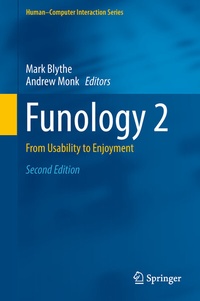
Funology 2
Description
Alles über E-Books | Antworten auf Fragen rund um E-Books, Kopierschutz und Dateiformate finden Sie in unserem Info- & Hilfebereich.
How should we understand and design for fun as a User Experience? This new edition of a classic book is for students, designers and researchers who want to deepen their understanding of fun in the context of HCI. The 2003 edition was the first book to do this and has been influential in broadening the field. It is the most downloaded book in the Springer HCI Series.
This edition adds 14 new chapters that go well beyond the topics considered in 2003. New chapter topics include: online dating, interactive rides, wellbeing, somaesthetics, design fiction, critical design and participatory design methods.
The first edition chapters are also reprinted, with new notes by their authors setting the context in which the 2003 chapter was written and explaining the developments since then. Taken with the new chapters this adds up to a total of 35 theoretical and practical chapters written by the most influential thinkers from academia and industry in this field.
Reviews / Votes
"I found the book interesting and many parts quite intriguing. . it does give great exposure to a lot of clever design ideas and new ways of looking at the world. If you are interested in HCI . this book is well worth reading." (David Goldfarb, Computing Reviews, August 30, 2021)More details
Other editions
Additional editions


Content
System requirements
File format: PDF
Copy protection: Watermark-DRM (Digital Rights Management)
System requirements:
- Computer (Windows; MacOS X; Linux): Use the free software Adobe Reader, Adobe Digital Editions, or any other PDF viewer of your choice (see eBook Help).
- Tablet/Smartphone (Android; iOS): Install the free app Adobe Digital Editions or another reading app for eBooks, e.g., PocketBook (see eBook Help).
- E-reader: Bookeen, Kobo, Pocketbook, Sony, Tolino and many more (only limited: Kindle).
The file format PDF always displays a book page identically on any hardware. This makes PDF suitable for complex layouts such as those used in textbooks and reference books (images, tables, columns, footnotes). Unfortunately, on the small screens of e-readers or smartphones, PDFs are rather annoying, requiring too much scrolling.
This eBook uses Watermark-DRM, a „soft” copy protection. This means that there are no technical restrictions to prevent illegal distribution. However, there is a personalised watermark embedded in the eBook that can be used to identify the purchaser of the eBook in the event of misuse and to provide evidence for legal purposes.
For more information, see our eBook Help page.