

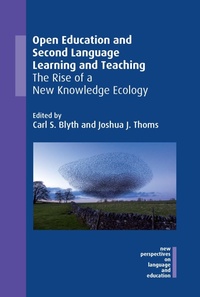
Open Education and Second Language Learning and Teaching
The Rise of a New Knowledge Ecology
Published on 3. February 2021
288 pages
978-1-80041-101-2 (ISBN)
Description

Compared with STEM fields, foreign language (FL) education and second language acquisition have only slowly embraced open education and the new knowledge ecologies it produces. FL educators may have been hesitant to participate in the open education movement due to a lack of research which investigates the benefits and challenges of FL learning and teaching in open environments. This book contextualizes open education in FL learning and teaching via an historical overview of the movement, along with an in-depth exploration of how the open movement affects FL education beyond the classroom context; fills the research void by exploring aspects of open second language learning and teaching across a range of educational contexts; and illustrates new ways of creating, adapting and curating FL materials that are freely shared among FL educators and students. This book is open access under a CC BY ND licence.
Reviews / Votes
This agenda-setting book challenges narrow conceptualizations of second language education by introducing a transdisciplinary approach inspired by an ecological perspective. The contributions illustrate the impact of the open education movement, which is disrupting L2 education and creating new knowledge ecosystems. With many teachers moving to online instruction today, such work is becoming ever more important, with the pedagogy of openness also promoting social justice imperatives in education. * Regine Hampel, The Open University, UK * An original and urgently needed volume for all language professionals, Blyth, Thoms, and colleagues unpack the complexities and affordances of open educational resources and practices. The volume crackles with the energy of educational openness, giving us a theoretically grounded and exquisitely practical guide toward engaging with and realizing the potential of what Blyth and Thoms appropriately frame as the "new knowledge ecology". * Glenn Levine, University of California, Irvine, USA * This forward-thinking volume illustrates the enormous and transformative potential of Open Education as an evolving knowledge ecosystem. Focusing on Open Education Practices and Resources for second language teaching and learning, Blyth and Thoms assemble innovative and critically important voices that, taken together, chart a course toward an Open future defined by greater generosity, professional sharing, and equity. * Steven L. Thorne, Portland State University, USA and University of Groningen, The Netherlands *More details
Series
Language
English
Place of publication
Bristol
United Kingdom
Target group
College/higher education
Product notice
Reflowable
ISBN-13
978-1-80041-101-2 (9781800411012)
Copyright in bibliographic data and cover images is held by Nielsen Book Services Limited or by the publishers or by their respective licensors: all rights reserved.
Schweitzer Classification
Other editions
Additional editions
Carl S. Blyth | Joshua J. Thoms
Open Education and Second Language Learning and Teaching
The Rise of a New Knowledge Ecology
Book
02/2021
Multilingual Matters
€48.60
Shipment within 10-20 days
Persons
Carl S. Blyth is Associate Professor of French Linguistics, and Director of the Center for Open Educational Resources and Language Learning at the University of Texas at Austin, USA. His research interests include discourse analysis, intercultural pragmatics and language learning technology.
Joshua J. Thoms is Associate Professor of Applied Linguistics and Spanish at Utah State University, USA. His research interests include classroom discourse in L2 literature environments, technology-enhanced language learning, and open educational resources and practices.
Joshua J. Thoms is Associate Professor of Applied Linguistics and Spanish at Utah State University, USA. His research interests include classroom discourse in L2 literature environments, technology-enhanced language learning, and open educational resources and practices.
Content
Contributors
Carl S. Blyth and Joshua J. Thoms: Introduction: Second Language Education as an Open Knowledge Ecology
Part 1: The Microsystem: Developing Knowledge in L2 Instructional Environments
Chapter 1. Gabriela C. Zapata and Alessandra Ribota: Open Educational Resources in Heritage and L2 Spanish Classrooms: Design, Development and Implementation
Chapter 2. Sabine Levet and Stephen L. Tschudi: Open by Design: The Cultura Project
Chapter 3. Sergio Romero: Open Educational Resources as Tools to Teach the Indigenous Languages of Latin America: Where Technology, Pedagogy, and Colonialism Meet
Chapter 4. Katerina Zourou and Anthippi Potolia: Openness in a Crowdsourced Massive Online Language Community
Part 2: The Mesosystem: Developing Knowledge in L2 Teacher Education
Chapter 5. Joshua J. Thoms and Frederick Poole: Second Language Teachers and the Open Education Movement in the United States: A National Survey
Chapter 6. Beatrice Dupuy: Raising the Curtain on OER/OEP: Opening Pathways from Awareness to Engagement in a Graduate Course on Foreign Language Program Direction
Chapter 7. Carl S. Blyth, Chantelle Warner and Joanna Luks: The Role of OER in Promoting Critical Reflection and Professional Development: The Foreign Languages and the Literary in the Everyday Project
Part 3: The Exosystem: Developing Knowledge in the Field of L2 Education
Chapter 8. Dorothy Chun and Trude Heift: The Affordances and Challenges of Open-access Journals: The Case of an Applied Linguistics Journal
Chapter 9. Tita Beaven: Analyzing Language Teachers' Tacit Professional Knowledge of OER: The Case of Languages Open Resources Online (LORO)
Chapter 10. Rebecca F. Davis and Carl S. Blyth: Towards a Pedagogy of Openness: Bridging English-language and Foreign-language Digital Humanities
Chapter 11. Christian Hilchey: Finding and Using the Good Stuff: Open Educational Practices for Developing Open Educational Resources
Carl S. Blyth and Joshua J. Thoms: Introduction: Second Language Education as an Open Knowledge Ecology
Part 1: The Microsystem: Developing Knowledge in L2 Instructional Environments
Chapter 1. Gabriela C. Zapata and Alessandra Ribota: Open Educational Resources in Heritage and L2 Spanish Classrooms: Design, Development and Implementation
Chapter 2. Sabine Levet and Stephen L. Tschudi: Open by Design: The Cultura Project
Chapter 3. Sergio Romero: Open Educational Resources as Tools to Teach the Indigenous Languages of Latin America: Where Technology, Pedagogy, and Colonialism Meet
Chapter 4. Katerina Zourou and Anthippi Potolia: Openness in a Crowdsourced Massive Online Language Community
Part 2: The Mesosystem: Developing Knowledge in L2 Teacher Education
Chapter 5. Joshua J. Thoms and Frederick Poole: Second Language Teachers and the Open Education Movement in the United States: A National Survey
Chapter 6. Beatrice Dupuy: Raising the Curtain on OER/OEP: Opening Pathways from Awareness to Engagement in a Graduate Course on Foreign Language Program Direction
Chapter 7. Carl S. Blyth, Chantelle Warner and Joanna Luks: The Role of OER in Promoting Critical Reflection and Professional Development: The Foreign Languages and the Literary in the Everyday Project
Part 3: The Exosystem: Developing Knowledge in the Field of L2 Education
Chapter 8. Dorothy Chun and Trude Heift: The Affordances and Challenges of Open-access Journals: The Case of an Applied Linguistics Journal
Chapter 9. Tita Beaven: Analyzing Language Teachers' Tacit Professional Knowledge of OER: The Case of Languages Open Resources Online (LORO)
Chapter 10. Rebecca F. Davis and Carl S. Blyth: Towards a Pedagogy of Openness: Bridging English-language and Foreign-language Digital Humanities
Chapter 11. Christian Hilchey: Finding and Using the Good Stuff: Open Educational Practices for Developing Open Educational Resources
