

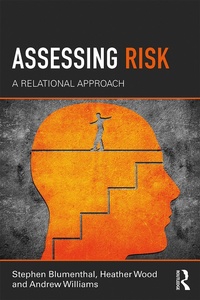
Assessing Risk
A Relational Approach
1st Edition
Published on 5. March 2018
234 pages
978-1-351-84781-0 (ISBN)
Description

Assessing Risk: A Relational Approach offers the practitioner a novel framework for understanding the complex and subtle issues involved in assessing and managing risks related to violence and sexual offending. The authors draw on their considerable experience working with high risk individuals in assessment and treatment. They have for many years consulted to practitioners in forensic mental health services and the criminal justice system and taught renowned courses at the Tavistock and Portman NHS Foundation Trust.
This book outlines a comprehensive model of risk which draws on mainstream empirical research, threat assessment, developmental psychopathology, attachment theory, and a relational model derived from psychoanalysis. The framework incorporates intrapersonal and interpersonal dimensions and is designed to enhance the reader's capacity to make a thorough risk formulation. The approach highlights the significance of childhood development in understanding violent and sexually violent acts, and the complicated interpersonal processes involved in managing individuals who have a propensity to violent enactment. These dynamic processes between people impact on risk and risk perception, and can distort judgement if not recognised and understood.
Assessing Risk will be of practical use in enhancing the skills of professionals to assess and manage risk in a comprehensive and effective way, and will appeal to all those mental health and criminal justice practitioners working with risky individuals.
This book outlines a comprehensive model of risk which draws on mainstream empirical research, threat assessment, developmental psychopathology, attachment theory, and a relational model derived from psychoanalysis. The framework incorporates intrapersonal and interpersonal dimensions and is designed to enhance the reader's capacity to make a thorough risk formulation. The approach highlights the significance of childhood development in understanding violent and sexually violent acts, and the complicated interpersonal processes involved in managing individuals who have a propensity to violent enactment. These dynamic processes between people impact on risk and risk perception, and can distort judgement if not recognised and understood.
Assessing Risk will be of practical use in enhancing the skills of professionals to assess and manage risk in a comprehensive and effective way, and will appeal to all those mental health and criminal justice practitioners working with risky individuals.
Reviews / Votes
"At last! An authoritative and accessible book that integrates psychoanalytical thinking with current approaches to evidence-based risk assessment. This volume is packed with interesting case vignettes, and explains complex ideas with compelling clarity; essential reading for the practitioner working with violent offenders."Dr Jackie Craissati, MBE, Consultant Clinical & Forensic Psychologist and Director of Psychological Approaches CIC
"Thank goodness we have thinkers such as Drs Blumenthal, Wood and Williams... In their seminal book, Risk: A Relational Perspective, they begin to integrate the insights from psychoanalysis-the narrative thread of attachment, the unconscious defences of the patient, and the enormous value of countertransference in the clinician-with the actuarial, and mostly phenomenal science of contemporary risk assessment."
Dr J. Reid Meloy, PhD, Clinical professor of psychiatry at the University of California, San Diego, School of Medicine
Forensic mental health is riven by polarities: mad v bad, sane v insane, treatment v punishment etc. What a pleasure then to find a book that seeks to integrate 'hard science' actuarial data on risk with 'soft science' psychoanalytic thought. The latter provides the authors with a meaning behind what otherwise often appears as inexplicable or bizarre behaviour. The authors argue that the exploration of this meaning with a client, while being informed by the relevant actuarial data, ought to reduce future violence thereby benefiting the client, the assessor and society more broadly.
Conor Duggan, OBE, Emeritus Professor, Division of Psychiatry and Applied Psychology, University of Nottingham
More details
Edition
1. Auflage
Language
English
Place of publication
London
United Kingdom
Publishing group
Taylor & Francis Ltd
Target group
Professional and scholarly
College/higher education
Illustrations
7 s/w Tabellen, 3 s/w Photographien bzw. Rasterbilder, 5 s/w Zeichnungen
7 Tables, black and white; 5 Line drawings, black and white; 3 Halftones, black and white
File size
3,33 MB
ISBN-13
978-1-351-84781-0 (9781351847810)
Copyright in bibliographic data and cover images is held by Nielsen Book Services Limited or by the publishers or by their respective licensors: all rights reserved.
Schweitzer Classification
Other editions
Additional editions
Book
03/2018
1st Edition
Routledge
€196.20
Shipment within 15-20 days
Book
03/2018
1st Edition
Routledge
€58.20
Shipment within 15-20 days
Persons
Stephen Blumenthal is Consultant Clinical Psychologist and Psychoanalyst at the Portman Clinic, Tavistock and Portman NHS Foundation Trust, and in private practice.
Heather Wood is Consultant Clinical Psychologist and Adult Psychotherapist, formerly at the Portman Clinic, Tavistock and Portman NHS Foundation Trust, and in private practice.
Andrew Williams is Consultant Psychiatrist in Forensic Psychotherapy and Psychoanalyst at the Portman Clinic, Tavistock and Portman NHS Foundation Trust, and in private practice.
Heather Wood is Consultant Clinical Psychologist and Adult Psychotherapist, formerly at the Portman Clinic, Tavistock and Portman NHS Foundation Trust, and in private practice.
Andrew Williams is Consultant Psychiatrist in Forensic Psychotherapy and Psychoanalyst at the Portman Clinic, Tavistock and Portman NHS Foundation Trust, and in private practice.
Content
CONTENTS
Introduction.....................................................................................
Risky assessment: making decisions about risk......................................
Key psychodynamic concepts in understanding risk................................
Relational issues in assessing and managing risk...................................
Developmental aspects of adult enactment............................................
A relational approach to violence and aggression....................................
Understanding deviant sexual behaviour and sexual offending...................
Female offending and risk...................................................................
Personality factors and understanding the offender...................................
Psychopathy and antisocial personality disorder.......................................
Self-harm and suicide............................................................................
Assessment and communication skills.....................................................
Institutional dynamics and risk...............................................................
Formulating risk: a framework for assessing and managing dangerousness....
INDEX.............................................................................................
REFERENCES..................................................................................
Introduction.....................................................................................
Risky assessment: making decisions about risk......................................
Key psychodynamic concepts in understanding risk................................
Relational issues in assessing and managing risk...................................
Developmental aspects of adult enactment............................................
A relational approach to violence and aggression....................................
Understanding deviant sexual behaviour and sexual offending...................
Female offending and risk...................................................................
Personality factors and understanding the offender...................................
Psychopathy and antisocial personality disorder.......................................
Self-harm and suicide............................................................................
Assessment and communication skills.....................................................
Institutional dynamics and risk...............................................................
Formulating risk: a framework for assessing and managing dangerousness....
INDEX.............................................................................................
REFERENCES..................................................................................
