

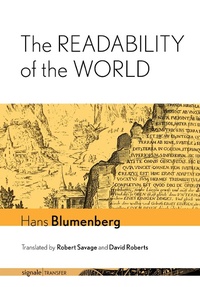
The Readability of the World
Published on 15. December 2022
426 pages
978-1-5017-6662-6 (ISBN)
Description

The Readability of the World represents Hans Blumenberg's first extended demonstration of the metaphorological method he pioneered in Paradigms for a Metaphorology. For Blumenberg, metaphors are symptomatic of patterns of thought and feeling that escape conceptual formulation but are nonetheless indispensable, because they allow humans to orient themselves in an otherwise overwhelming world. The Readability of the World applies this method to the idea that the world presents itself as a book. The metaphor of the book of nature has been central to Western interpretations of reality, and Blumenberg traces the evolution of this metaphor from ancient Greek cosmology to the model of the genetic code to access the different expectations of reality that it articulates, reflects, and projects.
Writing with equal authority on literature and science, theology and philosophy, ancient metaphysics and twentieth-century biochemistry, Blumenberg advances rich and original interpretations of the thinking of a range of canonical figures, including Berkeley, Vico, Goethe, Spinoza, Leibniz, Bacon, Flaubert, and Freud. Through his interdisciplinary, anthropologically sharpened gaze, Blumenberg uncovers a wealth of new insights into the continuities and discontinuities across human history of the longing to contain all of nature, history, and reality in a book, from the Bible, the Talmud, and the Qur'an to Diderot's Encyclopedia and Humboldt's Cosmos to the ACGT of the DNA code.
Writing with equal authority on literature and science, theology and philosophy, ancient metaphysics and twentieth-century biochemistry, Blumenberg advances rich and original interpretations of the thinking of a range of canonical figures, including Berkeley, Vico, Goethe, Spinoza, Leibniz, Bacon, Flaubert, and Freud. Through his interdisciplinary, anthropologically sharpened gaze, Blumenberg uncovers a wealth of new insights into the continuities and discontinuities across human history of the longing to contain all of nature, history, and reality in a book, from the Bible, the Talmud, and the Qur'an to Diderot's Encyclopedia and Humboldt's Cosmos to the ACGT of the DNA code.
Reviews / Votes
Spanning from the biblical account of creation to modern genetics, Blumenberg's book can be understood as an intense effort to refract the history of ideas through the lens of a fundamental metaphor. In detailed individual analyses of relevant historical texts, he explains the metaphor's various assignments of meaning from the intellectual, sociocultural, and biographical contexts in which it is deployed.(Rhetorica) Learning about Blumenberg's metaphorology as well as the stars of intellectual history has been made possible for Anglophones by the extraordinary translation skills of Robert Savage and David Roberts.
(Los Angeles Review of Books)
More details
Series
Language
English
Place of publication
Ithaca
United States
Publishing group
Cornell University Press
Product notice
Reflowable
ISBN-13
978-1-5017-6662-6 (9781501766626)
Copyright in bibliographic data and cover images is held by Nielsen Book Services Limited or by the publishers or by their respective licensors: all rights reserved.
Schweitzer Classification
Other editions
Additional editions
Hans Blumenberg
The Readability of the World
Book
12/2022
Cornell University Press and Cornell University Library
€64.57
Shipment within 15-20 days
Persons
Hans Blumenberg (1920-1996) was one of the most important German philosophers of the twentieth century. Among his books translated into English are Paradigms for a Metaphorology, Rigorism of Truth, St. Matthew Passion, The Legitimacy of the Modern Age, and Care Crosses the River. His criticism and other writings have been collected and translated in History, Metaphors, Fables.
Robert Savage is the author of Hoelderlin after the Catastrophe and the translator of several books, including Jan Assmann's The Invention of Religion.
David Roberts is the author of several books, including The Total Work of Art in European Modernism and History of the Present.
Robert Savage is the author of Hoelderlin after the Catastrophe and the translator of several books, including Jan Assmann's The Invention of Religion.
David Roberts is the author of several books, including The Total Work of Art in European Modernism and History of the Present.
Content
- The Readability of the World
- Contents
- Note on the Translation
- Preface
- I. A Metaphor for the Totality of Experience
- II. The World of Books and the Book of the World
- III. The Sky as Book, the Book in the Sky
- IV. Alphabetic Analogies
- V. The Delayed Appearance of the Second Book
- VI. The Illiterate Layman as Reader of the World Book
- VII. God's Books Agree with Each Other
- VIII. Asymmetries of Readability
- IX. Encryption and Decryption of the Human World
- X. World Chronicle or World Formula
- XI. A Robinsonian World against the Newtonian World
- XII. Anticipations of the Nineteenth Century
- XIII. The Hamburg Book of Nature and Its Reflection in Königsberg
- XIV. Signs on Foreheads, Signs in the Sky
- XV. "How Readable the Book of Nature is Becoming for Me . . ."
- XVI. "The World Must Be Romanticized"
- XVII. The Idea of the Absolute Book
- XVIII. A Book on Nature as a Book of Nature
- XIX. The Empty World Book
- XX. Preparation for the Interpretation of Dreams
- XXI. Making Dreams Readable
- XXII. The Genetic Code and Its Readers
- Notes
- Name Index
- A
- B
- C
- D
- E
- F
- G
- H
- I
- J
- K
- L
- M
- N
- O
- P
- R
- S
- T
- V
- W
- X
- Y
- Z
- Subject Index
- A
- B
- C
- D
- E
- F
- G
- H
- I
- J
- K
- L
- M
- N
- O
- P
- R
- S
- T
- U
- V
- W
