

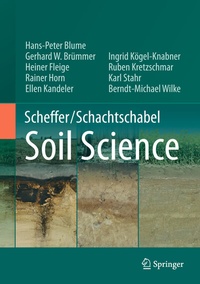
Scheffer/Schachtschabel Soil Science
Published on 24. November 2015
XVIII, 618 pages
978-3-642-30942-7 (ISBN)
Description

The soils are fundamental to our existence, delivering water and nutrients to plants, that feed us. But they are in many ways in danger and their conservation is therefore a most important focus for science, governments and society as a whole.
A team of world recognised researchers have prepared this first English edition based on the 16th European edition.
The precursors and the processes of soil development
The physical, biological and chemical properties of soils
Nutrients and Pollutants
The various soil classifications with the main focus on the World Reference Base for Soil Resources (WRB)
The most important soils and soil landscapes of the world
Soil Evaluation Techniques
Basic Principles of Soil Conservation
Whoever works with soils needs this book.
A team of world recognised researchers have prepared this first English edition based on the 16th European edition.
The precursors and the processes of soil development
The physical, biological and chemical properties of soils
Nutrients and Pollutants
The various soil classifications with the main focus on the World Reference Base for Soil Resources (WRB)
The most important soils and soil landscapes of the world
Soil Evaluation Techniques
Basic Principles of Soil Conservation
Whoever works with soils needs this book.
Reviews / Votes
"Each chapter is well organized with numerous subsections discussing specific topics. The text is also well illustrated to clarify relationships for the soil functions discussed. . The textbook is suitable for teaching advanced students in soil science or allied curricula. It is also an excellent resource for professionals with backgrounds in engineering, biology, ecology, and agriculture. Summing Up: Recommended. Upper-division undergraduates through professionals/practitioners." (S. G. Shetron, Choice, Vol. 53 (10), June, 2016)
More details
Series
Language
English
Place of publication
Berlin
Germany
Publishing group
Springer Berlin
Target group
Professional and scholarly
Product notice
Reflowable
Illustrations
XVIII, 618 p. 255 illus., 218 illus. in color.
File size
38,58 MB
ISBN-13
978-3-642-30942-7 (9783642309427)
DOI
10.1007/978-3-642-30942-7
Schweitzer Classification
Other editions
Additional editions
Hans-Peter Blume | Gerhard W. Brümmer | Heiner Fleige
Scheffer/Schachtschabel Soil Science
Book
12/2015
Springer
€149.79
Shipment within 7-9 days
Persons
Blume, H.-P., Brümmer, G.W., Horn, R., Kandeler, E., Kögel-Knabner, I., Kretzschmar, R., Schad, P., Stahr, K., Wilke, B.-M.
Content
- Intro
- Preface for the First English Edition
- Preface and Brief Historical Outlinefor the 16th Edition
- Contents
- 1 Introduction: Soils---The Earth's Skin
- 1.1 Soils as Natural Bodies in Ecosystems
- 1.2 Functions of the Soils in the Ecosphere
- 1.3 Soils as an Open System Worth Protecting
- References
- Supplementary Reading
- Cited References
- 2 Inorganic Soil Components---Minerals and Rocks
- 2.1 ?The Rock Cycle
- 2.2 ?Minerals
- 2.2.1 General
- 2.2.2 Silicate Structure
- 2.2.3 Primary (Lithogenic, Pyrogenic) Silicates
- 2.2.3.1 Feldspars
- 2.2.3.2 Micas and Chlorites
- 2.2.3.3 Pyroxenes, Amphiboles and Olivines
- 2.2.3.4 Rare Silicates
- 2.2.4 Clay Minerals
- 2.2.4.1 General Properties
- 2.2.4.2 Crystal Structure and Classification
- 2.2.4.3 Kaolinite and Halloysite
- 2.2.4.4 Illites and Glauconites
- 2.2.4.5 Vermiculites and Smectites
- 2.2.4.6 Pedogenic Chlorites
- 2.2.4.7 Palygorskite and Sepiolite
- 2.2.4.8 Allophane, Imogolite and Hisingerite
- 2.2.4.9 Interstratified Minerals
- 2.2.5 Clay Mineral Formation and Transformation
- 2.2.5.1 Changes in the Interlayer Filling
- 2.2.5.2 New Formation from the Weathering (Decay) Products of Silicates
- 2.2.5.3 Clay Mineral Transformation
- 2.2.6 Oxides and Hydroxides
- 2.2.6.1 Silica Oxides
- 2.2.6.2 Aluminum Oxides
- 2.2.6.3 Iron Oxides
- 2.2.6.4 Titanium Oxides
- 2.2.6.5 Manganese Oxides
- 2.2.7 Carbonates, Sulfates, Sulfides and Phosphates
- 2.3 ?Rocks
- 2.3.1 Igneous Rocks
- 2.3.2 Sediments and Sedimentary Rocks
- 2.3.2.1 General
- 2.3.2.2 Coarse Grained Sediments (Psephites)
- 2.3.2.3 Sands and Sandstones (Psamments)
- 2.3.2.4 Silts and Siltstones, Clays and Claystones (Pelites)
- 2.3.2.5 Carbonate Rocks and Marls
- 2.3.2.6 Quaternary Sediments
- 2.3.3 Metamorphic Rocks
- 2.3.4 Anthropogenic Substrates
- 2.4 ?Weathering
- 2.4.1 Physical Weathering
- 2.4.2 Chemical Weathering
- 2.4.2.1 Dissolution Through Hydration
- 2.4.2.2 Hydrolysis and Protolysis
- 2.4.2.3 Oxidation and Complex Formation
- 2.4.3 Role of the Biota
- 2.4.4 Weathering Stability
- 2.4.4.1 Thermodynamic Stability Conditions
- 2.4.4.2 Kinetics of Chemical Weathering
- 2.4.4.3 Weathering Intensity
- 2.5 ?Mineral Constituents of Soils
- References
- Supplementary Reading
- Cited References
- 3 Soil Organic Matter
- 3.1 Origins, Distribution and Dynamics
- 3.2 Contents and Quantities of Organic Matter in Soils
- 3.3 Plant Residues and Their Transformation During Decomposition
- 3.3.1 Composition and Structure of Organic Residues
- 3.3.1.1 Litter Type and Quantity
- 3.3.1.2 Chemical Composition of Plant Residues
- 3.3.1.3 Microbial Residues
- 3.3.2 Decomposition and Transformation Reactions in the Soil
- 3.3.2.1 Decomposition Pathways for Various Plant Constituents
- 3.4 Formation of Stable Organic Matter
- 3.4.1 Stabilization by Interactions with the Mineral Phase
- 3.4.2 Stabilization by Spatial Separation
- 3.4.3 Organic Matter in Functional Soil Fractions
- 3.5 Composition and Properties of Soil Organic Matter
- 3.5.1 Binding Forms of C, N, P and S in Soil Organic Matter
- 3.5.2 Properties of Soil Organic Matter
- 3.6 Soil Organic Matter Dynamics
- 3.6.1 Turnover Rates and Turnover Time of Organic Matter in Soils
- 3.6.2 Estimation of the Turnover Time
- 3.6.2.1 14C Content of Organic Matter
- 3.6.2.2 13C Isotope Signature of Organic Matter
- 3.6.3 C Turnover Modeling
- 3.6.4 Soils as a Carbon Reservoir and Source
- References
- Supplementary Reading
- Cited References
- 4 Soil Organisms and Their Habitat
- 4.1 ?Soil Organisms
- 4.1.1 Microflora and Viruses in Soils
- 4.1.2 Soil Fauna (Micro-, Meso-, Macro- and Megafauna)
- 4.1.3 Numbers and Biomass of Soil Organisms
- 4.1.3.1 Abundance of Organisms
- 4.1.3.2 Spatial and Temporal Variability of Soil Organisms
- 4.1.4 Soil Organisms as a Biocoenosis
- 4.1.4.1 Interactions Between Soil Organisms
- 4.1.4.2 Interactions Between Soil Microorganisms and Plants in the Rhizosphere
- 4.1.4.3 Symbioses Between Microorganisms and Plants
- 4.1.4.4 Interactions Between Soil Microorganisms and Soil Animals
- 4.2 ?Environmental Conditions
- 4.2.1 The Soil as a Source of Nutrients and Energy for Soil Organisms
- 4.2.2 Water and Atmosphere
- 4.2.3 pH Value and Redox Potential
- 4.2.4 Temperature
- 4.3 Functions of Soil Organisms
- 4.3.1 Function of Soil Organisms in Matter Cycles
- 4.3.1.1 Foodwebs
- 4.3.1.2 Carbon Cycle
- 4.3.1.3 Nitrogen Cycle
- 4.3.2 Function of Soil Organisms in Redox Reactions
- 4.3.3 Function of Soil Organisms in Soil Structure Stabilization
- 4.4 ?Soil Organisms as Bioindicators
- 4.4.1 Effect of Soil Management on Soil Organisms
- 4.4.1.1 Mineral and Organic Fertilization
- 4.4.1.2 Soil Tillage
- 4.4.1.3 Pesticides
- 4.4.2 Environmental Pollution
- 4.4.2.1 Heavy Metals
- 4.4.2.2 Organic Pollutants
- 4.4.3 Climate Change
- 4.5 ?Methods in Soil Biology
- 4.5.1 Microorganisms
- 4.5.1.1 Field Methods
- 4.5.1.2 Physiological, Biochemical and Molecular Methods
- 4.5.2 Soil Fauna
- References
- Supplementary Reading
- Cited References
- 5 Chemical Properties and Processes
- 5.1 Soil Solution
- 5.1.1 Composition of Rainwater
- 5.1.2 Composition of the Soil Solution
- 5.1.2.1 Dissolved Inorganic Substances
- 5.1.2.2 Dissolved Organic Matter (DOM)
- 5.2 Gas Equilibria
- 5.3 Speciation and Complex Formation
- 5.3.1 Ionic Strength, Concentration, and Activity
- 5.3.2 Solution Speciation
- 5.3.2.1 Dissolved Complexes and Ion Pairs
- 5.3.2.2 Mass Action Law and Stability Constants
- 5.3.2.3 Mass Balance Equations
- 5.3.2.4 Computer Programs for Chemical Speciation Calculations
- 5.4 Solubility and Dissolution Kinetics
- 5.4.1 Solubility Constant, Ion Activity Product, and Saturation Index
- 5.4.2 Stability Diagrams
- 5.4.3 Dissolution and Precipitation Kinetics
- 5.5 Sorption
- 5.5.1 Reactive Surfaces and Surface Charge
- 5.5.1.1 Specific Surface Area
- 5.5.1.2 Significance of Surface Charge
- 5.5.1.3 Permanent Surface Charge
- 5.5.1.4 Variable Surface Charge and Point of Zero Charge
- 5.5.1.5 Surface Charge of Individual Soil Components
- 5.5.1.6 Surface Charge in Soils
- 5.5.2 Ion Exchange
- 5.5.2.1 Cation Exchange Capacity (CEC)
- 5.5.2.2 Cation Exchange
- 5.5.3 Surface Complexation of Cations and Anions
- 5.5.4 Sorption of Organic Substances on Mineral Surfaces
- 5.5.5 Sorption Kinetics
- 5.5.6 Sorption Modeling
- 5.5.6.1 Sorption Isotherms
- 5.5.6.2 Cation Exchange Modeling
- 5.5.6.3 The Diffuse Double Layer
- 5.5.6.4 Modeling of Surface Complexation on Mineral Surfaces
- 5.5.6.5 Modeling Cation Binding to Organic Matter
- 5.6 Soil Reaction and pH Buffering
- 5.6.1 Soil Reaction
- 5.6.1.1 Alkaline Soils
- 5.6.1.2 Acidic Soils
- 5.6.1.3 Soil Acidification and Exchangeable Cations
- 5.6.2 Soil Acidity and Base Neutralization Capacity (BNC)
- 5.6.3 H+ Sources
- 5.6.3.1 Input Through Precipitation
- 5.6.3.2 Formation of Carbonic Acid Through Soil Respiration
- 5.6.3.3 Exudation of Organic Acids
- 5.6.3.4 Exudation of H+ by Plant Roots
- 5.6.3.5 Oxidation of NH4+ to NO32212
- 5.6.3.6 Oxidation of Soluble Fe2+ and Mn2+ Ions and of Fe Sulfides
- 5.6.4 pH Buffering, Soil Acidification and Acid Neutralization Capacity (ANC)
- 5.6.4.1 Buffering by Carbonates
- 5.6.4.2 Buffering by Surfaces with Permanent Charge
- 5.6.4.3 Buffering by Surfaces with Variable Charge
- 5.6.4.4 Buffering Through Silicate Weathering
- 5.6.5 Liming of Acidic Soils
- 5.6.5.1 Optimum pH Value for Agricultural Soils
- 5.6.5.2 Liming and Lime Requirement
- 5.7 Redox Reactions and Redox Dynamics
- 5.7.1 Redox Reactions and Redox Potential
- 5.7.1.1 Redox Reactions
- 5.7.1.2 Redox Potential
- 5.7.2 pe-pH Diagrams
- 5.7.3 Redox Reaction Kinetics
- 5.7.4 Redox Processes in Soils
- 5.7.5 Soil Redox Potential
- References
- Supplementary Reading
- Cited References
- 6 Physical Properties and Processes
- 6.1?? Texture and Packing
- 6.1.1 Particle Formation
- 6.1.2 Particle Size
- 6.1.3 Particle Classification
- 6.1.3.1 Particle Size Fractions
- 6.1.3.2 Mixtures, Particle Size Distributions
- 6.1.3.3 Determination of the Particle Size Distribution
- 6.1.4 Particle Properties
- 6.1.4.1 Composition and Shape
- 6.1.4.2 Surfaces
- 6.1.5 Common Particle Distributions
- 6.1.5.1 Reasons
- 6.1.5.2 Landscape-Related Occurrences
- 6.1.6 Packing of the Primary Particles
- 6.1.6.1 Bracing and Contact
- 6.1.6.2 Packing Parameters
- 6.1.6.3 Soil Pore Ratios
- 6.1.6.4 Pore Shapes
- 6.1.6.5 Pore Size Distribution
- 6.1.7 Temporal Changes
- 6.1.7.1 Textural Changes
- 6.1.7.2 Changes in the Packing
- 6.1.8 Correlation Between the Solid Phase and Other Soil Properties
- 6.2?? Interactions Between the Solid and Liquid Phases
- 6.2.1 Flocculation and Peptization
- 6.2.1.1 Energetic Interactions Between Soil Colloids
- 6.2.1.2 Effect of Exchangeable Cations and Valence on Flocculation
- 6.2.1.3 Effects of Polymers on Flocculation and Dispersion
- 6.2.1.4 Flake Structure
- 6.2.1.5 Effect of the Electrokinetic Potential
- 6.2.2 Shrinkage and Swelling
- 6.2.2.1 Shrinkage
- 6.2.2.2 Swelling
- 6.2.3 Wettability
- 6.2.4 Cohesion, Consistency and Hydraulic Pressure Head
- 6.3???Soil Structure
- 6.3.1 Structural Morphology
- 6.3.1.1 Macrostructure
- 6.3.1.2 Microstructures
- 6.3.1.3 Crack and Channel Systems
- 6.3.2 Stresses and Deformations
- 6.3.2.1 Forces on the Grain
- 6.3.2.2 Forces and Stresses in the Soil Profile
- 6.3.2.3 Effect of Water
- 6.3.3 Soil Structural Stability
- 6.3.3.1 Stabilizing Substances
- 6.3.3.2 Sealing, Kneading and &!blank
- Crust Formation
- 6.3.3.3 Hydraulic Pressure, Solifluction
- 6.3.3.4 Determination of the Structural Stability
- 6.3.4 Biological, Climatic and Anthropogenic Effects on Soil Structure
- 6.3.4.1 Structure of a Soil Profile as a State of Equilibrium
- 6.3.4.2 Natural Soil Development
- 6.3.4.3 Anthropogenic Effects
- 6.3.5 Assessment of the Soil Structure for Agricultural Purposes
- 6.4?? Soil Water
- 6.4.1 Introduction---Binding Forms
- 6.4.1.1 Groundwater and Stagnant Water
- 6.4.1.2 Adhesive Water and Capillary Water
- 6.4.1.3 Determination of the Water Content
- 6.4.2 Water Binding Intensity
- 6.4.2.1 Potentials
- 6.4.2.2 Potential Equilibrium
- 6.4.2.3 Relationship Between the Matric Potential and Water Content
- 6.4.3 Water Movement in the Liquid Phase
- 6.4.3.1 Effect of Texture and Soil Structure
- 6.4.3.2 Effect of the Water Content
- 6.4.3.3 Determination of the Hydraulic Conductivity
- 6.4.3.4 Water Uptake---Water Discharge
- 6.4.4 Water Movement in the Vapor Phase
- 6.4.4.1 Water Vapor Movement in the Soil
- 6.4.4.2 Evaporation from the Soil
- 6.4.4.3 Condensation in the Soil
- 6.4.5 Soil Water Balance
- 6.4.5.1 Soil Parameters
- 6.4.5.2 Seasonal Pattern of the Water Balance
- 6.4.6 Water Balance of Landscapes
- 6.4.6.1 Catchment Basins
- 6.4.6.2 Effect of Topography and Lithological Situation on the Water Balance
- 6.4.6.3 Effect of Climate and Weather Conditions on the Water Balance
- 6.4.6.4 Effects of Water Movement on Soil Development
- 6.4.6.5 Calculations
- 6.5?? Soil Air
- 6.5.1 Composition and Origin of the Constituents
- 6.5.2 Transport Mechanisms
- 6.5.3 Gas Balance
- 6.5.3.1 Gas Balance and the Environment
- 6.6?? Soil Temperature
- 6.6.1 Significance of Thermal Phenomena
- 6.6.2 Energy Gains and Losses
- 6.6.3 Thermal Properties
- 6.6.4 Heat Movement
- 6.6.5 Heat Balance
- 6.6.5.1 Natural Heat Balance
- 6.6.5.2 Anthropogenic Interference
- 6.7?? Transport Processes and Translocations
- 6.7.1 Transport in Soils in the Liquid Phase
- 6.7.2 Transport in Soils in the Gaseous Phase
- 6.8?? Soil Color
- 6.8.1 Color Classification
- 6.8.2 Coloring Components
- 6.8.3 Correlations Between Color and Soil Properties and Processes
- References
- Supplementary Reading
- Cited References
- 7 Soil Development and Soil Classification
- 7.1 Factors of Soil Formation
- 7.1.1 Parent Rock
- 7.1.2 Climate
- 7.1.3 Gravity and Relief
- 7.1.4 Water
- 7.1.5 Fauna and Flora
- 7.1.6 Human Activities
- 7.1.7 Time
- 7.2 Processes of Soil Development
- 7.2.1 Transformations and Depletions of the Mineral Body
- 7.2.1.1 Frost, Temperature and Salt Splitting
- 7.2.1.2 Brunification and Loamification
- 7.2.1.3 Ferrallitization and Desilification
- 7.2.2 Humus Accumulation---Development of Humus Forms
- 7.2.2.1 Terrestrial Humus Forms
- 7.2.2.2 Hydromorphic Humus Forms
- 7.2.2.3 The Classification of Humus Forms
- 7.2.3 Structure Formation
- 7.2.4 Translocations
- 7.2.4.1 Clay Migration
- 7.2.4.2 Podzolization
- 7.2.4.3 Decalcification and Calcification
- 7.2.4.4 Silification
- 7.2.4.5 Salinization
- 7.2.5 Redoximorphosis
- 7.2.6 Turbations
- 7.2.6.1 Bioturbation
- 7.2.6.2 Cryoturbation
- 7.2.6.3 Peloturbation
- 7.2.6.4 Accumulation in Cracks
- 7.2.7 Soil Landscape Processes
- 7.2.7.1 Mass Transfer on Slopes
- 7.2.7.2 Soil Erosion by Water and Wind
- 7.2.7.3 Slope Water Transport
- 7.2.8 Profile Differentiation
- 7.3 Diagnostic Criteria of Soils
- 7.3.1 Soil Horizon Designation
- 7.3.2 Diagnostic Horizons, Properties and Materials
- 7.4 Soil Classification
- 7.4.1 Soil Classification According to the WRB
- 7.4.2 Soil Classification According to the US Soil Taxonomy
- 7.4.3 Soil Classification in Germany
- 7.5 Representative Soil Units
- 7.5.1 Leptosols (LP)
- 7.5.1.1 Lithic Leptosols and Foli-Lithic Leptosols
- 7.5.1.2 Rendzic Leptosols
- 7.5.1.3 Silti-``Turbic'' Leptosols and Silti-Leptic Cryosols
- 7.5.1.4 Foli-Hyperskeletic Leptosol
- 7.5.1.5 Other Leptosols
- 7.5.2 Arenosols (AR)
- 7.5.3 Regosols (RG)
- 7.5.4 Cambisols (CM)&!blank
- and Umbrisols (UM)
- 7.5.4.1 Cambisols
- 7.5.4.2 Umbrisols
- 7.5.4.3 Terrae Calcis---Chromic and Rhodic Cambisols
- 7.5.4.4 Vertic Cambisols
- 7.5.5 Chernozems (CH), Phaeozems (PH) and Kastanozems (KS)
- 7.5.5.1 Chernozems and Phaeozems
- 7.5.5.2 Kastanozems
- 7.5.6 Soils with Clay Migration
- 7.5.6.1 Luvisols (LV)&!blank
- and Albeluvisols (AB)
- 7.5.6.2 Acrisols (AC), Alisols (AL) and Lixisols (LX)
- 7.5.6.3 Nitisols (NT)
- 7.5.7 Podzols (PZ)
- 7.5.8 Stagnosols (ST)&!blank
- and Planosols (PL)
- 7.5.8.1 Stagnosols
- 7.5.8.2 Planosols
- 7.5.9 ``Reductosols'' and Reductic Technosols (TC)
- 7.5.9.1 Haplic Reductosols
- 7.5.9.2 Asphaltic Reductosols
- 7.5.9.3 Reductic Technosols
- 7.5.10 Vertisols (VR)
- 7.5.11 Andosols (AN)
- 7.5.12 Ferralsols (FR) and Plinthosols (PT)
- 7.5.12.1 Ferralsols
- 7.5.12.2 Plinthosols
- 7.5.13 Calcisols (CL) and Gypsisols (GY)
- 7.5.14 Durisols (DU)
- 7.5.15 Solonchaks (SC)
- 7.5.16 Solonetz (SN)
- 7.5.17 Desert Soils--Soils with a Yermic Horizon and Aridic Properties
- 7.5.18 Gleysols (GL)
- 7.5.19 Fluvisols (FL)
- 7.5.19.1 Subhydric Soils---Limnic Fluvisols
- 7.5.19.2 Valley Soils---Haplic Fluvisols
- 7.5.19.3 Tidalic Fluvisols, ``Tidalic'' Arenosols and Fluvic Gleysols
- 7.5.20 Peat Soils---Histosols (HS)
- 7.5.21 Cryosols (CR) and Other Soils with Permafrost
- 7.5.22 Anthrosols (AT)
- 7.5.22.1 Hortic Anthrosols
- 7.5.22.2 Colluvic Subunits
- 7.5.22.3 Plaggic Anthrosols
- 7.5.22.4 Paddy Soils---Hydragric and Irragric Anthrosols
- 7.5.23 ``Zoosols'' (ZO)
- 7.5.23.1 Soils Produced by Penguins or Influenced by Weaverbirds
- 7.5.23.2 Soils Formed by Earthworms and Mammals
- 7.5.23.3 Soils Formed by Termites and Ants
- 7.5.23.4 Soils Formed by Lugworms
- 7.6 Paleosols on Earth, and Soils on Mars and Titan
- 7.6.1 Paleosols on Earth
- 7.6.2 Soils on Mars and Titan
- References
- Supplementary Reading
- Cited References
- 8 Soil Geography
- 8.1 The Pedosphere
- 8.2 Paradigms of Soil Landscapes and Soil Genesis
- 8.2.1 Basic Principles of Soil Associations
- 8.3 Soil Association Systematics and Soil Regions of Central Europe
- 8.3.1 Soil Regions of Central Europe (Fig. 8.4)
- 8.3.2 Soil Regions in Urban Industrial Areas
- 8.4 Soil Zones of the World
- 8.4.1 Ferralsols-Gleysols-Fluvisols Soil Zones in the Inner (Humid) Tropics (Rain Forest)
- 8.4.2 Acrisols-(Luvisols-Plinthosols)-Nitisols-Vertisols Soil Zones in the Outer (Seasonal) Tropics (Savannah)
- 8.4.3 Regosols-Calcisol-Solonchak Soil Zones in Semi-deserts
- 8.4.4 Arenosol-(Leptosol)-Gypsisol-Solonchak Soil Zones in (Extreme) Deserts (Fig. 8.1)
- 8.4.5 Planosol-Luvisol-(Acrisol)-Cambisol Zones in the Mediterranean Region
- 8.4.6 Chernozem-Kastanozem-Solonetz Zones of the Grasslands (Steppe, Prairie, Pampa, Veld) (Fig. 8.2)
- 8.4.7 Cambisol-Luvisol-Gleysol Zone of Temperate Zones (Mixed Forest and Forest Steppe)
- 8.4.8 Podzol-Cambisol-Histosol Zone of Boreal Forests (Taiga)
- 8.4.9 Leptosol-Regosol-Gleysol-Histosol Zone of the Tundra (Polar Steppe)
- 8.4.10 Leptosol-Gelic-Regosol-Cryosol Zone of Cold Deserts
- References
- Supplementary Reading
- Cited References
- 9 Soil-Plant Relations
- 9.1 Rootability and Rooting Zone
- 9.1.1 Root System of Plants and Rootability
- 9.1.2 Potential Rooting Zone
- 9.2 Water Supply to Plants
- 9.2.1 Plant-Available Water
- 9.2.2 Water Transport in the Soil--Plant--Atmosphere Continuum
- 9.2.2.1 Water Transport to Plant Roots
- 9.2.2.2 Water Uptake by Plants
- 9.2.3 Water Consumption and Plant Yields
- 9.3 Soil Air and Oxygen Supply to Plant Roots
- 9.3.1 Soil Air Budget
- 9.3.2 Oxygen Supply to Plant Roots
- 9.4 Soil Thermal Budget, Soil Temperature and Plant Growth
- 9.5 Plant Nutrient Supply
- 9.5.1 Nutrient Contents, Binding Forms and Budgets
- 9.5.1.1 Nutrient Inputs
- 9.5.1.2 Nutrient Losses
- 9.5.2 Nutrient Availability and Nutrient Supply in Soils
- 9.5.2.1 Nutrients in the Soil Solution
- 9.5.2.2 Nutrient Supply and Transport
- 9.5.2.3 Nutrient Uptake from the Subsoil
- 9.5.2.4 Measurement of the Nutrient Supply in Soils
- 9.5.2.5 Soil Test Categories for Nutrient Elements in Soils
- 9.5.3 Nutrient Fertilization
- 9.6 Essential Nutrient Elements
- 9.6.1 Nitrogen
- 9.6.1.1 Biological N2 Fixation and Nitrogen Cycle
- 9.6.1.2 N Compounds and N Contents
- 9.6.1.3 Ammonification and NH4+ Fixation, Nitrification and Denitrification
- 9.6.1.4 N Budget, N Fertilization and Crop Yields
- 9.6.1.5 Environmental Pollution Through Nitrogen Leaching
- 9.6.2 Phosphorus
- 9.6.2.1 P Contents of Rocks and Soils
- 9.6.2.2 P Forms and P Minerals in Soils
- 9.6.2.3 P Mobilization Under Reducing Conditions
- 9.6.2.4 P Supply to Plants, P Fertilization and P Budget
- 9.6.2.5 Water Pollution by P Losses
- 9.6.3 Sulfur
- 9.6.3.1 S Contents of Rocks and Soils
- 9.6.3.2 S Forms and Minerals in Soils
- 9.6.3.3 S Supply to Plants, S Leaching and S Fertilization
- 9.6.4 Potassium
- 9.6.4.1 K Contents of Rocks and Soils
- 9.6.4.2 K Minerals and Forms in Soils
- 9.6.4.3 Correlations Between Exchangeable and Dissolved K
- 9.6.4.4 K Supply to Plants, K Fertilization and K Leaching
- 9.6.5 Calcium
- 9.6.5.1 Ca Contents, Minerals and Forms in Soils
- 9.6.5.2 Ca Supply to Plants, Ca Fertilization and Ca Leaching
- 9.6.6 Magnesium
- 9.6.6.1 Mg Contents, Minerals and Forms in Soils
- 9.6.6.2 Mg Supply to Plants, Mg Fertilization and Mg Leaching
- 9.6.7 Sodium
- 9.7 Micronutrient Elements
- 9.7.1 Manganese
- 9.7.1.1 Mn Contents, Minerals and Forms in Soils
- 9.7.1.2 Mn Supply to Plants, Mn Extraction and Leaching, Mn Fertilization
- 9.7.2 Iron
- 9.7.3 Copper
- 9.7.3.1 Cu Contents, Minerals and Forms in Soils
- 9.7.3.2 Cu Supply to Plants, Cu Removal and Leaching, Cu Fertilization
- 9.7.4 Zinc
- 9.7.4.1 Zn Contents, Minerals and Forms in Soils
- 9.7.4.2 Zn Supply to Plants, Zn Removal and Leaching, Zn Fertilization
- 9.7.5 Boron
- 9.7.6 Molybdenum
- 9.7.7 Chlorine
- 9.8 Beneficial Elements
- 9.8.1 Silicium
- 9.8.2 Cobalt
- 9.8.3 Selenium
- References
- Supplementary Reading
- Cited References
- 10 Threats to the Soil Functions
- 10.1 Threats to the Soil Functions Through Chemical Contaminations
- 10.1.1 Entry Paths of Pollutants in Soils
- 10.2 Inorganic Substances
- 10.2.1 Sulfur Dioxide and Nitrogen Compounds---Forest Decline
- 10.2.2 Fluorine
- 10.2.3 Cyanides
- 10.2.4 Heavy Metals
- 10.2.4.1 Sources and Entry Paths
- 10.2.4.2 Contents in Soils
- 10.2.4.3 Binding Forms, Solubility and Translocability
- 10.2.4.4 Translocation, Losses
- 10.2.4.5 Heavy Metal Uptake and Effects on Plants
- 10.2.4.6 Effects on Soil Organisms
- 10.2.5 Salts
- 10.2.6 Radionuclides
- 10.2.6.1 Geogenic Radioactivity of Soils and Rocks
- 10.2.6.2 Inputs, Soil Radiation, Radiation Exposure
- 10.2.6.3 Behavior in Soils
- 10.2.6.4 Uranium
- 10.2.6.5 Cesium
- 10.2.6.6 Strontium
- 10.2.6.7 Transition into Plants
- 10.3 Organic Pollutants
- 10.3.1 Classification, Use, Inputs and Contents in Soils
- 10.3.2 Processes at the Soil Surface
- 10.3.3 Fixation in the Soil
- 10.3.4 Decomposition and Translocation
- 10.3.5 Uptake by and Effects on Organisms
- 10.4 Farmyard and Secondary Raw Material Fertilizers, Dredged Material
- 10.5 Toxicological/Ecotoxicological Evaluation of Chemical Soil Pollution
- 10.5.1 Values for the Soil---Human Path
- 10.5.2 Values for the Soil---Crop Plant Path
- 10.5.3 Soil Values for the Soil---Groundwater Path
- 10.5.4 Biological Evaluation of Soil and Soil Material
- 10.6 Remediation of Chemical Contaminations
- 10.7 Threats to Soil Functions Through Non-chemical Contaminations
- 10.7.1 Soil Erosion
- 10.7.1.1 Significant Causes for Soil Erosion
- 10.7.1.2 Water Erosion
- 10.7.1.3 Wind Erosion
- 10.7.1.4 Tillage Erosion
- 10.7.1.5 Extent of Soil Erosion by Water and Wind
- 10.7.1.6 Soil Deterioration
- 10.7.1.7 Erosion Protection
- 10.7.2 Mechanical Soil Deformation
- 10.7.2.1 Definition of Soil Deformation
- 10.7.2.2 Stability in the Recompaction and Virgin Compaction Range
- 10.7.2.3 Consequences of Soil Deformation for Soil Parameters
- 10.7.2.4 Counteractive Measures and Their Limits
- References
- Supplementary Reading
- Cited References
- 11 Land Evaluation and Soil Protection
- 11.1 Principles of Soil Evaluation/Assessment
- 11.2 Evaluation for Taxing and Agricultural Use
- 11.2.1 Soil Evaluation---German Soil Taxation Framework
- 11.2.2 Soil Evaluation---Grassland Taxation Framework
- 11.2.3 Assessment for Special Crops
- 11.3 Assessment for Forest Use
- 11.4 Evaluation for Societal Requirements Without Use of the Primary Production
- 11.5 Common International Soil Evaluation Methods
- 11.5.1 Storie Index Rating (SIR)
- 11.5.2 Fertility Capability Classification (FCC)
- 11.5.3 Land Capability Classification (LCC)
- 11.5.4 Land Suitability Classification (LSC)
- 11.5.5 Agro-Ecological Zones
- 11.5.6 Soil Quality Assessment
- 11.6 Soil Information Systems
- 11.7 Soil Protection
- 11.7.1 Reasons for Soil Protection
- 11.7.2 Protection of the Natural Body
- 11.7.3 Soil Functions and Potentials
- 11.7.4 German Federal Soil Protection Act
- References
- Supplementary Reading
- Cited References
- Appendix
- Index
