

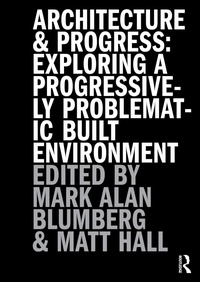
Architecture and Progress
Exploring a Progressively Problematic Built Environment
Published on 3. November 2025
212 pages
978-1-040-45058-1 (ISBN)
Description

This volume proposes an interdependent relationship between progress and obstacles in architecture and the built environment. It challenges the positive notion of progress, and the conception of progress and obstacle as a dichotomy.
For shapers of the world, finding 'the solution' is often a mark of progress that becomes embedded in culture, society, and history. Progress is ever-present. Through the exploration of diverse positions in history, theory, and practice, this book explores the potential utility of the progressively problematic rather than the natural tendency towards the progressively solved. Chapters draw on historic spaces, technological advancement, incorporation of the natural world, alterative production, and the consideration of human experience both sensory and psychological. Challenging the positive connotation of 'progress', the writings also explore reversing the notion of obstacle from disruptive anti-tool to obstacle of utilitarian method, a useful tool, pressing approach, and overarching value system.
This will be interesting reading for upper-level students and scholars of Architecture, Urban Design, Philosophy, and Sociology.
For shapers of the world, finding 'the solution' is often a mark of progress that becomes embedded in culture, society, and history. Progress is ever-present. Through the exploration of diverse positions in history, theory, and practice, this book explores the potential utility of the progressively problematic rather than the natural tendency towards the progressively solved. Chapters draw on historic spaces, technological advancement, incorporation of the natural world, alterative production, and the consideration of human experience both sensory and psychological. Challenging the positive connotation of 'progress', the writings also explore reversing the notion of obstacle from disruptive anti-tool to obstacle of utilitarian method, a useful tool, pressing approach, and overarching value system.
This will be interesting reading for upper-level students and scholars of Architecture, Urban Design, Philosophy, and Sociology.
More details
Language
English
Place of publication
London
United Kingdom
Publishing group
Taylor & Francis Ltd
Target group
College/higher education
Illustrations
67 Halftones, black and white; 67 Illustrations, black and white
File size
79,63 MB
ISBN-13
978-1-040-45058-1 (9781040450581)
Copyright in bibliographic data and cover images is held by Nielsen Book Services Limited or by the publishers or by their respective licensors: all rights reserved.
Schweitzer Classification
Other editions
Additional editions
Mark Blumberg | Matthew Hall
Architecture and Progress
Exploring a Progressively Problematic Built Environment
Book
11/2025
1st Edition
Routledge
€52.50
Shipment within 10-20 days
Mark Blumberg | Matthew Hall
Architecture and Progress
Exploring a Progressively Problematic Built Environment
Book
11/2025
1st Edition
Routledge
€215.41
Shipment within 10-20 days
Persons
Mark Alan Blumberg is an Assistant Professor at the Auburn University College of Architecture Design and Construction, USA. Mark researches the spaces between cognition and representation through diagrams, and between abstraction and analysis in mapping. His interests in the urban scale and complexities serve as a connection between present environmental, cultural, and societal conditions and potential future outcomes of current decisions and practices.
Matt Hall is a Professor at the Auburn University College of Architecture Design and Construction, USA, and partner in the design firms Superunison and Obstructures. His work is concerned with the rift between intentions and consequences, the dilemmas of decision making, and the uncertain future contexts that all design is inevitably subject to. His is the co-editor of Lewerentz Fragments (Actar, 2021) and an A+U feature issue on Swedish architect Bernt Nyberg (2017), along with other publications on post-war Swedish architecture. He has lectured, published, and exhibited internationally on topics related to theory, criticism, and pedagogy.
Matt Hall is a Professor at the Auburn University College of Architecture Design and Construction, USA, and partner in the design firms Superunison and Obstructures. His work is concerned with the rift between intentions and consequences, the dilemmas of decision making, and the uncertain future contexts that all design is inevitably subject to. His is the co-editor of Lewerentz Fragments (Actar, 2021) and an A+U feature issue on Swedish architect Bernt Nyberg (2017), along with other publications on post-war Swedish architecture. He has lectured, published, and exhibited internationally on topics related to theory, criticism, and pedagogy.
Content
Introduction: Obstacles in Progress 1. Ex, Est, Ut 2. I Just Want to Say One Word to You, Just One Word: Plastics. 3. The Mediation of Doubt and the Doubt of Mediations 4. Drawing on History 5. Types and Specimens: Plants, Digital Assets, and Ecological World-Building in Spatial Design 6. The Panecillo of Quito in 1903: Resisting Modernity in the Andes 7. Proving Grounds: Speculative Scenography and Staging the Future 8. Atado con Alambre: The Alternative Production of Ingenious Architectures 9. Driven to Distraction 10. Syn(es)thetic Futures: Lessons from the Hermetically Sealed 11. Newer Babylons 12. Unresolution: Fiction in the Space Between Inquiry and Invention 13. On Enemy Territory
