

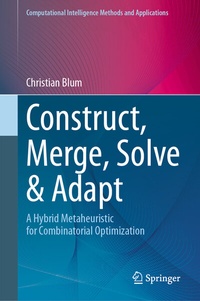
Construct, Merge, Solve & Adapt
Description

This book describes a general hybrid metaheuristic for combinatorial optimization labeled Construct, Merge, Solve & Adapt (CMSA). The general idea of standard CMSA is the following one. At each iteration, a number of valid solutions to the tackled problem instance are generated in a probabilistic way. Hereby, each of these solutions is composed of a set of solution components. The components found in the generated solutions are then added to an initially empty sub-instance. Next, an exact solver is applied in order to compute the best solution of the sub-instance, which is then used to update the sub-instance provided as input for the next iteration. In this way, the power of exact solvers can be exploited for solving problem instances much too large for a standalone application of the solver.
Important research lines on CMSA from recent years are covered in this book. After an introductory chapter about standard CMSA, subsequent chapters cover a self-adaptive CMSA variant as well as a variant equipped with a learning component for improving the quality of the generated solutions over time. Furthermore, on outlining the advantages of using set-covering-based integer linear programming models for sub-instance solving, the author shows how to apply CMSA to problems naturally modelled by non-binary integer linear programming models. The book concludes with a chapter on topics such as the development of a problem-agnostic CMSA and the relation between large neighborhood search and CMSA. Combinatorial optimization problems used in the book as test cases include the minimum dominating set problem, the variable-sized bin packing problem, and an electric vehicle routing problem.
The book will be valuable and is intended for researchers, professionals and graduate students working in a wide range of fields, such as combinatorial optimization, algorithmics, metaheuristics, mathematical modeling, evolutionary computing, operations research, artificial intelligence, or statistics.
More details
Other editions
Additional editions
Person
Christian Blum is a Senior Research Scientist at the Artificial Intelligence Research Institute (IIIA) and the Spanish National Research Council (CSIC). He is one of the most influential researchers at the intersection of Artificial Intelligence, Operations Research, Optimization, Heuristics, Natural Computing and Computational Intelligence. He is the co-editor of "Swarm Intelligence" (Springer, 2006) and co-author of "Hybrid Metaheuristics" (Springer, 2016).
Content
Introduction to CMSA.- Self-Adaptive CMSA.- Adding Learning to CMSA.- Replacing Hard Mathematical Models with Set Covering Formulations.- Application of CMSA in the Presence of Non-Binary Variables.- Additional Research Lines Concerning CMSA.
