

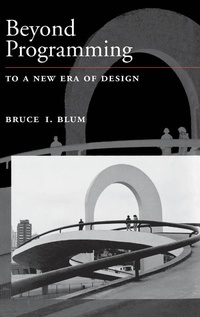
Beyond Programming
To a New Era of Design
1st Edition
Published on 11. January 1996
440 pages
978-0-19-535798-1 (ISBN)
Description

This book provides a unique examination of the software development process, arguing that discipline, still dominated by methods conceived in the framework of older technologies, must undergo a fundamental reexamination of its guiding principles in order for significant progress to take place. To gain fresh insights into how we ought to direct future research, the author begins with a search for first principles. The book begins with an exploration of the scientific foundations of computer technology, then examines design from the perspective of practitioners. The book also offers a critique of the methods employed in software development and an evaluation of an alternate paradigm that has been used successfully for 14 years. The concepts reviewed here comprise a set of core readings for understanding the research and development challenges that will confront computer technology in the 21st century and will be of great interest to computer science researchers and educators, graduate students, and software engineers.
More details
Other editions
Additional editions
Book
02/1996
Oxford University Press Inc
€252.10
Shipment within 15-20 days
Content
- Intro
- CONTENTS
- PROLOGUE
- PART I: SCIENCE AND TECHNOLOGY
- 1. IN THE TRADITION
- 1.1. The Underlying Thesis
- 1.2. Going Beyond Programming
- 1.3. An Engineering Discipline of Software
- 2. THE PHILOSOPHY OF SCIENCE
- 2.1. Why Study the Philosophy of Science?
- 2.2. Science in the Early Twentieth Century
- 2.3. Popper's Correction to Logical Positivism
- 2.4. Epistemological Refinements
- 2.5. Science in a Historical Context
- 2.6. Some Other Contributions
- 2.7. The Structure of Science
- 3. DISCOVERY AND DESIGN
- 3.1. The Relationship Between Science and Technology
- 3.2. Comparing the Engineer and the Scientist
- 3.3. Technological Knowledge
- 3.4. Modeling Reality
- 3.5. Scientific and Technological Models
- 3.6. Science and Free Phenomena
- 3.7. A Short Coda
- PART II: ECOLOGICAL DESIGN
- 4. A FOUNDATION FOR DESIGN
- 4.1. The Foundation, So Far
- 4.2. The Rejection of Technical Rationality
- 4.3. Heidegger's Being-in-the-World
- 4.4. An Ecological Study of Design
- 5. PROBLEM SOLVING
- 5.1. The Chapter's Unifying Theme
- 5.2. Human Problem Solving
- 5.3. Human Problem Solving in the Real World
- 5.4. The Nature of Expertise
- 5.5. Scientific Expertise
- 5.6. Complex Problem Solving
- 6. ACTIVITY, REFLECTION, CONTEXT
- 6.1. A Check Point
- 6.2. Activity Theory
- 6.3. Reflection in Practice
- 6.4. Closing the Circle
- 6.5. Reason, Bias, and Error
- 7. THE DESIGN PROCESS
- 7.1. Finally, an Examination of Design
- 7.2. Design Practice
- 7.3. Architectural and Industrial Design
- 7.4. Engineering and System Design
- 7.5. The Individual Designer
- 7.6. The Challenge
- 8. PARTICIPATORY DESIGN
- 8.1. Evolving Models of Design
- 8.2. Human Factors and the Interface
- 8.3. User-Centered Design
- 8.4. The Scandinavian Approach
- 8.5. A Model of Computer Technology Adaptation
- 8.6. A Closing Observation
- PART III: SOFTWARE DESIGN
- 9. THE SOFTWARE PROCESS
- 9.1. A Foundation for Software Design
- 9.2. Software Engineering, a Historical Overview
- 9.3. The Traditional Technological Perspective
- 9.4. The Essential Software Process
- 9.5. Looking to the Future
- 9.6. Exploiting Software's Unique Properties
- 10. DESIGN METHODS
- 10.1. Adaptive Design in Context
- 10.2. Methodological Dilemmas
- 10.3. A Taxonomy of Design Methods
- 10.4. A Brief Survey of Design Methods
- 10.5. The Design Method Taxonomy
- 11. ADAPTIVE DESIGN
- 11.1. A Personal Preface
- 11.2. Exploiting Software's Unique Capabilities
- 11.3. Introduction to TEDIUM
- 11.4. Application Database Representation
- 11.5. Representing Knowledge in TEDIUM
- 11.6. Family Knowledge
- 11.7. The TEDIUM Window into Design
- 11.8. Some Final Observations
- 12. A CASE STUDY
- 12.1. Issues in Evaluation
- 12.2. The Oncology Clinical Information System
- 12.3. Characterizing the Project
- 12.4. Evaluating the Environment
- 12.5. The Representation as a Specification
- 12.6. The Representation as a Conceptual Model
- 12.7. Characterizing the Software Process
- 12.8. Characterizing the Product
- 12.9. What the Case Study Tells Us
- EPILOGUE
- References
- Index
- A
- B
- C
- D
- E
- F
- G
- H
- I
- J
- K
- L
- M
- N
- O
- P
- Q
- R
- S
- T
- U
- V
- W
- X
- Y
- Z
