

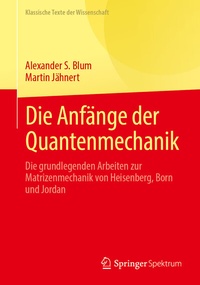
Die Anfänge der Quantenmechanik
Description

More details
Other editions
Additional editions
Persons
Die Kommentatoren
Alexander Blum ist Wissenschaftshistoriker und aktuell Leiter der Max-Planck-Forschungsgruppe Historical Epistemology of the Final Theory Program an den Max-Planck-Instituten für Wissenschaftsgeschichte (Berlin) und für Gravitationsphysik (Albert-Einstein-Institut Potsdam). Nach seiner Promotion in der Teilchenphysik forschte er zur Geschichte von Relativitätstheorie und Quantenphysik und verfasste u.a. das Buch Heisenberg's 1958 Weltformel and the Roots of Postempirical Physics .
Martin Jähnert ist Wissenschaftshistoriker und aktuell wissenschaftlicher Mitarbeiter in der Forschungsgruppe Historical Epistemology of the Final Theory Program (MPIWG). Er ist der Autor von Practicing the Correspondence Principle in the Old Quantum Theory : A Transformation through Implementation und hat - als Mitglied des Projekts History and Foundation of Quantum Physics , der TU Berlin, der Universität Regensburg und der Forschungsgruppe Historical Epistemology of the Final Theory Program (MPIWG) - zahlreiche Beiträge zur Geschichte der Quantenphysik geleistet.
Die Originalautoren
Werner Heisenberg (1901-1976), Max Born (1882-1970) und Pascual Jordan (1902-1980) waren bedeutende deutsche Physiker des 20. Jahrhunderts und gelten als Begründer der Quantenmechanik.
Content
Einleitung.- Quantentheorie bis 1924.- Heisenbergs Weg zur Umdeutung.- Elemente der Umdeutung.- Born, Jordan und die "Dreimännerarbeit".- Ausblick.- Heisenberg: "Über quantentheoretische Umdeutung kinematischer und mechanischer Beziehungen".- Born/Jordan: "Zur Quantenmechanik.".- Born/Heisenberg/Jordan: "Zur Quantenmechanik. II.".
