

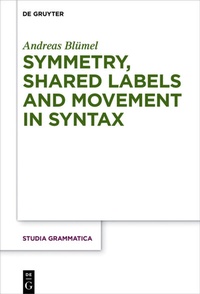
Symmetry, Shared Labels and Movement in Syntax
Description

What is the trigger for displacement phenomena in natural language syntax? And how can constraints on syntactic movement be derived from interface conditions and so-called Third Factor principles?
Within the Minimalist Program a standard answer to the first question is that it is driven by morphosyntactic features. This monograph challenges that view and suggests that the role of features in driving syntactic computation has been overestimated. Instead it proposes that "labeling" -- the detection of a prominent element in sets formed by Merge -- plays a role in driving transformations, and labeling itself is understood to derive from an interplay of efficient computation and the need for a label at the Conceptual-Intentional systems. It explores this idea in four empirical domains: Long-distance dependencies, Criterial Freezing-phenomena, nested dependencies and ATB-movement. The languages considered include English, German and Hebrew.
More details
Other editions
Additional editions
Person
Content
- Intro
- Contents
- Abbreviations
- 1. Preface
- 2. Introduction
- 2.1 Successive-cyclic Movement as intermediate labeling Indeterminacies
- 2.2 X-Immobility and Criterial Freezing
- 2.3 ATB involves Forked chains
- 3. Minimalist Reflections
- 3.1 Conceptual Underpinnings
- 3.2 On Movement as Internal Merge
- 4. Propagating Symmetry
- 4.1 The Syntax of Successive-Cyclic A-Movement
- 4.2 The Evidence
- 4.2.1 The successive Cyclicity Hypothesis within the Theory of Phases
- 4.3 Previous Analyses
- 4.3.1 Shortest Step Approaches
- 4.3.2 Moving-Element-driven Approaches
- 4.4 A Novel Approach to Successive-cyclic A-Movement
- 4.4.1 From PS-Grammar to a Labelless Bare Phrase Structure
- 4.5 Some Consequences and Extensions
- 4.5.1 On the Timing of Labeling and Bavarian wh-Questions
- 4.6 Summary
- 5. Shared Labels and Criterial Freezing
- 5.1 Introduction
- 5.2 Shared Labels and Full Interpretation
- 5.3 X-Immobility (XIM)
- 5.3.1 Introducing XIM
- 5.4 Criterial Freezing
- 5.4.1 Criterial Freezing and A-movement
- 5.4.2 Criterial Freezing and A-movement
- 5.5 Summary
- 6. In Defense of Forked chains
- 6.1 Introduction
- 6.1.1 A Word of Motivation
- 6.1.2 Organization of this Chapter
- 6.2 Properties of Coordination and ATB
- 6.2.1 General Properties of Coordination
- 6.2.2 General Properties of ATB
- 6.3 Previous Analyses
- 6.3.1 Asymmetric Analyses
- 6.3.2 Symmetric Analyses
- 6.3.3 A Hybrid Analysis - Ha 2007
- 6.4 The Current Analysis
- 6.4.1 Coordinative Core
- 6.4.2 ATB from the Coordinative Core
- 6.4.3 Splitting up CC
- 6.5 Open Issues and Remaining Questions
- 6.6 Summary
- 7. Summary and Outlook
- Bibliography
- Index
