

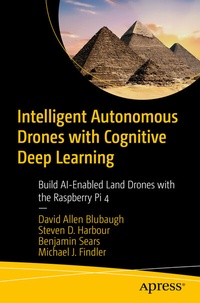
Intelligent Autonomous Drones with Cognitive Deep Learning
Build AI-Enabled Land Drones with the Raspberry Pi 4
Published on 31. October 2022
XVI, 511 pages
978-1-4842-6803-2 (ISBN)
Description

What is an artificial intelligence (AI)-enabled drone and what can it do? Are AI-enabled drones better than human-controlled drones? This book will answer these questions and more, and empower you to develop your own AI-enabled drone.
You'll progress from a list of specifications and requirements, in small and iterative steps, which will then lead to the development of Unified Modeling Language (UML) diagrams based in part to the standards established by for the Robotic Operating System (ROS). The ROS architecture has been used to develop land-based drones. This will serve as a reference model for the software architecture of unmanned systems.
Using this approach you'll be able to develop a fully autonomous drone that incorporates object-oriented design and cognitive deep learning systems that adapts to multiple simulation environments. These multiple simulation environments will also allow you to further build public trust in the safety of artificial intelligence within drones and small UAS. Ultimately, you'll be able to build a complex system using the standards developed, and create other intelligent systems of similar complexity and capability.
Intelligent Autonomous Drones with Cognitive Deep Learning uniquely addresses both deep learning and cognitive deep learning for developing near autonomous drones.
What You'll Learn
Who This Book IsFor
Primarily for engineers, computer science graduate students, or even a skilled hobbyist. The target readers have the willingness to learn and extend the topic of intelligent autonomous drones. They should have a willingness to explore exciting engineering projects that are limited only by their imagination. As far as the technical requirements are concerned, they must have an intermediate understanding of object-oriented programming and design.
You'll progress from a list of specifications and requirements, in small and iterative steps, which will then lead to the development of Unified Modeling Language (UML) diagrams based in part to the standards established by for the Robotic Operating System (ROS). The ROS architecture has been used to develop land-based drones. This will serve as a reference model for the software architecture of unmanned systems.
Using this approach you'll be able to develop a fully autonomous drone that incorporates object-oriented design and cognitive deep learning systems that adapts to multiple simulation environments. These multiple simulation environments will also allow you to further build public trust in the safety of artificial intelligence within drones and small UAS. Ultimately, you'll be able to build a complex system using the standards developed, and create other intelligent systems of similar complexity and capability.
Intelligent Autonomous Drones with Cognitive Deep Learning uniquely addresses both deep learning and cognitive deep learning for developing near autonomous drones.
What You'll Learn
- Examine the necessary specifications and requirements for AI enabled drones for near-real time and near fully autonomous drones
- Look at software and hardware requirements
- Understand unified modeling language (UML) and real-time UML for design
- Study deep learning neural networks for pattern recognition
- Review geo-spatial Information for the development of detailed mission planning within these hostile environments
Who This Book IsFor
Primarily for engineers, computer science graduate students, or even a skilled hobbyist. The target readers have the willingness to learn and extend the topic of intelligent autonomous drones. They should have a willingness to explore exciting engineering projects that are limited only by their imagination. As far as the technical requirements are concerned, they must have an intermediate understanding of object-oriented programming and design.
More details
Series
Edition
First Edition
Language
English
Place of publication
Berkeley
United States
Publishing group
APRESS
Target group
Professional and scholarly
Product notice
Reflowable
Illustrations
XVI, 511 p. 168 illus.
File size
15,85 MB
ISBN-13
978-1-4842-6803-2 (9781484268032)
DOI
10.1007/978-1-4842-6803-2
Schweitzer Classification
Other editions
Additional editions
David Allen Blubaugh | Steven D. Harbour | Benjamin Sears
Intelligent Autonomous Drones with Cognitive Deep Learning
Build AI-Enabled Land Drones with the Raspberry Pi 4
Book
11/2022
APress
€69.54
Shipment within 15-20 days
Persons
Dr. Stephen Harbour is an experienced technical adviser skilled in artificial intelligence, cognitive engineering, proposal writing, technical writing, research, and command. Harbour is a strong program and project management professional with a Doctor of Philosophy (PhD) focused in Cognitive Science from Northcentral University and teaches at the University of Dayton.
Benjamin Sears has an in-depth understanding of the theory behind drone missions and crew resource management. He also has applied experience as an actual drone pilot/operator who conducted missions as a civilian contractor in both Iraq and Afghanistan areas of operation.
Michael J. Findler is a computer science instructor at Wright State University with experience in working in embedded systems development projects. Mike Findler also has developed and worked on various different fields within the universe of artificial intelligence and will no doubt serve as an excellent source of information during the development of the fore-mentioned manuscript on applications of Cognitive Deep Learning for Autonomous Drones and Drone Missions.
David Allen Blubaugh has a decade of experience in applied engineering projects, embedded systems, design, computer science, and computer engineering.
Benjamin Sears has an in-depth understanding of the theory behind drone missions and crew resource management. He also has applied experience as an actual drone pilot/operator who conducted missions as a civilian contractor in both Iraq and Afghanistan areas of operation.
Michael J. Findler is a computer science instructor at Wright State University with experience in working in embedded systems development projects. Mike Findler also has developed and worked on various different fields within the universe of artificial intelligence and will no doubt serve as an excellent source of information during the development of the fore-mentioned manuscript on applications of Cognitive Deep Learning for Autonomous Drones and Drone Missions.
David Allen Blubaugh has a decade of experience in applied engineering projects, embedded systems, design, computer science, and computer engineering.
Content
Chapter 1. Rover Platform Overview. -Chapter 2. AI Rover System Design and Analysis.- Chapter 3. Installing Linux and Development Tools .- Chapter 4. Building a Simple Virtual Rover.- Chapter 5. Adding Sensors to Our Simulation.- Chapter 6. Sense and Avoidance.- Chapter 7. Navigation, SLAM, and Goals.- Chapter 8. OpenCV and Perception.- Chapter 9. Reinforced Learning.- Chapter 10. Subsumption Cognitive Architecture.- Chapter 11. Geospatial Guidance for AI Rover.- Chapter 12. Noetic ROS Further Examined and Explained.- Chapter 13. Further Considerations.- Appendix A: Bayesian Deep Learning.- Appendix B: Open AI Gym.- Appendix: Introduction to the Future of AI-ML Research.
