

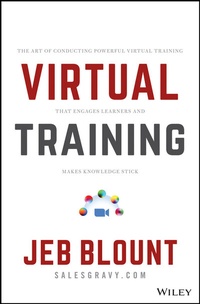
Virtual Training
Description

Remote learning has been around since the 18th century. Caleb Phillips began advertising correspondence courses in the Boston Gazette in 1728 allowing people, for the first time, to learn new skills no matter where they lived.
For the past 300 years, virtual training, in its various formats, has been meandering into shore on an inevitable yet slow building tide. And then, just like that, everything changed. A global pandemic. Social distancing. Working from home. In an instant, the tide became a tsunami.
The global pandemic accelerated the broad adoption of virtual instructor led training along with awareness that classroom-based training is often expensive, inefficient, and fails to deliver a fair return on investment. While it is certainly more challenging to re-create the collaborative environment of the physical classroom in a virtual setting, virtual training combines the structure, accountability, and social learning benefits of classroom training with speed, agility, and significant cost savings.
Simply put, virtual training enables organizations to rapidly upskill more people, while generating a far higher return on the training investment. Virtual training is also green. Studies indicate that virtual training consumes nearly 90% less energy and produces 85% fewer CO2 emissions than classroom training.
Still, the biggest challenge with virtual training, and the reason there has been so much resistance to it, is historically the experience has been excruciating. Not the quality of the curriculum or content. Not the talent of the trainer. The learning experience. There are few people who haven't had the pleasure of sitting through agonizing virtual training sessions. Death by voice over PowerPoint, delivered by a disengaged instructor, has an especially bitter flavor.
It is the way virtual training is delivered that matters most. When the virtual learning experience is emotionally positive:
- Participants are more engaged, embrace new competencies, and knowledge sticks
- Participants are more likely to show up to class and be open to future virtual training
- Trainers enjoy their work and gain fulfillment from making an impact
- Leaders book more virtual training
- Organizations more readily blend and integrate virtual training into learning & development initiatives
This is exactly what this book is about. Virtual Training is the definitive guide to delivering virtual training that engages learners and makes new skills and behavioral changes stick. Jeb Blount, one of the most celebrated trainers and authors of our generation, walks you step-by-step through the seven elements of effective, engaging virtual learning experiences.
- Trainer Mindset & Emotional Discipline
- Production & Technology
- Media & Visuals
- Virtual Curriculum & Instructional Design
- Planning & Preparation
- Virtual Communication Skills
- Dynamic & Interactive Training Delivery
As you dive into these powerful insights, and with each new chapter, you'll gain greater and greater confidence in your ability to effectively deliver training in a virtual classroom. Once you master virtual training delivery and experience the power of remote learning, you may never want to go back to the physical classroom again.
More details
Other editions
Additional editions
Person
JEB BLOUNT
is an acclaimed trainer and international bestselling author of thirteen books, including Virtual Selling, Fanatical Prospecting, Sales EQ, People Follow You, and Inked. Through his global training organization Sales Gravy, Jeb and his team help companies of all sizes accelerate sales productivity and revenue growth fast.Content
Foreword ix
Preface xiii
Special Note: Free Virtual Training Resources xvii
PART I The Virtual Training Tsunami 1
Chapter 1 Just Like That, Everything Changed 3
Chapter 2 Look Mom, I Built a Virtual Training Studio 9
Chapter 3 The Case for Virtual Training 15
Chapter 4 Experience Is Everything 21
Chapter 5 The Five Elements of a Legendary Virtual Learning Experience 25
PART II Mission and Mindset 31
Chapter 6 Mission and Mindset for a Legendary Virtual Learning Experience 33
Chapter 7 Emotional Discipline 43
Chapter 8 Rise Above Your Tech and Video Camera Phobia 49
Chapter 9 Good Enough Is Not Good Enough 55
PART III Production 61
Chapter 10 The Brain on Virtual Training 63
Chapter 11 The Essentials of Highly Effective Virtual Training Production 71
Chapter 12 Virtual Training Backdrop 83
Chapter 13 Live Switching 89
PART IV Virtual Communication Skills 101
Chapter 14 Be Video Ready 103
Chapter 15 Video Framing 109
Chapter 16 Body Language 115
Chapter 17 Eye Contact 121
PART V Design and Delivery 129
Chapter 18 Essentials of VILT Course Design 131
Chapter 19 Media and Visuals 147
Chapter 20 VILT Delivery Preparation 159
Chapter 21 Set the Rules 175
Chapter 22 Controlling the Virtual Classroom 181
Chapter 23 VILT Communication Plan 193
Chapter 24 The Fine Art of Engagement 207
Notes 229
Index 237
1
Just Like That, Everything Changed
An instant wave of panic came over me as I grasped the gravity of the situation. The Covid-19 pandemic had made its way around the world.
Two days earlier, I'd delivered a keynote to 6,000 people. I didn't know it then, but it would be the last time I'd walk onto a physical stage or into a physical classroom for almost a year.
Before Covid, my training and consulting company, Sales Gravy, had been on a hyper-growth trajectory. Our master trainers were on the ground delivering training on every continent except Antarctica.
The year before, I'd spent 311 nights in hotel rooms, clocking over 200,000 air miles as I crisscrossed the globe delivering keynotes, workshops, and trainings to a who's who of the most prestigious organizations in the world.
With the economy on fire and our company growing at an ever-increasing pace, my trainers and I were road warriors. Our training calendar was packed, and my sales team was inundated with calls and emails from even more companies that wanted to hire us. I was getting regular inquiries from venture capital and private equity firms that wanted to discuss potential investments. It felt like we were unstoppable.
And then, just like that, everything changed. A global pandemic. Travel bans. Social distancing. Working from home. Panic. In a heartbeat, we were grounded.
Educators, instructors, and trainers were confronting a harsh reality. Classrooms were empty and livelihoods were on the line. It was chaos and we were in an all-hands-on-deck battle to save our company.
I remember sitting down with my company's CFO to figure out how long we could keep paying our trainers if we lost all of our training contracts. My number one focus was saving the business while retaining the talented people on our team that we'd worked so hard to attract and develop.
Meanwhile, customers were ringing our phones off the hook. Most of our scheduled trainings in physical classrooms were being indefinitely postponed. Our account executives were working to calm our panicked clients long enough to move those deliveries to the virtual classroom. As entire companies shifted from working together in office buildings to working from home, the organizations we served were frantically seeking alternatives to classroom learning.
In the midst of this initial shock wave, large companies were laying off members of their learning and development teams. Out-of-work corporate trainers were contacting us in droves. They were looking for advice, a shoulder to cry on, and, mostly, jobs.
The entire education, training, learning, and development industry was being forced to instantly pivot from classroom-based training to virtual training. And most trainers and organizations were woefully unprepared.
History is full of transformational points in which smart, innovative people were pressed to invent technology that could help them meet the moment, but at least for those of us in the training world, the powerful, high-quality technology was right in front of us. All we needed to do was catch up.
The Remote Learning Tidal Wave
In those early months, virtual training felt entirely new. Legions of trainers, disoriented and unsettled, approached virtual training as if they were stumbling into an alien world on some distant planet.
Remote learning, instruction, and training, though, is not new. Correspondence courses have been advertised in newspapers since the early 1700s, when the United States was still a colony. The earliest on record was for a course in shorthand, a style of notetaking, that was placed in the Boston Gazette in 1728.
It took until the 1920s for colleges to start broadcasting courses over the radio, and by the 1950s, some universities offered courses over broadcast television. Thanks to teleconferencing, in 1976, Coastline Community College in California became the first fully virtual institution.
Then, the internet arrived and brought remote learning into a new era. As corporate learning, development, and enablement started investing in new technologies, online courses became mainstream. I took my first virtual instructor-led course in the late 1990s. It leveraged an online content portal and weekly conference calls (audio only) with the instructor.
By the early twenty-first century, video conferencing technology was ubiquitous-and virtual instruction and e-learning technology exploded. Massive investment in online learning by corporate and governmental organizations accelerated innovation even more. Over the past 20 years, there has been a 900 percent market growth rate for online learning.1
But there was a problem: Most of the investment was focused on self-directed, asynchronous e-learning. Those types of courses aren't instructor-led-meaning, students log on whenever they want, consume preassigned content, and do some assignments that may or may not be graded or reviewed by anyone. Students and instructors often don't interact, and there's only a limited student community, if there's any at all.
Despite these drawbacks, venture capitalists and investors have poured money into e-learning companies, and some e-learning platforms were snapped up by bigger organizations. LinkedIn, for example, paid $1.5 billion for Lynda.com.2
In the online learning boom of the past two decades, there was a massive focus on asynchronous e-learning, while synchronous virtual instructor-led training (VILT) was mostly treated as an afterthought. Even with all of the investment and attention focused on e-learning, only 10 percent of synchronous training delivery was virtual.3
Don't get me wrong. Plenty of people and technology entrepreneurs were thinking about it. The problem was that, in learning and development (L&D), virtual training was more likely to be talked about than actually delivered. (It didn't help when the initial excitement about massive open online courses (MOOCs) fizzled with a 94 percent abandonment rate.)4
My company was one of the few that had been delivering VILT programs since 2011. These deliveries almost always supplemented our in-person, classroom-based courses or simple broadcast-style webinars without substantial interaction. It was exceedingly rare that we'd teach an entire course in a purely virtual environment.
The primary reason was demand. Our clients and their learners did not want virtual instruction because they saw no value in virtual training.
My trainers didn't enjoy delivering virtual training, either. It wasn't fun or fulfilling. The virtual environment didn't offer the same emotional high, that juice you get when you walk into a classroom as an instructor. VILT was uncomfortable for them. They believed, as did our clients, that the only viable way to really teach people was face to face.
We were far more likely to get on an airplane and fly 20 hours to Singapore to deliver a two-day classroom-based course to participants who'd also flown in from various places across the globe than to teach those same students virtually. In those pre-Covid days, the virtual instruction we delivered was mostly on-screen PowerPoint slides accompanied with live voice-over. Because of this, we were not particularly proud of our VILTs, so we charged very little for them. That led us and our customers to view virtual training delivery as a low-value option, so we didn't actively pursue the sales of virtual training deliveries.
This was where we found ourselves as we entered the spring of 2020: Asynchronous e-learning was sexy. Synchronous face-to-face training was perceived as the most valuable. And virtual instructor-led training was a low-value afterthought. Then, everything changed.
For 300 years, remote learning had been meandering to shore on a slow-building tide. In 2020, it became a tsunami that washed away the foundational belief that in-person training was the only real way to teach people.
To remain relevant, trainers had to immediately shift the way we were delivering training and engaging learners. Likewise, learners, leaders, and entire organizations had to rethink their negative perceptions of virtual learning. The global coronavirus pandemic moved synchronous virtual instructor-led training into the spotlight and accelerated its broad adoption. VILT finally emerged from the shadows and met its moment.
As March rolled into April, my team at Sales Gravy was catching up fast, scrambling to hold onto our training contracts, retain our customers, and save our company.
The good news is we had two things going for us. First, we had already made significant investments in both technology and developing our competency to deliver high-quality virtual training. Second, our customers, trainers, and learners no longer had a choice. The only way to deliver and attend high-quality, interactive synchronous training was in a virtual classroom.
Notes
- 1 eLearn2grow, "62 eLearning Stats and Facts That You Need to Know Now," eLearn2grow, June 16, 2020, https://www.elearn2grow.com/2020/06/16/elearning-stats/.
- 2 Darrell Etherington, "LinkedIn to Buy Online Education Site Lynda.com for $1.5 Billion," TechCrunch, April 9, 2015, https://techcrunch.com/2015/04/09/linkedin-to-buy-online-education-site-lynda-com-for-1-5-billion/.
- 3 Cindy Huggett, "Is Your Organization Ready for the Future of Virtual...
