

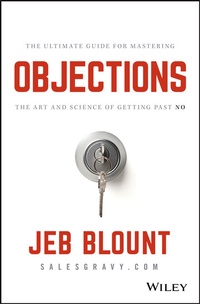
Objections
Description

Except for objections. There is democracy in objections. Every salesperson must endure many NOs in order to get to YES.
Objections don't care or consider:
* Who you are
* What you sell
* How you sell
* If you are new to sales or a veteran
* If your sales cycle is long or short - complex or transactional
For as long as salespeople have been asking buyers to make commitments, buyers have been throwing out objections. And, for as long as buyers have been saying no, salespeople have yearned for the secrets to getting past those NOs.
Following in the footsteps of his blockbuster bestsellers Fanatical Prospecting and Sales EQ, Jeb Blount's Objections is a comprehensive and contemporary guide that engages your heart and mind.
In his signature right-to-the-point style, Jeb pulls no punches and slaps you in the face with the cold, hard truth about what's really holding you back from closing sales and reaching your income goals. Then he pulls you in with examples, stories, and lessons that teach powerful human-influence frameworks for getting past NO - even with the most challenging objections.
What you won't find, though, is old school techniques straight out of the last century. No bait and switch schemes, no sycophantic tie-downs, no cheesy scripts, and none of the contrived closing techniques that leave you feeling like a phony, destroy relationships, and only serve to increase your buyers' resistance.
Instead, you'll learn a new psychology for turning-around objections and proven techniques that work with today's more informed, in control, and skeptical buyers. Inside the pages of Objections, you'll gain deep insight into:
* How to get past the natural human fear of NO and become rejection proof
* The science of resistance and why buyers throw out objections
* Human influence frameworks that turn you into a master persuader
* The key to avoiding embarrassing red herrings that derail sales calls
* How to leverage the "Magical Quarter of a Second" to instantly gain control of your emotions when you get hit with difficult objections
* Proven objection turn-around frameworks that give you confidence and control in virtually every sales situation
* How to easily skip past reflex responses on cold calls and when prospecting
* How to move past brush-offs to get to the next step, increase pipeline velocity, and shorten the sales cycle
* The 5 Step Process for Turning Around Buying Commitment Objections and closing the sale
* Rapid Negotiation techniques that deliver better terms and higher prices
As you dive into these powerful insights, and with each new chapter, you'll gain greater and greater confidence in your ability to face and effectively handle objections in any selling situation. And, with this new-found confidence, your success and income will soar.
More details
Other editions
Additional editions
Content
- Objections: The Ultimate Guide to Mastering the Art and Science of Getting Past NO
- Contents
- Foreword: The Democracy of Objections
- Introduction: It Wasn't Supposed To Be This Book
- Chapter 1: Asking-The Most Important Discipline in Sales
- The Discipline to Ask
- You Are Not Getting What You Want Because You Are Not Asking for What You Want
- Conjuring the Deepest, Darkest Human Fear
- There Is No Silver-Bullet Objection Slayer
- Chapter 2: How to Ask
- Emotional Contagion: People Respond in Kind
- The Assumptive Ask
- Shut Up
- Be Prepared for Objections
- Chapter 3: The Four Objections You Meet in a Deal
- Types of Objections
- Prospecting Objections
- Red Herrings
- Micro-Commitment Objections
- Buying Commitment Objections
- Objection Turnaround Frameworks
- Chapter 4: The Science of Resistance
- Buyers Don't Go to Objection School
- You Cannot Argue People into Believing They Are Wrong
- Objections Originate at the Emotional Level
- Cognitive Biases and Heuristics
- People Ignore Patterns
- Status Quo and Safety Biases
- Triggering the Negativity Bias
- Sunk-Cost Fallacy
- Ambiguity Bias and the Less-Is-Better Effect
- Cognitive Dissonance
- Pulling It All Together
- Chapter 5: Objections Are Not Rejection, But They Feel That Way
- Not the Same
- But It Feels the Same
- Chapter 6: The Science Behind the Hurt
- A Biological Response
- The Most Insatiable Human Need
- Chapter 7: The Curse of Rejection
- Sales Is an Unnatural Profession
- Fight or Flight-The Genesis of Disruptive Emotions
- Chapter 8: Rejection Proof
- The Seven Disruptive Emotions
- Develop Self-Awareness
- Positive Visualization
- Manage Self-Talk
- Change Your Physiology
- Stay Fit
- Push Pause with a Ledge
- The This-or-That Technique
- Obstacle Immunity
- Adversity Is Your Most Powerful Teacher
- Chapter 9: Avoiding Objections Is Stupid
- Get the Truth on the Table-Early and Often
- Are You the Decision Maker?
- Mapping Stakeholders
- BASICT
- Bringing Objections to the Surface
- Activating the Self-Disclosure Loop
- Deep Listening
- Chapter 10: Prospecting Objections
- When You Fail to Interrupt, You Fail
- The Rule of Thirds
- RBOs
- Reflex Responses
- Brush-Off
- True Objections
- Prospecting RBOs Can Be Anticipated in Advance
- Planning for Prospecting RBOs
- The Three-Step Prospecting Objection Turnaround Framework
- The Ledge
- Disrupt
- Ask
- Putting It All Together
- Bitch Just Hung Up in My Face
- Chapter 11: Yes Has a Number
- Sales Is Governed by Numbers
- Money Ball: It's All About the Ratios
- Changing Your Yes Number
- Chapter 12: Red Herrings
- Avoid Red Herring Objections
- PAIS
- Leveraging the Call Agenda Framework to Gain Control and Avoid Red Herrings
- Open
- Objective
- Check the Stakeholder's Agenda
- Control
- Chapter 13: Micro-Commitment Objections
- The Bane of Sales Organizations
- The Power of Micro-Commitments
- The Cardinal Rule of Sales Conversations
- The Origin of Micro-Commitment Objections
- The Three-Step Micro-Commitment Objection Turnaround Framework
- Ledge
- Explain Value
- Ask Again!
- Chapter 14: Buying Commitment Objections
- It's the Sales Process, Stupid: The Truth About Impossible Objections
- The Five-Step Objection Turnaround Framework
- Buying Commitment Objections Don't Fit into a Neat Box
- Relate
- Isolate
- Clarify
- Minimize
- A Pocket Full of Yeses
- Leveraging Social Proof to Minimize Objections
- Ask
- Putting It All Together
- Fall Back
- Chapter 15: Bending Win Probability in Your Favor
- Fanatical Prospecting
- Qualify, Qualify, Qualify
- Map the Account Stakeholders
- Leverage Precall Planning
- What You Already Know
- What You Want to Know
- Meeting Objectives and Targeted Next Steps
- The Confirmation Step
- Murder Boarding
- Practice and Run Through Scenarios
- Chapter 16: The Relentless Pursuit of Yes
- Success Is Paid for in Advance
- Never Let Anyone Tell You What You Can't Do
- Shaquem Can't Compete
- Stop Making Excuses for Why You Can't
- Notes
- Acknowledgments
- About the Author
- Training, Workshops, and Speaking
- Index
- End User License Agreement
1
Asking-The Most Important Discipline in Sales
Go for no.
-Andrea Waltz
Richard left 71 voice mail messages asking for an appointment. He sent 18 emails. He stalked me on LinkedIn.
He managed to get me to answer the phone on at least three occasions, but I brushed him off each time. He also called, and wrote, and connected on social media with each of the key stakeholders in my organization.
For five months Richard asked and asked and asked for an opportunity to demonstrate his software solution. And for five months, he got nowhere-until he finally caught me at the right time. It was in May, five months after his first attempt to set an appointment.
When I answered the phone, I recognized his voice. I almost brushed him off again, but since I didn't have anything else scheduled and he'd been so persistent, I felt a subconscious obligation to give him a chance.
Richard wasted no time getting me to agree to a demo. His software as a service (SaaS) solution was impressive, and it did solve one of our training delivery problems. I was transparent about how much I liked what he'd shown me. Less than an hour later, he asked for my commitment to buy.
Without thinking, I threw out an objection:
"Richard, it looks like a great program and I like it. But I'm going to need to discuss it with my team before we commit to anything. I know some of them have advocated for your platform, but my schedule is packed, and getting everyone up to speed and using it is going to be a distraction in the short term. I want to be sure we are all aligned before making this investment, because I don't want to buy yet another software program that everyone is excited about but never uses."
Richard responded by relating to my situation and clarifying my concern:
"Jeb, it sounds like you've been burned in the past with SaaS subscriptions that go unused. I get it! It feels like you're just pouring money down the drain.
"If I understand you correctly, it seems like your top concerns are: a) it's going to be a distraction training everyone, and b) if we don't get your team up to speed fast, they won't use it and it will be a wasted investment.
"Did I get that right?"
I agreed that those were my biggest concerns. It felt good that he really seemed to understand where I was coming from.
"Other than these two concerns, what else do we need to address?"
I responded that there was nothing else holding me back. Then he minimized my concern:
"The best way for your team to experience the power of our platform is to get their hands on it. What if I take the burden off you and take full responsibility for getting your team trained and making sure they are using it?
"With your blessing, I'll schedule a training call with your trainers and coaches to show them how to use the platform. I'll then monitor their usage and report back to you each week until we've integrated usage into their daily routine. That way it doesn't take any time out of your busy schedule, and you have the peace of mind that your money is well spent.
"Since this isn't a long-term commitment and you can quit anytime, if your team doesn't use the program we can shake hands and part ways. There isn't much to lose here and there's a lot to gain, so why don't we get your account set up, and let me make this easy for you?"
Before I knew it, he had my corporate AMEX card number and Sales Gravy was his newest customer.
The Discipline to Ask
Asking is the most important discipline in sales. You must ask for what you want, directly, assumptively, assertively, and repeatedly. Asking is the key that unlocks:
- Qualifying information
- Appointments
- Demos
- Leveling up to decision makers or down to influencers
- Information and data for building your business case
- Next steps
- Micro-commitments
- Buying commitments
In sales, asking is everything. If you fail to ask, you'll end up carrying a box full of the stuff from your desk to your car on the way to the unemployment line. Your income will suffer. Your career will suffer. Your family will suffer. You will suffer.
When you fail to ask, you fail.
It's the truth and this truth will not change. But as my favorite line from the movie The Big Short goes, "The truth is like poetry. And most people fucking hate poetry."
You Are Not Getting What You Want Because You Are Not Asking for What You Want
If you are having a hard time getting the next appointment, getting to decision makers, getting information from stakeholders, leveling up higher in the organization, or closing the deal, it's not because you lack prospecting skills, closing skills, the right words to say, or tactics for getting past the inevitable objections.
Nope, you are not getting what you want because you are not asking for what you want. Why? Nine times out of ten you are insecurely and passively beating around the bush because you are afraid to hear the word no.
In this state, confident and assumptive asking gets replaced with wishing, hoping, and wanting. You hesitate and use weak, passive words. Your tone of voice and body language exude insecurity and desperation. You wait for your prospect to do your job for you and set the appointment, set the next step, or close the deal themselves.
But they don't.
Instead, they resist and push back with objections. They put you off, brush you off, turn you off, and sometimes steamroll right over you. Your passive, insecure, fearful behavior only serves to encourage more resistance and rejection.
In sales, passive doesn't work. Insecurity won't play. Wishing and hoping is not a viable strategy.
Only direct, confident, assumptive asking gets you what you want.
Conjuring the Deepest, Darkest Human Fear
Asking with confidence is one of the most difficult things for humans to do. The assumptive ask requires you to put it all out there and take an emotional risk, with no guarantees. When you ask with confidence, you make yourself instantly vulnerable, with no place to take cover.Vulnerability, according to Dr. Brene Brown, author of the Power of Vulnerability, is created in the presence of uncertainty, risk, and emotional exposure. This vulnerability conjures up the deepest and darkest of human fears: Rejection.
Leading up to your ask, everything in your body and mind are screaming at you to stop as the anticipation of being rejected generates this deep sense of vulnerability. Rejection is a painful demotivator and the genesis of deep-rooted fear.
The fear and avoidance of the emotional pain caused by rejection is why most people seek the easy way out. It's the top reason why sales professionals fail to reach their true potential and income. The fear of rejection is the most treacherous disruptive emotion for salespeople.
There Is No Silver-Bullet Objection Slayer
For as long as salespeople have been asking buyers to make commitments, buyers have been throwing out objections; and, as long as buyers have been saying no, salespeople have yearned for the secrets to getting past no.
Salespeople are obsessed with shortcuts and silver bullets that will miraculously deliver yeses without the risk of rejection. This is exactly why so many of the questions I get about dealing with objections begin with: "What's the trick for.," or "Can you tell me the secret to.," or "What words can I say that will get them to say yes?"
Salespeople seek techniques for avoiding no in the same vein that golfers pursue the perfect putter. And there is an endless line of pseudo-experts, gurus, and artificial-intelligence witch doctors who pander to the deep insecurities of vulnerable salespeople with false and dangerous claims that they have the secret to the ever-present mystery of how to eliminate rejection.
Let's get this straight from the get-go: These charlatans, most of whom couldn't sell their way out of a paper bag, are just dead wrong.
- There is no perfect putter that will take 20 strokes off your game overnight.
- There is no easy button that will close the deal every time.
- There is no magic fairy dust that will take the sting out of rejection.
- There are no silver-bullet words that will slay objections and stun prospects into submission.
- There are no perfect scripts that will turn no into yes, every time.
- Artificial intelligence and software programs will not close the deal for you.
- There are no unicorns.
Here are two brutal, and undeniable, truths (and we already know how people feel about the truth):
- The only way to eliminate rejection is to never ask for anything again. Ever!
- To be successful in sales, you must ditch your wishbone and grow a backbone.
Everything in sales begins with and depends on the discipline to ask.
Author's Note
Throughout the book I use the terms "stakeholder,"...
