

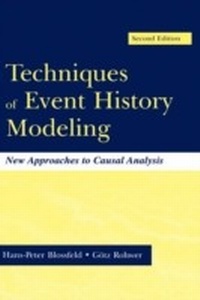
Techniques of Event History Modeling
New Approaches to Casual Analysis
2nd Edition
Published on 1. September 2001
320 pages
978-1-135-63912-9 (ISBN)
Description

Including new developments and publications which have appeared since the publication of the first edition in 1995, this second edition:
*gives a comprehensive introductory account of event history modeling techniques and their use in applied research in economics and the social sciences;
*demonstrates that event history modeling is a major step forward in causal analysis. To do so the authors show that event history models employ the time-path of changes in states and relate changes in causal variables in the past to changes in discrete outcomes in the future; and
*introduces the reader to the computer program Transition Data Analysis (TDA). This software estimates the sort of models most frequently used with longitudinal data, in particular, discrete-time and continuous-time event history data.
Techniques of Event History Modeling can serve as a student textbook in the fields of statistics, economics, the social sciences, psychology, and the political sciences. It can also be used as a reference for scientists in all fields of research.
*gives a comprehensive introductory account of event history modeling techniques and their use in applied research in economics and the social sciences;
*demonstrates that event history modeling is a major step forward in causal analysis. To do so the authors show that event history models employ the time-path of changes in states and relate changes in causal variables in the past to changes in discrete outcomes in the future; and
*introduces the reader to the computer program Transition Data Analysis (TDA). This software estimates the sort of models most frequently used with longitudinal data, in particular, discrete-time and continuous-time event history data.
Techniques of Event History Modeling can serve as a student textbook in the fields of statistics, economics, the social sciences, psychology, and the political sciences. It can also be used as a reference for scientists in all fields of research.
Reviews / Votes
"Techniques of Event History Modeling fully attains both goals, showing the usefulness of event history modeling as a new approach to causal modeling and being an introduction to the program TDA. The book deserves the attention of researchers from the field of OB, although - or better: because - it offers a somewhat different perspective on social processes."-Rainier, Hampp, Verlag "Techniques of Event History Modeling fully attains both goals, showing the usefulness of event history modeling as a new approach to causal modeling and being an introduction to the program TDA. The book deserves the attention of researchers from the field of OB, although - or better: because - it offers a somewhat different perspective on social processes."
-Rainier, Hampp, Verlag
More details
Edition
2nd edition
Language
English
Place of publication
London
United Kingdom
Publishing group
Taylor & Francis Ltd
Target group
Professional and scholarly
Edition type
Revised edition
File size
14,64 MB
ISBN-13
978-1-135-63912-9 (9781135639129)
Copyright in bibliographic data and cover images is held by Nielsen Book Services Limited or by the publishers or by their respective licensors: all rights reserved.
Schweitzer Classification
Other editions
Additional editions
Hans-Peter Blossfeld | G"tz Rohwer
Techniques of Event History Modeling
New Approaches to Casual Analysis
Book
09/2001
2nd Edition
Psychology Press
€193.50
Shipment within 10-20 days
Hans-Peter Blossfeld | G"tz Rohwer
Techniques of Event History Modeling
New Approaches to Casual Analysis
Book
09/2001
2nd Edition
Psychology Press
€77.50
Shipment within 10-20 days
Persons
G"tz Rohwer, Hans-Peter Blossfeld
Content
Contents: Preface. Introduction. Event History Data Structures. Nonparametric Descriptive Methods. Exponential Transition Rate Models. Piecewise Constant Exponential Models. Exponential Models With Time-Dependent Covariates. Parametric Models of Time-Dependence. Methods to Check Parametric Assumptions. Semi-Parametric Transition Rate Models. Problems of Model Specification. Appendix: Basic Information About TDA.
