

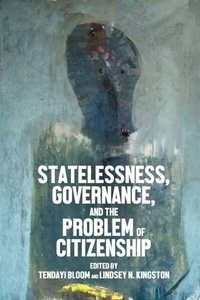
Statelessness, Governance, and the Problem of Citizenship
1st Edition
Published on 12. October 2021
400 pages
978-1-5261-5640-2 (ISBN)
Description

When a person is not recognised as a citizen anywhere, they are typically referred to as 'stateless'. This can give rise to challenges both for individuals and for the institutions that try to govern them. Statelessness, governance, and the problem of citizenship breaks from tradition by relocating the 'problem' to be addressed from one of statelessness to one of citizenship. It problematises the governance of citizenship - and the use of citizenship as a governance tool - and traces the 'problem of citizenship' from global and regional governance mechanisms to national and even individual levels.
With contributions from activists, affected persons, artists, lawyers, academics, and national and international policy experts, this volume rejects the idea that statelessness and stateless persons are a problem. It argues that the reality of statelessness helps to uncover a more fundamental challenge: the problem of citizenship. -- .
With contributions from activists, affected persons, artists, lawyers, academics, and national and international policy experts, this volume rejects the idea that statelessness and stateless persons are a problem. It argues that the reality of statelessness helps to uncover a more fundamental challenge: the problem of citizenship. -- .
Reviews / Votes
'Statelessness, governance, and the problem of citizenship manifests an extraordinary breadth of empirical and theoretical research emerging in the hiatus between social criticism, anthropology, international relations as well as domestic and international law. The research, with concrete examples from many countries, destabilises traditional state-centric approaches to nationality laws, national identity, a globalizing economy, and international regulatory governance. Taken as a whole, the book has succeeded in providing a voice to diverse silenced groups throughout the globe.'William E. Conklin, Professor of Law, University of Windsor, and author of Statelessness: The Enigma of the International Community
'A remarkable compendium on a vastly under-researched topic, illustrating the complex ways through which one loses or never obtains a citizenship, a concept which used to signify emancipation and has become a tool of exclusion and a governance "problem". Indeed, despite exceptions, the book probes the depth of the populist nationalism which infects many polities and uses nationality, immigration and security standards to ever more restrictively define who is "in", despite harsh consequences for the excluded.'
Francois Crepeau, Hans and Tamar Oppenheimer Professor of Public International Law at McGill University and former Special Rapporteur on the Human Rights of Migrants, OHCHR (2011-17)
'This important book critically explores the challenge of statelessness, while flipping the narrative, changing the point of departure, investigating deeper and engaging the reader through the wide-ranging perspectives, voices and experiences on offer. Statelessness - often viewed as the "problem" to be solved - is explored through this book as a symptom of a much deeper set of historically rooted challenges: of citizenship, governance and discrimination. The wide range of contributors from around the world who have all encountered statelessness in different ways (lived experience, academic research, creative endeavour and policy engagement) and the broad scope of the research and analysis on offer, showcases the sheer ambition of this project. The sensitivity and thoughtfulness with which difficult human rights issues are unpacked, is a testament to the skill of the editors and contributors, for not losing sight of what is truly important. This book should be read by all those working on citizenship rights and statelessness, but also by students of history, governance, human rights and social justice.'
Amal de Chickera, Co-founder and Co-director of the Institute on Statelessness and Inclusion
'This exciting new book seeks to understand the "messy reality" of "the structures that move people into or out of recognition." It powerfully highlights, and will make a vital contribution to, our understanding the complex relationship between citizenship and statelessness. More than this though, it imagines a world in which people are empowered no matter their citizenship status. The editors have assembled a truly diverse, interdisciplinary, and global set of contributors, who together offer a deeply nuanced and pluralistic interrogation of the problems of citizenship. Statelessness, governance, and the problem of citizenship will be an important read for anyone interested in the problems of citizenship.'
Kelly Staples, Associate Professor of International Politics, University of Leicester, and author of Retheorising Statelessness
'This book is must read for anyone who, regardless of his or her intellectual endeavours, believes that all Creation, no matter the place and who lives there, is Sacred.'
Carimo Mohomed, The Muslim World Book Review Volume 43 Issue No 4 -- .
All prices
More details
Language
English
Place of publication
United Kingdom
Target group
College/higher education
Professional and scholarly
Illustrations
7 black & white illustrations
ISBN-13
978-1-5261-5640-2 (9781526156402)
Copyright in bibliographic data and cover images is held by Nielsen Book Services Limited or by the publishers or by their respective licensors: all rights reserved.
Schweitzer Classification
Other editions
Additional editions
Tendayi Bloom | Lindsey N. Kingston
Statelessness, Governance, and the Problem of Citizenship
Book
04/2023
Manchester University Press
€40.10
Shipment within 15-20 days
Tendayi Bloom | Lindsey N. Kingston
Statelessness, Governance, and the Problem of Citizenship
Book
09/2021
Manchester University Press
€135.70
Shipment within 15-20 days
Persons
Tendayi Bloom is a Lecturer in Politics and International Studies at the University of Birmingham
Lindsey N. Kingston is Associate Professor of International Human Rights at Webster University in Saint Louis, Missouri -- .
Lindsey N. Kingston is Associate Professor of International Human Rights at Webster University in Saint Louis, Missouri -- .
Content
A Stateless Poem - Danielle Legros Georges
Introduction: Opening a conversation about statelessness, governance, and the problem of citizenship - Tendayi Bloom and Lindsey N. Kingston
Part I: Producing and maintaining statelessness
Figure 1 New Democracy II - Shabu Mwangi
1 The problem of citizenship in global governance - Tendayi Bloom
2 'Fonua' cultural statelessness in the Pacific and the effects of climate change - Kate Wilkinson Cross and Pefi Kingi
3 A regional politics of foreignness and Pakistan's Afghan refugees - Anoshay Fazal
4 The statelessness of refugees - Jason Tucker
Figure 2 Dissolution of the moonbeam union - Mawa Rannahr
5 Statelessness and the administrative state: The legal prowess of the first-line bureaucrat in Malaysia - Jamie Chai Yun Liew
6 Language and statelessness: The impact of political discourses on the Bidoon community in Kuwait - Ahmad Benswait
7 The weaponisation of citizenship: Punishment, erasure, and social control - Lindsey N. Kingston
8 Statelessness and governance in the absence of recognition: The case of the 'Donetsk People's Republic' - Nataliia Kasianenko
9 Legal identity and rebel governance: A comparative perspective on lived consequence of contested sovereignty - Katharine Fortin, Bart Klem, and Marika Sosnowski
Part II: Living with the problem of citizenship
Figure 3 Obsession - Manal Deeb
10 Transnational surrogacy, biocitizenship, and statelessness: India's response to the 'ghosts of the republic' - Pragna Paramita Mondal
11 The birth certificate as fetish object in the governance of citizenship and its presumed sex and gender norms - Jan Lukas Buterman
12 Seeking 'a right to belong': A stateless Shan youth's journey to citizenship in northern Thailand - Janepicha Cheva-Isarakul
13 Being excluded or excluding yourself?: Citizenship choices among stateless youth in Estonia - Maarja Vollmer
Figure 4 Letter - Karina Gareginovna Ambartsoumian- Clough
14 Statelessness and governance at the periphery: 'Nomadic' populations and the modern state in Thailand, Cote d'Ivoire, and Lebanon - Christoph Sperfeldt
15 Ageing and stateless: Non-decisionism and state violence across temporal and geopolitical space from Bhutan to the United States - Odessa Gonzalez Benson, Yoosun Park, Francis Tom Temprosa, and Dilli Gautam
16 Asking the 'other questions': Applying intersectionality to understand statelessness in Europe - Deirdre Brennan, Nina Murray, and Allison J. Petrozziello
Part III: Rethinking governance
Figure 5 I don't recognize me in the shadows - Thana Faroq
17 The ethics of quantifying statelessness - Heather Alexander
18 Registering persons at risk of statelessness in Kenya: Solutions or further problems? - Edwin O. Abuya
19 Too little too late? Naturalisation of stateless Kurds and transitional justice in Syria - Haqqi Bahram
20 Statelessness elimination through legal fiction: The United Arab Emirates' Comorian minority - Yoana Kuzmova
Figure 6 All faces - Arison Kul
21 Supra-national jurisprudence: Necessary but insufficient to contest statelessness in the Dominican Republic - Bridget Wooding
22 'Civil society advocacy: Using norms to promote progress on the Global Action Plan to End Statelessness - Melissa Schnyder
23 The construction of a Brazilian 'hospitality policy' and the adoption of a new legal framework for stateless persons - Thiago Assuncao
24 Ideological governance of citizen and non-citizen others in Kuwait - Areej Alshammiry
25 'We are not stateless! You can call us what you like, but we are citizens of Myanmar!': Rohingya resistance and the stateless label - Natalie Brinham
26 United Stateless in the United States: Reflections from an activist - Ekaterina E
Figure 7 We are not immigrants - Fred Kuwornu
Index -- .
Introduction: Opening a conversation about statelessness, governance, and the problem of citizenship - Tendayi Bloom and Lindsey N. Kingston
Part I: Producing and maintaining statelessness
Figure 1 New Democracy II - Shabu Mwangi
1 The problem of citizenship in global governance - Tendayi Bloom
2 'Fonua' cultural statelessness in the Pacific and the effects of climate change - Kate Wilkinson Cross and Pefi Kingi
3 A regional politics of foreignness and Pakistan's Afghan refugees - Anoshay Fazal
4 The statelessness of refugees - Jason Tucker
Figure 2 Dissolution of the moonbeam union - Mawa Rannahr
5 Statelessness and the administrative state: The legal prowess of the first-line bureaucrat in Malaysia - Jamie Chai Yun Liew
6 Language and statelessness: The impact of political discourses on the Bidoon community in Kuwait - Ahmad Benswait
7 The weaponisation of citizenship: Punishment, erasure, and social control - Lindsey N. Kingston
8 Statelessness and governance in the absence of recognition: The case of the 'Donetsk People's Republic' - Nataliia Kasianenko
9 Legal identity and rebel governance: A comparative perspective on lived consequence of contested sovereignty - Katharine Fortin, Bart Klem, and Marika Sosnowski
Part II: Living with the problem of citizenship
Figure 3 Obsession - Manal Deeb
10 Transnational surrogacy, biocitizenship, and statelessness: India's response to the 'ghosts of the republic' - Pragna Paramita Mondal
11 The birth certificate as fetish object in the governance of citizenship and its presumed sex and gender norms - Jan Lukas Buterman
12 Seeking 'a right to belong': A stateless Shan youth's journey to citizenship in northern Thailand - Janepicha Cheva-Isarakul
13 Being excluded or excluding yourself?: Citizenship choices among stateless youth in Estonia - Maarja Vollmer
Figure 4 Letter - Karina Gareginovna Ambartsoumian- Clough
14 Statelessness and governance at the periphery: 'Nomadic' populations and the modern state in Thailand, Cote d'Ivoire, and Lebanon - Christoph Sperfeldt
15 Ageing and stateless: Non-decisionism and state violence across temporal and geopolitical space from Bhutan to the United States - Odessa Gonzalez Benson, Yoosun Park, Francis Tom Temprosa, and Dilli Gautam
16 Asking the 'other questions': Applying intersectionality to understand statelessness in Europe - Deirdre Brennan, Nina Murray, and Allison J. Petrozziello
Part III: Rethinking governance
Figure 5 I don't recognize me in the shadows - Thana Faroq
17 The ethics of quantifying statelessness - Heather Alexander
18 Registering persons at risk of statelessness in Kenya: Solutions or further problems? - Edwin O. Abuya
19 Too little too late? Naturalisation of stateless Kurds and transitional justice in Syria - Haqqi Bahram
20 Statelessness elimination through legal fiction: The United Arab Emirates' Comorian minority - Yoana Kuzmova
Figure 6 All faces - Arison Kul
21 Supra-national jurisprudence: Necessary but insufficient to contest statelessness in the Dominican Republic - Bridget Wooding
22 'Civil society advocacy: Using norms to promote progress on the Global Action Plan to End Statelessness - Melissa Schnyder
23 The construction of a Brazilian 'hospitality policy' and the adoption of a new legal framework for stateless persons - Thiago Assuncao
24 Ideological governance of citizen and non-citizen others in Kuwait - Areej Alshammiry
25 'We are not stateless! You can call us what you like, but we are citizens of Myanmar!': Rohingya resistance and the stateless label - Natalie Brinham
26 United Stateless in the United States: Reflections from an activist - Ekaterina E
Figure 7 We are not immigrants - Fred Kuwornu
Index -- .
