

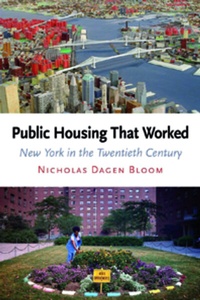
Public Housing That Worked
New York in the Twentieth Century
1st Edition
Published on 4. August 2014
368 pages
978-0-8122-0132-1 (ISBN)
Description

When it comes to large-scale public housing in the United States, the consensus for the past decades has been to let the wrecking balls fly. The demolition of infamous projects, such as Pruitt-Igoe in St. Louis and the towers of Cabrini-Green in Chicago, represents to most Americans the fate of all public housing. Yet one notable exception to this national tragedy remains. The New York City Housing Authority, America's largest public housing manager, still maintains over 400,000 tenants in its vast and well-run high-rise projects. While by no means utopian, New York City's public housing remains an acceptable and affordable option.
The story of New York's success where so many other housing authorities faltered has been ignored for too long. Public Housing That Worked shows how New York's administrators, beginning in the 1930s, developed a rigorous system of public housing management that weathered a variety of social and political challenges. A key element in the long-term viability of New York's public housing has been the constant search for better methods in fields such as tenant selection, policing, renovation, community affairs, and landscape design.
Nicholas Dagen Bloom presents the achievements that contradict the common wisdom that public housing projects are inherently unmanageable. By focusing on what worked, rather than on the conventional history of failure and blame, Bloom provides useful models for addressing the current crisis in affordable urban housing. Public Housing That Worked is essential reading for practitioners and scholars in the areas of public policy, urban history, planning, criminal justice, affordable housing management, social work, and urban affairs.
The story of New York's success where so many other housing authorities faltered has been ignored for too long. Public Housing That Worked shows how New York's administrators, beginning in the 1930s, developed a rigorous system of public housing management that weathered a variety of social and political challenges. A key element in the long-term viability of New York's public housing has been the constant search for better methods in fields such as tenant selection, policing, renovation, community affairs, and landscape design.
Nicholas Dagen Bloom presents the achievements that contradict the common wisdom that public housing projects are inherently unmanageable. By focusing on what worked, rather than on the conventional history of failure and blame, Bloom provides useful models for addressing the current crisis in affordable urban housing. Public Housing That Worked is essential reading for practitioners and scholars in the areas of public policy, urban history, planning, criminal justice, affordable housing management, social work, and urban affairs.
Reviews / Votes
"Highly recommended."-Choice"While high-rise public housing in the United States is widely regarded as a disaster, the experiment in New York City has thrived for more than seventy years. Nicholas Bloom's well-written, well-researched, and well-illustrated work provides the most sophisticated answers yet to this American paradox."-Kenneth T. Jackson, Columbia University
"Nicholas Dagen Bloom's bold thesis is powerfully argued and effectively overturns much received wisdom about the history of public housing in the United States. This well researched and clearly written book will undoubtedly trigger a fierce debate both among historians and those interested in current housing policy."-Robert Bruegmann, author of Sprawl: A Compact History
"In Public Housing That Worked, Nicholas Dagen Bloom offers the best examination to date of the origins, choices, mistakes, and management of the New York City Housing Authority from its beginnings in the 1930s up through the present. He stresses effective management as the principal reason behind why the city's public stock of housing has survived in decent condition while scores of projects across the country have been demolished. The book should be essential reading for planners and policy analysts seeking a detailed look inside how and why New York's public housing became a notable if controversial exception."-John Goering, Baruch College and CUNY Graduate Center and former HUD project manager
More details
Language
English
Place of publication
Pennsylvania
United States
Target group
College/higher education
Illustrations
33 illus.
33 illus.
ISBN-13
978-0-8122-0132-1 (9780812201321)
Copyright in bibliographic data and cover images is held by Nielsen Book Services Limited or by the publishers or by their respective licensors: all rights reserved.
Schweitzer Classification
Other editions
Additional editions
Book
02/2009
University of Pennsylvania Press
€33.00
Shipment within 10-20 days
Person
Nicholas Dagen Bloom is Chair of Interdisciplinary Studies at the New York Institute of Technology and author of Merchant of Illusion: James Rouse, America's Salesman of the Businessman's Utopia.
Content
- Cover
- Half-title
- Title
- Copyright
- Dedication
- Contents
- Introduction
- Part I: Model Housing as a Municipal Service
- 1 Defining a Housing Crisis
- European Envy
- Diffusing the Opposition
- Institutionalizing Housing
- First Lessons
- What NYCHA Learned from the PWA
- 2 Three Programs Are Better Than One
- The USHA and the New York City Housing Authority
- Pioneering the State and City Programs
- 3 High-Rise Public Housing Begins
- Searching for the Minimum
- Estates for the People: Landscaping Public Housing
- Rethinking Slum Clearance
- 4 Model Tenants for Model Housing
- The Red Hook Row
- The Complexion of Housing
- Early Mistakes Elsewhere
- 5 Tightly Managed Communities
- Part II: Transforming Postwar New York
- 6 The Boom Years
- Harsh Medicine: Prescription for a Moses-Free Authority
- Housing Deceleration
- 7 Designs for a New Metropolis
- Paired for Mixture
- Tower-block Designs
- Selective Hearing: The Critics Speak
- The Unstoppable Superblock
- Shoddy versus Economical Development
- 8 The Price of Design Reform
- A Fresh Design Vision
- Postwar Landscape Design: From Passive to Active Recreation
- 9 The Benefits of Social Engineering
- 10 Meeting the Management Challenge
- The NYCHA System
- A Necessary Evil: Police Power in Public Housing Communities
- Building Community in the Postwar Era
- Failing the Management Challenge
- Part III: Welfare-State Public Housing
- 11 Surviving the Welfare State
- Opening the Welfare Gates
- The Aftermath
- 12 The Value of Consistency
- Soldiering On
- Trial by Fire: Housing Police Face the Enemy Within
- Community Programs
- NYCHA under the Microscope
- Part IV: Affordable Housing
- 13 Model Housing Revisited
- Matching a New Mood
- Rewards for Renovation
- The New (Electronic) Eyes on the Street
- Hope VI Deferred
- A Century of Public Housing?
- Appendix A: Guide to Housing Developments
- Appendix B: Tenant Selection Policies and Procedures
- Notes
- Index
- Acknowledgments
