

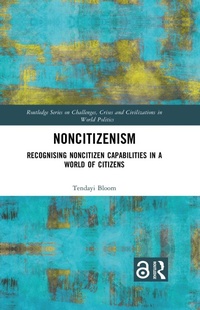
Noncitizenism
Recognising Noncitizen Capabilities in a World of Citizens
Published on 25. October 2017
234 pages
978-1-351-68980-9 (ISBN)
Description

Noncitizens have always been present in liberal political philosophy. Often hard to situate within traditional frameworks that prioritise citizenship, noncitizens can appear voiceless and rightsless, which has implications for efforts towards global justice and justice in migration. This book proposes an alternative.
Noncitizenism identifies an analytical category of noncitizenship. While maintaining the importance of citizenship, noncitizenship is another form of special individual-State relationship. It operates far from a State, at its borders, and within its territory, providing a tool for examining the continuity between sites of engagement and the literatures, questions, and conclusions relating to them. The book argues that an accurate liberal theoretical framework, and one which can address contemporary challenges, must acknowledge the political relationship of noncitizenship between individuals and States.
This book is for students and scholars of political philosophy and for those interested in noncitizenship and how it can inform the response of liberal theory, citizenship, global justice, migration studies, political theory and policy work.
Noncitizenism identifies an analytical category of noncitizenship. While maintaining the importance of citizenship, noncitizenship is another form of special individual-State relationship. It operates far from a State, at its borders, and within its territory, providing a tool for examining the continuity between sites of engagement and the literatures, questions, and conclusions relating to them. The book argues that an accurate liberal theoretical framework, and one which can address contemporary challenges, must acknowledge the political relationship of noncitizenship between individuals and States.
This book is for students and scholars of political philosophy and for those interested in noncitizenship and how it can inform the response of liberal theory, citizenship, global justice, migration studies, political theory and policy work.
Reviews / Votes
'It takes a bold thinker to introduce a new term into the thicket of contemporary discussions of citizenship, migration and belonging. Tendayi Bloom does this with her ambitious concept of noncitzenism. She presents noncitizenship as a unifying analytic category that describes a particular relationship between individuals and States. Her claim is that the relationship deserves attention because of its special consequences for the rights of affected individuals, irrespective of their particular type of noncitizenship. Cogently argued and lucidly written, this impressive book is both a valuable addition to the literature on one of the major political challenges of our times, and a stimulating provocation for constituencies actively engaged in contesting the many injustices it describes.' - Jacqueline Bhabha, Harvard University, USA.'By documenting critical social movements this book illustrates how the rights of noncitizens are being constituted as a site of political struggle. It is a brilliant book that restores political agency to noncitizens in (liberal) theory - something that states resist in (illiberal) practices.' - Engin Isin, Queen Mary University of London, UK.
'This book is a timely challenge to 'methodological citizenism' - the assumption that all political thinking has to be structured around citizenship. Against this, it poses the idea of noncitizenship, rather than non-citizenship. Drawing on a wide range of resources, it points the way forward, offering a vision of what liberal theory and practice could look like if they were to break out of the state-citizen relationship. And it stands as an urgent warning that, if they are to remain relevant to the project of social justice, then they must embrace the category of the noncitizen as an essential part of the liberal framework. It is essential reading for anybody concerned with the contradictions of national membership and global justice.' - Phillip Cole, University of the West of England, UK.
'...Noncitizenism is an ambitious and radical work, yet it is also careful and nuanced... Bloom presents a significant and timely proposal for a liberal theory of justice which can better account for the rights of noncitizens and one which is situated in a growing field of attention to noncitizenship studies that challenges us to look beyond the disciplinary orthodoxies of liberal theory itself.' - Katherine Tonkiss, Aston University, UK. Review in Migration Studies, May 2018.
'...Noncitizenism is a valuable addition to a variety of fields: from global justice, migration, human rights, and citizenship studies to political theory and social movement scholarship. Its core argument that the state has obligations toward individuals (not just "citizens") when it impairs their ability to be fully flourishing agents is one that resonates with anyone who believes in the equal treatment of, and the provision of conditions of autonomy for, people regardless of who and where they are.' - Kristy A. Belton, International Studies Association. Review in Migration and Society: Advances in Research 2, 2019.
More details
Series
Language
English
Place of publication
London
United Kingdom
Publishing group
Taylor & Francis Ltd
Target group
College/higher education
Illustrations
1 Tables, black and white; 18 Halftones, black and white; 18 Illustrations, black and white
File size
14,79 MB
ISBN-13
978-1-351-68980-9 (9781351689809)
Copyright in bibliographic data and cover images is held by Nielsen Book Services Limited or by the publishers or by their respective licensors: all rights reserved.
Schweitzer Classification
Other editions
Additional editions
Book
12/2019
1st Edition
Routledge
€68.30
Shipment within 15-20 days
Book
11/2017
1st Edition
Routledge
€215.41
Shipment within 10-20 days
Person
Tendayi Bloom is Lecturer in Politics and International Studies at The Open University, UK.
Content
1. Introduction 2. Noncitizenism 3. Theoretical Error, Real-World Problems 4. Introducing 'Unwanted' Noncitizens 5. Banal Dehumanisation 6. Unwanted and Ambivalent Citizenship 7. Noncitizens Overseas and Migration 8. Activating Noncitizenship 9. Dynamic Capabilities 10. Learning from Feminism 11. Global Challenges to Citizenism
