

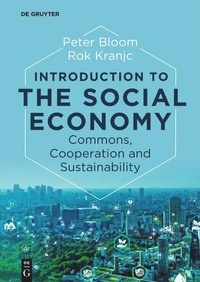
Introduction to the Social Economy
Description

Mainstream economic models prioritize growth, individualism, and efficient allocation driven by self-interest. However, across history, groups marginalized or disillusioned by the status quo have imagined and constructed alternative economic systems - the "social economy", referring to organizations and enterprises oriented toward social goals and community benefit rather than profit maximization and centered on different values like cooperation, sustainability, democracy, and community benefit. In an accessible and unique manner, Introduction to the Social Economy explores the core topics that help to conceptually understand and practically implement a social economy.
The book presents a wide range of conceptions of alternative economic theories and models within the social economy, ranging from the solidarity economy to the commons to feminist and degrowth perspectives. It provides a standard set of knowledge and cases that can be drawn upon in a diverse set of disciplines and cultural contexts. Furthermore, it does so at multiple levels - from macro-economic theories and policies to organisational design and community-based transformation. It offers students an important set of understandings and tools for innovatively addressing contemporary grand challenges such as economic inequality and climate change.
Introduction to the Social Economy will be of immense benefit to scholars and students striving to study, advocate and organize economic activities to better serve human and ecological wellbeing.
More details
Other editions
Additional editions
Persons
Peter Bloom is a Professor of Management at the University of Essex. His research critically explores the radical possibilities of technology for redefining and transforming contemporary work and society. It focuses on better understanding the trans-human aspects of organisational existence and the potential for constructing more empowering cultural paradigms for organising the economy and politics. He is the author of nine books and is regularly published in top international journals and media outlets. He is currently leading the development on a first of its kind community economy digital platform called "Shared Futures" and is the founding Director of the Research Centre COVER (Commons Organising, Values, Equalities, and Resilience). Originally from the United States, he now lives in London with his family.
Rok Kranjc serves as an independent researcher, writer, translator, editor and curator, and is the founder of Futurescraft, a design studio focused on experiential futures, generative games, and other forms of engagement with alternative economies. He collaborates internationally with institutions like Participatory Futures Global Swarm, Aksioma - Institute for Contemporary Art, and the P2P Foundation. Kranjc has translated several books on political ecology and ecological economics into his native Slovenian. Presently, he leads an international series of events featuring his serious game, Game-Changers: The Game, and is concurrently involved in the production of a public experiential futures theatre performance titled Future 14b.
