

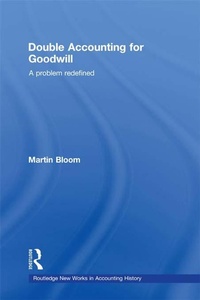
Double Accounting for Goodwill
A Problem Redefined
Published on 13. May 2013
248 pages
978-1-134-07389-4 (ISBN)
Description

Goodwill, sometimes purchased but often more significantly internally generated, is the major constituent of the value of many listed companies. Accounting aims to provide users of financial statements with useful information, and more than fifty current International Financial Reporting Standards prescribe accounting disclosure requirements in minute detail. However, these Standards dismiss internally generated goodwill with a single brief provision that it is not to be brought to account at all. The impairment regime now laid down for dealing with purchased goodwill contains severe flaws, while previous methods have also been found to be unsatisfactory.
This book traces the history of the goodwill accounting controversy in detail and demonstrates that it has been a prime example of an issue 'conceived in a way that it is in principle unsolvable'. It explores the problem of recognising the importance of goodwill as a whole and finding a way of presenting meaningful information regarding it in the context of the financial statements. The author's proposed solution builds upon research undertaken and uses a Market Capitalization Statement, based on a modification of nineteenth century 'double accounting' in a modern context. Examples show that the proposed Market Capitalization Statement has the potential to provide significant information not currently available form conventional financial statements, which in turn are freed to present clearer information.
This book traces the history of the goodwill accounting controversy in detail and demonstrates that it has been a prime example of an issue 'conceived in a way that it is in principle unsolvable'. It explores the problem of recognising the importance of goodwill as a whole and finding a way of presenting meaningful information regarding it in the context of the financial statements. The author's proposed solution builds upon research undertaken and uses a Market Capitalization Statement, based on a modification of nineteenth century 'double accounting' in a modern context. Examples show that the proposed Market Capitalization Statement has the potential to provide significant information not currently available form conventional financial statements, which in turn are freed to present clearer information.
Reviews / Votes
"Never in my twenty plus years of valuing, teaching goodwill and fair value including serving state and national committees including the FASB have I seen such a thoroughly researched and cogent history of goodwill. M.H. Bloom captures the very essence of the tension in goodwill between relevance and reliability... I had no idea such tension went back over a hundred years. The reader of this book will acquire a new appreciation for the age-old difficulties management faces today in presenting the most meaningful financial results of the company." Michael Mard, Financial Valuation Group, USA.More details
Series
Language
English
Place of publication
London
United Kingdom
Publishing group
Taylor & Francis Ltd
Target group
College/higher education
Illustrations
15 Tables, black and white; 1 Line drawings, black and white; 1 Illustrations, black and white
File size
1,02 MB
ISBN-13
978-1-134-07389-4 (9781134073894)
Copyright in bibliographic data and cover images is held by Nielsen Book Services Limited or by the publishers or by their respective licensors: all rights reserved.
Schweitzer Classification
Other editions
Additional editions
Book
12/2009
1st Edition
Routledge
€71.40
Shipment within 15-20 days
Book
06/2008
1st Edition
Routledge
€231.70
Shipment within 15-20 days
Person
Martin Bloom is a Chartered Accountant who has been in public practice for over forty years and is currently a Director in the Sydney office of Deloitte, a global network of accounting, consulting and business advisory firms.
Content
1. An Overview
2. What is Goodwill?
3. Internally Generated Goodwill: "Alice-in-Wonderland Accounting"
4. Purchased Goodwill: Historical Treatment
5. Impairment: The Current Conventional Wisdom
6. The Market Capitalization Statement (the MCS)
7. The MCS and CoCoA
2. What is Goodwill?
3. Internally Generated Goodwill: "Alice-in-Wonderland Accounting"
4. Purchased Goodwill: Historical Treatment
5. Impairment: The Current Conventional Wisdom
6. The Market Capitalization Statement (the MCS)
7. The MCS and CoCoA
