

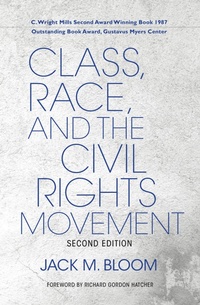
Class, Race, and the Civil Rights Movement
2nd Edition
Published on 12. March 2021
376 pages
978-0-253-04247-7 (ISBN)
Description

Revised and updated: the award-winning historical analysis of the civil rights movement examining the interplay of race and class in the American South.
In Race, Class, and the Civil Rights Movement, sociologist Jack M. Bloom explains what the civil rights movement was about, why it was successful, and why it fell short of some of its objectives. With a unique sociohistorical analysis, he argues that Southern racist practices were established by the agrarian upper class, and that only when this class system was undermined did the civil rights movement became possible. He also demonstrates how the movement was the culmination of political struggles beginning in the Reconstruction era and influenced by the New Deal policies of the 1930s.
Widely praise when it was first published 1987, Race, Class, and the Civil Rights Movement was a C. Wright Mills Second Award-winning book and also won the Gustavus Myers Center Outstanding Book Award. In this second edition, Bloom updates his study in light of current scholarship on civil rights history. He also presents an analysis of the New Right within the Republican Party, starting in the 1960s, as a reaction to the civil rights movement.
In Race, Class, and the Civil Rights Movement, sociologist Jack M. Bloom explains what the civil rights movement was about, why it was successful, and why it fell short of some of its objectives. With a unique sociohistorical analysis, he argues that Southern racist practices were established by the agrarian upper class, and that only when this class system was undermined did the civil rights movement became possible. He also demonstrates how the movement was the culmination of political struggles beginning in the Reconstruction era and influenced by the New Deal policies of the 1930s.
Widely praise when it was first published 1987, Race, Class, and the Civil Rights Movement was a C. Wright Mills Second Award-winning book and also won the Gustavus Myers Center Outstanding Book Award. In this second edition, Bloom updates his study in light of current scholarship on civil rights history. He also presents an analysis of the New Right within the Republican Party, starting in the 1960s, as a reaction to the civil rights movement.
More details
Other editions
Additional editions
Jack M. Bloom
Class, Race, and the Civil Rights Movement
Book
07/2019
2nd Edition
Indiana University Press
€70.50
Shipment within 10-20 days
Person
Jack M. Bloom is Associate Professor of Sociology at Indiana University Northwest.
Content
Preface to the Second Edition
Introduction
I. The Changing Political Economy of Racism
1. The Political Economy of Southern Racism
2. The Old Order Changes
3. 1948: The Opening of the Breach
4. The Splitting of the Solid South
II. The Black Movement
5. The Defeat of White Power and the Emergence of the "New Negro" in the South
6. The Second Wave
7. Ghetto Revolts, Black Power, and the Limits of the Civil Rights Coalition
8. Class and Race: A Retrospective
Notes
Bibliography
Index
