

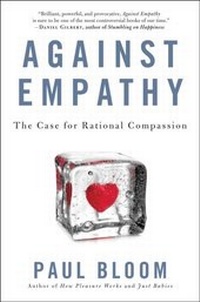
Against Empathy
Description

?Like a tough-to-crack case against an idea that most of us have long known is key to repairing the world... will legitimately change how you think about the world and your own sense of morality.? ?New York Magazine
New York Post Best Book of the Year
We often think of our capacity to experience the suffering of others as the ultimate source of goodness. Many of our wisest policy-makers, activists, scientists, and philosophers agree that the only problem with empathy is that we don't have enough of it.
Nothing could be farther from the truth, argues Yale researcher Paul Bloom. In AGAINST EMPATHY, Bloom reveals empathy to be one of the leading motivators of inequality and immorality in society. Far from helping us to improve the lives of others, empathy is a capricious and irrational emotion that appeals to our narrow prejudices. It muddles our judgment and, ironically, often leads to cruelty. We are at our best when we are smart enough not to rely on it, but to draw instead upon a more distanced compassion.
Basing his argument on groundbreaking scientific findings, Bloom makes the case that some of the worst decisions made by individuals and nations?who to give money to, when to go to war, how to respond to climate change, and who to imprison?are too often motivated by honest, yet misplaced, emotions. With precision and wit, he demonstrates how empathy distorts our judgment in every aspect of our lives, from philanthropy and charity to the justice system; from medical care and education to parenting and marriage. Without empathy, Bloom insists, our decisions would be clearer, fairer, and?yes?ultimately more moral.
Brilliantly argued, urgent and humane, AGAINST EMPATHY shows us that, when it comes to both major policy decisions and the choices we make in our everyday lives, limiting our impulse toward empathy is often the most compassionate choice we can make.
All prices
More details
Other editions
Additional editions
Person
Paul Bloom is Professor of Psychology at the University of Toronto, and the Brooks and Suzanne Ragen Professor Emeritus of Psychology at Yale University. His research explores the psychology of morality, identity, and pleasure. Bloom is the recipient of multiple awards and honors, including, most recently, the million-dollar Klaus J. Jacobs Research Prize. He has written for scientific journals such as Nature and Science, and for the New York Times, the New Yorker, and the Atlantic Monthly. He is the author or editor of eight books, including Against Empathy, Just Babies, How Pleasure Works, Descartes' Baby, and, most recently, The Sweet Spot.
