

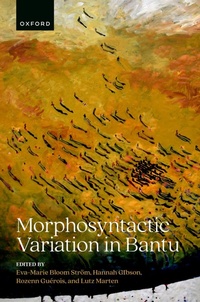
Morphosyntactic Variation in Bantu
Published on 5. November 2024
480 pages
978-0-19-255445-1 (ISBN)
Description

This volume explores the rich and complex pattern of morphosyntactic variation in the Bantu languages, providing a comprehensive overview of the wealth of empirical and conceptual work in the field. The chapters discuss data from some 80 Bantu languages as well as drawing on a wider comparative set of more than 200 languages from across Central, Eastern and Southern Africa: some studies focus on one specific language in a comparative context; some investigate fine-grained variation among a close-knit group of languages; and others present large-scale comparative studies spanning the whole of the Bantu-speaking area. The contributors address a range of topics from a micro-variation perspective, primarily in the areas of nominal and verbal morphology and syntax and information structure. The volume highlights key aspects of contemporary research in Bantu morphosyntax and outlines distinct and novel approaches to prominent questions; it combines the most recent thinking on morphosyntactic variation in Bantu with different theoretical and methodological approaches and novel empirical data from a wide range of languages.
More details
Other editions
Additional editions
Eva-Marie Bloom Stroem | Hannah Gibson | Rozenn Guerois
Morphosyntactic Variation in Bantu
Book
11/2024
Oxford University Press
€141.50
Shipment within 15-20 days
Persons
Eva-Marie Bloom Ström is Associate Professor in the Department of Philosophy, Linguistics and Theory of Science at the University of Gothenburg. Her research interests include information structure in languages with flexible sentence structure, such as the Bantu languages, as well as language description and documentation. She works primarily on languages of Tanzania and South Africa.
Hannah Gibson is a Professor of Linguistics at the University of Essex. Her research examines linguistic variation with a focus on the morphosyntax of Bantu languages of Eastern and Southern Africa. She works also on language contact, language change, and multilingualism.
Rozenn Guérois is a Researcher at the LLACAN-CNRS and a Research Associate at the University of KwaZulu-Natal. Her research interests include the description of Bantu languages spoken in Mozambique, morphosyntactic variation, typology, and comparative and historical linguistics.
Lutz Marten is Professor of General and African Linguistics at SOAS University of London. He is interested in linguistic theory, comparative and historical linguistics, and questions of language and identity. Most of his work focuses on African languages and he has carried out research in Eastern and Southern Africa.
Content
- 1: Lutz Marten, Rozenn Guérois, Hannah Gibson, and Eva-Marie Bloom Ström: Morphosyntactic variation in Bantu: An introduction
- Part I. Morphosyntactic variation across Bantu
- 2: Peter Edelsten, Rozenn Guérois, and Lutz Marten: Comparative analysis of morphosyntactic variation in Bantu languages: Parameters, data representation, and database design
- 3: Nobuko Yoneda: Micro-variation of noun-modifying constructions in Bantu languages
- 4: Justine Sikuku: Reflexive and reciprocal marking in Bantu
- 5: Rozenn Guérois, Hannah Gibson, and Lutz Marten: A parametric approach to negation in Bantu languages
- 6: Rasmus Bernander, Maud Devos, and Hannah Gibson: Existential constructions in Bantu languages
- 7: Denis Creissels: Predicative possession in Bantu languages
- Part II. Areal and micro-level morphosyntactic variation in Bantu
- 8: Eva-Marie Bloom Ström and Matti Miestamo: The use of the augment in Nguni languages: A marker of referentiality?
- 9: Atikonda Mtenje-Mkochi: Micro-variation in the nominal class marking systems of Malawian languages
- 10: Dorothee Beermann and Allen Asiimwe: Locatives in Runyankore-Rukiga
- 11: Amani Lusekelo: Morphosyntactic properties of object marking in Nyakyusa
- 12: Sebastian Dom, Heidi Goes, and Koen Bostoen: Multiple-reciprocity marking in the Kikongo language cluster: Functional distribution and origins
- 13: Koen Bostoen: Reflexive-reciprocal polysemy in South-Western Bantu: Distribution, typology, and origins
- 14: Yuko Abe: Morphosyntactic and semantic variation of the persistive aspect in Lake Tanganyika Bantu: A focus on Bende
- 15: Daisuke Shinagawa: A micro-parametric approach to focus marking ni in Kilimanjaro Bantu languages: With special reference to Rombo-Mkuu and Uru
