

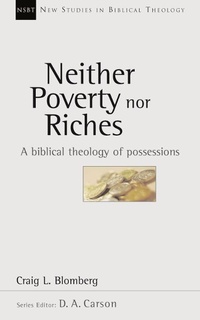
Neither Poverty Nor Riches
Description

One of the most difficult questions facing us today is that of the proper attitude toward possessions.
In wealthy nations such as Britain and the USA, individuals accumulate much and yet are daily exposed to the plight of the poor, whether the homeless on their own city streets or starving children on their TV screens. What action should they take on behalf of the poor? What should they do with their own possessions?
In Neither Poverty nor Riches Craig Blomberg asks what the Bible has to say to these issues. He avoids easy answers, and instead seeks a comprehensive biblical theology of possessions. Beginning with the groundwork laid by the Old Testament and the ideas developed in the intertestamental period, he draws out what the whole New Testament has to say on the subject and finally offers conclusions and applications relevant to the modern world.
This is a book that all concerned with issues of poverty and wealth should read.
More details
Other editions
Additional editions
Person
Content
- Intro
- Title
- Copyright
- Contents
- Series preface
- Author's preface
- Abbreviations
- Introductory considerations
- A sampling of statistics
- Christian response
- 1. The Old Testament and material possessions: the historical books
- From Eden to Sinai
- From Sinai to Canaan: the Law of Moses
- In the Promised Land: cycles of obedience and disobedience
- Summary and conclusions
- 2. The Old Testament wisdom and prophetic literature
- Poetry and wisdom literature
- The Prophets
- Summary and conclusions
- Conclusions concerning the entire Old Testament and material possessions
- 3. Additional historical background: between the Testaments
- Socio-political developments
- The literature of the Jews
- Other ideological developments prior to the New Testament
- Information from the Gospels bearing on the socio-economic status of the main characters
- Conclusions
- 4. The teaching of Jesus in the Synoptic Gospels
- The parables of Jesus
- The remaining teachings of Jesus
- Conclusions
- 5. Earliest Christianity
- The epistle of James
- The book of Acts
- 6. The life and teaching of Paul
- Galatians
- 1 and 2 Thessalonians
- l Corinthians
- 2 Corinthians
- Romans
- The Prison Epistles
- The Pastoral Epistles
- Summary and conclusions
- 7. The rest of the New Testament
- The synoptic evangelists
- The rest of the New Testament
- Summary and conclusions
- 8. Summary, conclusions and applications
- Summary
- Additional conclusions
- Applications
- Bibliograph
- Index of authors
