

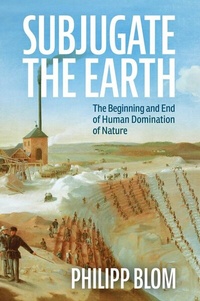
Subjugate the Earth
Description

Subjugate the Earth traces the biography of a strange idea: the idea that human beings can subdue nature and rule over it. Born in Mesopotamia at the dawn of civilization, the idea of subjugating the Earth was included in the Bible, reached Europe through Christianity, and spread to the entire world through colonialism. The Enlightenment gave a scientific appearance to the ambition of controlling nature but did not change the ambition itself. Yet every birth presages a death. Only with the climate crisis has it become apparent that the subjugation of nature must be a self-defeating ambition, because it alters and deregulates natural systems which humans depend on for their survival, precisely because they are part of nature and not separate from it. Subjugating the Earth is an idea that is dying around us.
The polycrisis threatening to engulf humanity is inextricably linked to how humans see themselves and their relationship with nature. Based on developments in the natural sciences, a new understanding of this relationship looks not at individual phenomena but at systems, connections and entanglements between humans and other manifestations of nature. Is it possible to build a new understanding of humanity in nature by turning the traditional vision of free, rational individuals on its head and seeing humans as fascinating, irrational and system-dependent beings within the vast system of nature?
Interlacing historical episodes, individual life stories, works of art and scientific discoveries, Subjugate the Earth tells the story of the rise and fall of an idea that has shaped our world, and weaves a rich tapestry that is as surprising as it is enriching.
More details
Other editions
Additional editions
Person
Content
List of Illustrations
Up into the Air
Prologue: Buy Me a Cloud
I MYTH
The World on a Vase
Gilgamesh the Hero
The View from the Parapet
The Free Market of Offerings
Before the Flood
In Search of Lost Matriarchy
In Search of Presumed Religion
The Dancing God
King of the World, King of Assyria
... and subjugate it
Lost in Translation?
Look on My works!
The Triumph of Light over Darkness
The Map of Misreadings
II LOGOS
Landscape with the Fall of Icarus
Why Europe?
Technology and the Burden of Empire
The Justification Industry
The Age of Iron
Monsieur Grat and His Master
'If only I could paint his spirit!'
The Canon and the Antichrist
An Experiment on a Bird in an Air Pump
The Theology of Fish
Lisbon
A Work of Nature
Virtuous Terror
Carte Blanche
Stuffed and Exhibited
The Silent Death of Saartjie Baartman
Hare Hunting
Modern Times
III COSMOS
Agony
The One-Armed Lumberjack
Liberal Lifelong Lies
The World as Clockwork
Admiration for Cannibals
Entangled Life
A Handful of Earth
Risky Thinking
Notes
Index
Prologue
Buy Me a Cloud
Look at the sky, at its infinity, and before that, at the high-domed tumult of the clouds. Whatever lies on the strip of land below - an alpine panorama, the daily traffic jam on Sunset Boulevard, an industrial ruin, storm-lashed oceans, cornfields or glittering skyscrapers - up there the wind blows freely, and thoughts must be equally free in ever new forms. It must be the last bastion of wildness.
Painters have always been infatuated with clouds, with their stormy metamorphoses, with the sensuality of their forms, the play of light and shade and the dramatic shifts of mood that take over when the sun suddenly disappears, or when it breaks through the looming leaden masses like a revelation.
The greatest cloud virtuosos were the Dutchmen around the middle of the seventeenth century who began to see their own moods echoed in the fragmentation and poetry of celestial landscapes, if only because the terrestrial one had little to offer them: barely a hill, let alone dramatic peaks or canyons, majestic rivers or panoramas. Here everything was damp and small, a brownish hue with some grey, with little that stood out - no ancient ruins or other sources of sublime frisson. The people there were farmers or herring fishers. The land was a line on the horizon, interrupted only by a few trees or a row of windmills. Large parts of this landscape were created by human hands: not only the fields, whose edges were drawn with a ruler, but also the canals and towns, the very land itself, which engineers, dike wardens and the hard work of anonymous arms had wrested from the North Sea. 'God created the Earth', an old saying goes, 'and the Dutch created their own country.' They were not lacking in self-confidence.
But the painters were looking for more than delineated production units for market gardens and dairy pastures. Their patrons, the patricians of Amsterdam and other trade centres, demanded visual representations of their approach to life and their ideas. They were strict Protestants who believed that they were directly accountable to God. Without confession or absolution, they were thrown back entirely on their conscience. The artists of the time projected this drama onto nature. Canvases showing a farmhouse or a little wood provide the stage for psychological dramas in which the cloud masses represent the storm of emotions and the inner struggles.
1 Jacob von Ruisdael, Wheat Field, c.1670, oil on canvas, 100 × 130.2 cm. Metropolitan Museum of Art, New York, estate of Benjamin Altman, 1913. Accession number: 14.40623
In the sky, Rembrandt, Ruisdael and their colleagues recognized the last wilderness of a world that had been heaped up, delineated and cut into strips. The sea, that eternal provider and eternal foe of all coastal peoples, represented a nature that could not be subdued and whose force one had to respect if one valued one's life. But the sea was always also a source of fish and merchandise, of work and careers. However much they respected it, people had a pragmatic relationship with the North Sea. The sky was the last space in which the storms of the soul could be depicted.
*
1 July 2021: the hundredth anniversary of the Communist Party of China. A guard of honour marches in front of 70,000 invited guests in uniform and 56 loaded pieces of artillery across Tiananmen Square, and through an enormous gate crowned with the dates 1921 and 2021 as well as a hammer and sickle in gold. The soldiers move with the discipline of a single body; every corner is as straight as a ruler, the metal of their guns sparkles in the sun and their eyes stare rigidly ahead, into a glorious future. While the national flag is hoisted, the cannons fire a 100-gun salute. The Communist Youth and the Young Pioneers enthusiastically pay tribute to the party in front of a gigantic portrait of Mao Zedong. The youngsters have little earphones in their left ears so that they can chant the choruses and party anthems in perfect synchronicity; nothing is left to chance. Helicopters fly above the square in formation, presenting the number 100.
Some distance away from this ceremony and the omnipresent posters, banners and neon signs for the party jubilee, the city's normal, chaotic life continues. The oppressive smog that usually makes it hard to breathe has cleared somewhat. It is a welcome side effect of the festivities for many people in Beijing: the sky is a radiant blue, and although photographs from this day will show a yellowish-grey vapour above the houses, the visibility and air quality are substantially better than on other days, because factories in the vicinity of Beijing with particularly dirty emissions had to halt production a few days before the ceremony.
International scientists found another reason for the fine weather on that festive day, however. The government had employed a technology in which they had invested huge amounts of money in the last few years: cloud seeding. Here silver iodide or other chemicals are sprayed on clouds by aeroplanes in order to stimulate the production of droplets, and thus provoke the shedding of moisture by the clouds in a desired location. Thanks to the artificial rain on the previous day, the air was clean and the sky above Tiananmen Square was almost blue. Cloud seeding had also ensured attractive television footage of the 2008 Olympic Games.
According to official Chinese figures, more than 200 billion cubic metres of rainfall had been artificially stimulated between 2012 and 2017 alone, and artillery shells filled with iodine had prevented massive damage from hailstones in 2019. The aim is to expand changes of weather through cloud seeding until one can cover a surface one and a half times the size of India, in order to secure agricultural production quotas and propaganda events.1
*
'I, Noa Jansma, sell clouds', a young Dutch artist announces on her website. She explains her project in business language:
- Prospecting: clouds become my property. Following Jean-Jacques Rousseau's theory of occupation, I take control of it by drawing a boundary around it before someone else. I have trained Artificial Intelligence to do it for me.
- UR (Unique Registration): according to John Locke's theory of labour, people must interact with the clouds to make them their property. I have built an installation in which people can lie on the grass and gaze at projections of clouds that drift past. The clouds are priced (in ?) according to their attributes and are given a QR code. When viewers scan this QR code with their telephones, they enter the world of virtual speculation. As part of their interaction, they share their data (a selfie and their name) with the cloud and receive a certificate.
- The US (Universal System): after payment, the owners receive a certificate that is also archived in an online land registry. The purchased clouds float in virtual space with the purchase prices. Inspired by capitalist market forces, larger clouds in the registry can eat up smaller ones and grow at their expense.2
The pandemic forced Jansma's project to mutate into an online event. Nonetheless, she believes that Buycloud clearly has great potential in the face of disaster: 'New studies predict that with rising emissions, there will soon be no more cumulus clouds. This will cause a rise in temperature by 8° Celsius - catastrophic for the planet, but excellent for the cloud market. The purchase of a cloud becomes a poetic, but stable investment.'
The laughter occasionally sticks in the investors' throats, but the artist plans to take her ideas a step further. Her inspiration came from the history of European conquests of other continents, she explains: 'When in the 15th century the Western "explorers" went to what-we-now-call-America, they told the native people they wanted to buy their land. The natives were confused; "Their land?" "To buy it?" Their vocabulary did not have a word or understanding of ownership over natural phenomena.'3 As the last remaining not-yet-colonized phenomenon, the clouds are waiting to finally be marketed globally.
2 Noa Jansma's project Buycloud. Source: https://noajansma.com/buycloud
*
Clouds - the last untamed part of nature? They are indeed, these ever-changing formations - but only in our imagination. Their growth has long been accelerated by global heating; they are observed, classified, tracked, analysed, chemically manipulated and, in more than one art project, awarded prizes and turned into objects of speculation: future options on the crop yields of individual agricultural commodities, and thus bets on the weather over the harvest period, have long since become normal. One can make a great deal of money from clouds.
Anyone who spends enough time gazing at a landscape - or, rather, a skyscape or cloudscape - of cumulus clouds, a field of finest cirrus in the light of the setting sun or a leaden impending storm front cannot help being hypnotically sucked in by their inexhaustibly inventive variations on a theme. Faces and figures appear, dragons fight with other wonderful creatures, menacing rock faces tower up, sunbeams cut through dark walls or illuminate a scene like something from a Baroque opera. No landscape can be more grandiose than the mountains and canyons of these looming chimeras. As when...
