

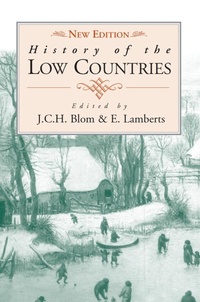
History of the Low Countries
Description

The history of the smaller European countries is rather neglected in the teaching of European history at university level. We are therefore pleased to announce the publication of the first comprehensive history of the Low Countries - in English - from Roman Times to the present. Remaining politically and culturally fragmented, with its inhabitants speaking Dutch, French, Frisian, and German, the Low Countries offer a fascinating picture of European history en miniature. For historical reasons, parts of northern France and western Germany also have to be included in the "Low Countries," a term that must remain both broad and fluid, a convenient label for a region which has seldom, if ever, composed a unified whole. In earlier ages it as even more difficult to the region set parameters, again reflecting Europe as a whole, when tribes and kingdoms stretched across expanses not limited to the present states of Belgium, Luxembourg, and the Netherlands.
Nevertheless, its parts did demonstrate many common traits and similar developments that differentiated them from surrounding countries and lent them a distinct character. Internationally, the region often served both as a mediator for and a buffer to the surrounding great powers, France, Britain, and Germany; an important role still played today as Belgium and the Netherlands have increasingly become involved in the broader process of European integration, in which they often share the same interest and follow parallel policies. This highly illustrated volume serves as an ideal introduction to the rich history of the Low Countries for students and the generally interested reader alike.
More details
Other editions
Additional editions
Persons
J. C. H. Blom is director of the Dutch State Institute for War Documentation , Amsterdam.
Content
Translator's Note
Preface
Chapter 1. A Long Beginning: The Low Countries Through the Tenth Century
L. J. R. Mills
Chapter 2. Counts, Cities, and Clerics: The Eleventh, Twelth, and Thirteenth Centuries
L. J. R. Mills
Chapter 3. The Formation of a Political Union, 1300-1588
W. P. Blockmans
Chapter 4. The Dutch Republic, 1588-1780
A. T. van Deursen
Chapter 5. The Spanish and Austrian Netherlands, 1579-1780
P. Janssens
Chapter 6. Revolution in the North and South, 1780-1830
J. Roegiers and N . C. F. van Sas
Chapter 7. Belgium since 1830
E. Lamberts
Chapter 8. The Netherlands since 1830
J. C. H. Blom
Epilogue: Unity and Diversity in the Low Countries
J. C. H. Blom and E. Lamberts
Recommended Literature
Index
Contributors
