

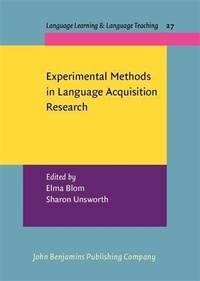
Experimental Methods in Language Acquisition Research
1st Edition
Published on 26. October 2010
VII, 292 pages
978-90-272-8795-3 (ISBN)
Description

Experimental Methods in Language Acquisition Research provides students and researchers interested in language acquisition with comprehensible and practical information on the most frequently used methods in language acquisition research. It includes contributions on first and child/adult second language learners, language-impaired children, and on the acquisition of both spoken and signed language. Part I discusses specific experimental methods, explaining the rationale behind each one, and providing an overview of potential participants, the procedure and data-analysis, as well as advantages and disadvantages and dos and don'ts. Part II focuses on comparisons across groups, addressing the theoretical, applied and methodological issues involved in such comparative work. This book will not only be of use to advanced undergraduate and postgraduate students, but also to any scholars wishing to learn more about a particular research method. It is suitable as a textbook in postgraduate programs in the fields of linguistics, education and psychology.
More details
Other editions
Additional editions
Elma Blom | Sharon Unsworth
Experimental Methods in Language Acquisition Research
Book
10/2010
John Benjamins Publishing Co
€111.30
Shipment within 10-15 days
Persons
Content
- Experimental Methods in Language Acquisition Research
- Editorial page
- Title page
- LCC data
- Table of contents
- Preface
- Introduction
- Ethics
- Planning
- Recruitment
- Materials and equipment
- Test sessions
- References
- 1. Production methods in language acquisition research
- 1. Introduction
- 2. Naturalistic studies
- 2.1 Rationale
- 2.2 Linguistic variables
- 2.3 Subjects
- 2.4 Description of procedure
- 2.5 Analysis and outcomes
- 3. Semi-structured elicitation
- 3.1 Rationale
- 3.2 Linguistic variables
- 3.3 Subjects
- 3.4 Description of procedure
- 3.5 Analysis and outcomes
- 4. Production experiments
- 4.1 Rationale
- 4.2 Linguistic variables
- 4.3 Subjects
- 4.4 Description of procedure
- 4.5 Analysis and outcomes
- 5. Advantages and disadvantages
- Do's and don'ts
- Acknowledgements
- References
- 2. Using comprehension methods in language acquisition research
- 1. Introduction
- 2. Truth value judgment task
- 2.1 Rationale
- 2.2 Linguistic variables
- 2.3 Subjects
- 2.4 Description of procedure
- 2.5 Analyses and outcomes
- 3. Picture matching task
- 3.1 Rationale
- 3.2 Linguistic variables
- 3.3 Subjects
- 3.4 Description of procedure
- 3.5 Analyses and outcomes
- 4. Act-out task
- 4.1 Rationale
- 4.2 Linguistic variables
- 4.3 Subjects
- 4.4 Description of procedure
- 4.5 Analysis and outcomes
- 5. Advantages and disadvantages
- Do's and don'ts
- References
- 3. Using Magnitude Estimation in developmental linguistic research
- 1. Introduction
- 2. Rationale
- 3. Linguistic variables
- 4. Subjects
- 5. Description of procedure
- 5.1 Design requirements
- 5.2 Development of stimuli
- 5.3 Equipment
- 6. Analysis and outcomes
- 7. Advantages and disadvantages
- Do's and don'ts
- References
- 4. Using infant and toddler testing methods in language acquisition research
- 1. Introduction
- 2. Visual fixation procedure
- 2.1 Rationale
- 2.2 Linguistic variables
- 2.3 Subjects
- 2.4 Description of procedure
- 2.4 Analysis and outcomes
- 3. Headturn preference procedure
- 3.1 Rationale
- 3.2 Linguistic variables
- 3.3 Subjects
- 3.4 Description of procedure
- 3.5 Analysis and outcomes
- 4. Preferential looking procedure
- 4.1 Rationale
- 4.2 Linguistic variables
- 4.3 Subjects
- 4.4 Description of procedure
- 4.5 Analysis and outcomes
- 5. Advantages and disadvantages
- Do's and don'ts
- References
- 5. Using Event-Related Potentials in language acquisition research
- 1. Introduction
- 2. Rationale
- 3. Linguistic variables
- 3.1 Auditory processing
- 3.2 Semantic processing
- 3.3 Syntactic processing
- 4. Subjects
- 5. Description of procedure
- 5.1 Design requirements
- 5.2 Development of stimuli
- 5.3 Equipment
- 6. Analysis and outcomes
- 7. Advantages and disadvantages
- Do's and don'ts
- References
- 6. Using eyetracking in language acquisition research
- 1. Introduction
- 2. Rationale
- 3. Linguistic variables
- 3.1 Spoken word recognition
- 3.2 Verb argument structure and thematic relations
- 3.3 Syntactic ambiguity resolution
- 3.4 Pragmatic constraints on reference
- 3.5 Pronoun and anaphora resolution
- 4. Subjects
- 5. Description of the procedure
- 5.1 Design requirements
- 5.2 Development of stimuli
- 5.3 Equipment
- 6. Analysis and outcomes
- 7. Advantages and disadvantages
- Do's and don'ts
- Acknowledgments
- References
- 7. Using on-line processing methods in language acquisition research
- 1. Introduction
- 2. Word-monitoring
- 2.1 Rationale
- 2.2 Linguistic variables
- 2.3 Subjects
- 2.4 Description of procedure
- 2.5 Analysis and outcomes
- 3. Self-paced reading/listening
- 3.1 Rationale
- 3.2 Linguistic variables
- 3.3 Subjects
- 3.4 Description of procedure
- 3.5 Analysis and outcomes
- 4 Cross-modal priming
- 4.1 Rationale
- 4.2 Linguistic variables
- 4.3 Subjects
- 4.4 Description of procedure
- 4.5 Analysis and outcomes
- 5. Self-paced listening with picture verification
- 5.1 Rationale
- 5.2 Linguistic variables
- 5.3 Subjects
- 5.4 Description of procedure
- 5.5 Analysis and outcomes
- 6. Advantages and disadvantages
- Do's and don'ts
- Acknowledgments
- References
- 8. Using computational modeling in language acquisition research
- 1. Introduction
- 2. Rationale
- 3. Linguistic variables
- 3.1 Aspects of the sound system
- 3.2 Aspects of words
- 3.3 Aspects of syntax and semantics
- 4. Subjects
- 5. Description of procedure
- 5.1 Empirical grounding of the model
- 5.2 Variables in models
- 5.3 Control conditions and experimental conditions
- 5.4 Equipment
- 6. Analysis and outcomes
- 7. Advantages and disadvantages
- Do's and don'ts
- Acknowledgements
- References
- 9. Measuring second language proficiency
- 1. Introduction
- 2. Theoretical and conceptual issues
- 3. Important constructs in psychometrics
- 3.1 Validity and reliability
- 3.2 Discrete point and integrative tests
- 3.3 Direct versus indirect tests
- 4. Some language proficiency tests
- 4.1 Vocabulary tests
- 4.2 Sentence imitation
- 4.3 The cloze test
- 4.4 Elicited production
- 5. Advantages and disadvantages
- Do's and don'ts
- Acknowledgements
- References
- 10. Comparing L1 children, L2 children and L2 adults
- 1. Introduction
- 2. Theoretical and applied issues
- 2.1 Defining groups
- 2.2 Maturational effects
- 2.3 Transfer effects
- 2.4 Input effects
- 3. Methodological issues
- 3.1 Determining age of first exposure
- 3.2 Controlling for cognitive development
- 3.3 Controlling for proficiency
- 3.4 Controlling for (quantity and quality of ) input
- Do's and don'ts
- Acknowledgements
- References
- 11. Comparing typically-developing children and children with specific language impairment
- 1. Introduction
- 2. Theoretical and applied issues
- 2.1 Theoretical issues
- 2.2 Applied issues
- 2.3 The logic of the three-group design
- 3. Methodological issues
- 3.1 Considerations for comparing population groups
- 3.2 Creating a three-group matched design study
- 3.3 Calculating mean length of utterance
- 3.4 Bilingual children
- Do's and don'ts
- References
- 12. Measuring the linguistic development of deaf learners
- 1. Introduction
- 2. Theoretical and applied issues
- 2.1 Theoretical issues
- 2.2 Applied questions
- 3. Methodological issues
- 3.1 Subjects
- 3.2 Design requirements and procedure
- 3.3 Situational influences on data collection
- 3.4 Analysis and outcomes
- Do's and don'ts
- References
- 13. How to design and analyze language acquisition studies
- 1. Introduction
- 2. Testing hypotheses
- 3. Types of studies
- 4. Validity
- 5. Significance, power and effect size
- 6. Frequently asked questions
- 6.1 How many participants and items are required?
- 6.2 What if only a small number of participants are available?
- 6.3 How can I increase the sensitivity of my study?
- 6.4 How can I prove that there is no difference?
- 6.5 What to do about missing data?
- Do's and don'ts
- Acknowledgement
- References
- Contributors
- Index
- The series Language Learning & Language Teaching
