

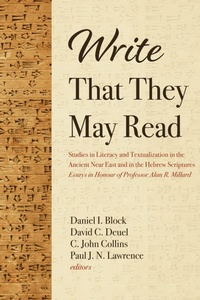
Write That They May Read
Studies in Literacy and Textualization in the Ancient Near East and in the Hebrew Scriptures:Essays in Honour of Professor Alan R. Millard
Published on 11. July 2020
538 pages
978-1-7252-5209-7 (ISBN)
Description

Write That They May Read is a collection of essays written in honor of our mentor, friend, and fellow scholar, Professor Alan R. Millard. Respectful of his contribution to our understanding of writing and literacy in the ancient biblical world, all the essays deal with some aspect of this issue, ranging in scope from archeological artifacts that need to be "read," to early evidence of writing in Israel's world, to the significance of reading and writing in the Bible, including God's own literacy, to the production of books in the ancient world, and the significance of metaphorical branding of God's people with his name. The contributors are distributed among Professor Millard's peers and colleagues in a variety of institutions, his own students, and students of his students. They represent a variety of disciplines including biblical archeology, Egyptology, Assyriology, Hebrew and other Northwest Semitic texts, and the literature of the Bible, and reside in North America, Japan, the United Kingdom, Denmark, and Germany.
Write That They May Read contains contributions by:
Section 1: Artifacts and Minimalist Literacy
1. "See That You May Understand": Artifact Literacy--The Twin-cup Libation Vessels from Khirbet Qeiyafa
Gerald Klingbeil, Research Professor of Old Testament and Ancient Near Eastern Studies, Andrews University
Martin Klingbeil, Professor of Biblical Studies and Archaeology, and Associate Director, Institute of Archaeology Southern Adventist University
2. Ketiv-Qere: The Writing and Reading of EA 256 and Its Place in Reflecting the Realia of Power and Polity in the LBA-IA Golan and Peripheries
Timothy M. Crow, Senior Lecturer in History, University of Akron; Professional Fellow Old Testament, Ashland Theological Seminary
3. Another Inscribed Arrowhead in the British Museum
Terrence C. Mitchell+. Former Keeper of Western Asiatic Antiquities, The British Museum, London, England
4. Earliest Literary Allusions to Homer and the Pentateuch from Ischia in Italy and Jerusalem
Paul J. N. Lawrence, Translation Consultant, Summer Institute of Linguistics International
5. The Etymology of Hebrew lo¯g and the Identity of Shavsha the Scribe
Yoshiyuki Muchiki, Professor of Biblical Theology, Japan Bible Seminary, Tokyo
Section 2: Artifacts and Official Literacy
6. The Writing/Reading of the Stone Tablet Covenant in the Light of the Writing/Reading/Hearing of the Silver Tablet Treaty
Gordon Johnston, Professor of Old Testament, Dallas Theological Seminary
7. For Whose Eyes? The Divine Origins and Function of the Two Tablets of the Israelite Covenant
Daniel I. Block, Gunther H. Knoedler Professor Emeritus of Old Testament, Wheaton College
8. Write That They May Judge? Applying Written Law in Biblical Israel
Jonathan Burnside, Professor of Biblical Law, Law School, University of Bristol.
9. "And Samuel Wrote in the Book" (1 Samuel 10:25) and His Apology in First Samuel 1-15
Wolfgang Ertl, Dozent am Bibelseminar Bonn, Bornheim/Germany; Associate Professor of Old Testament, Southwestern Baptist Theological Seminary
10. "For the one who will read it aloud will be able to run with it" (Habakkuk 2:2c)
David Toshio Tsumura, Professor of Old Testament, Japan Bible Seminar
Section 3: The Rise of Literary Literacy
11. The History and Pre-History of the Hebrew Language in the West Semitic Literary Tradition
Richard E. Averbeck, Professor of Old Testament and Semitic Languages, Trinity Evangelical Divinity School
12. Divine Action in the Hebrew Bible: "Borrowing" from Ancient Near Eastern Cultures and "Inspiration"
C. John Collins, Professor of Old Testament, Covenant Theological Seminary
13. Encoding and Decoding Culture
Jens Bruun Kofoed, Professor of Old Testament, Fjellhaug International University College,
14. No Books, No Authors: Literary Production in a Hearing-Dominant Culture
John H. Walton, Professor of Old Testament, Wheaton College
15. The Discovery of the Book of the Law in 2 Kings 22:8-10 in the Light of the Literary Renaissance of the Eighth to Seventh Centuries in the Ancient Near East
James K. Hoffmeier, Emeritus Professor of Old Testament and Near Eastern Archaeology, Trinity Evangelical Divinity School
16. "Read This Torah" (Deuteronomy 31:11): The Importance and Function of Israel's Primary Scripture in Early Spiritual Growth
David C. Deuel, Academic Dean Emeritus, The Master's Academy International
17. What is a "Messianic Text"? The Uruk Prophecy and the Old Testament
Ernest C. Lucas, Vice-Principal Emeritus, Bristol Baptist College, UK
18. "Joshua 24 and Psalm 81 as Intertexts"
Cheryl Eaton, PhD Candidate, Trinity College, Bristol
19. "Much Study is a Weariness of the Flesh": To Read or not to Read in Ecclesiastes 12:11-12
Knut Heim, Professor of Old Testament, Denver Seminary
Section 4: Metaphorical Literacy
20. Belonging to YHWH: Real and Imagined Inscribed Seals in Biblical Tradition
Carmen Joy Imes, Associate Professor of Old Testament, Prairie College, Three Hills, Alberta
21. Reading the Eye: Optic Metaphorical Agency in Deuteronomic Law
A. Rahel Wells, Associate Professor of Biblical Studies, Andrews University
5. Epilogue
22. Literacy and Postmodern Fallacies
Richard S. Hess, Distinguished Professor of Old Testament and Semitic Languages, Denver Seminary
Abstract:
23. In Praise of a Venerable Scribe: A Tribute to Alan R. Millard
Edwin M. Yamauchi, Professor of History Emeritus, Miami University, Oxford, Ohio
[with contributions from Daniel I. Block and Paul J. N. Lawrence]
More details
Other editions
Additional editions
Daniel I. Block | David C. Deuel | C. John Collins
Write That They May Read
Studies in Literacy and Textualization in the Ancient Near East and in the Hebrew Scriptures: Essays in Honour of Professor Alan R. Millard
Book
07/2020
Wipf & Stock Publishers
€59.20
Shipment within 3-4 weeks
Daniel I. Block | David C. Deuel | C. John Collins
Write That They May Read
Studies in Literacy and Textualization in the Ancient Near East and in the Hebrew Scriptures: Essays in Honour of Professor Alan R. Millard
Book
07/2020
Wipf & Stock Publishers
€81.70
Shipment within 3-4 weeks
Persons
Daniel I. Block is Gunther H. Knoedler Professor Emeritus of Old Testament, Wheaton College; David C. Deuel is Academic Dean Emeritus, The Master's Academy International; C. John Collins is Professor of Old Testament, Covenant Theological Seminary; Paul J. N. Lawrence is a translation consultant for SIL International.
Content
- Intro
- Title Page
- Credits
- Figures
- Tables
- Editors' Preface and Acknowledgments
- Contributors
- Abbreviations
- Introduction
- Chapter 1: "See That You May Understand"
- Chapter 2: Ketiv-Qere
- Chapter 3: Another Inscribed Arrowhead in the British Museum
- Chapter 4: Earliest Literary Allusions to Homer and the Pentateuch from Ischia in Italy and Jerusalem
- Chapter 5: The Etymology of Hebrew log and the Identity of Shavsha the Scribe
- Chapter 6: The Writing/Reading/Hearing of the Stone Tablet Covenant in the Light of the Writing/Reading/Hearing of the Silver Tablet Treaty
- Chapter 7: For Whose Eyes?
- Chapter 8: Write That They May Judge?
- Chapter 9: Samuel as Scribal Prophet in 1 Samuel 10:25 and 1 Samuel 1-15
- Chapter 10: Running and Reading: A Reexamination of Habakkuk 2:2c
- Cahpter 11: The History and Pre-History of the Hebrew Language in the West Semitic Literary Tradition
- Chapter 12: Divine Action in the Hebrew Bible
- Chapter 13: Encoding and Decoding Culture
- Chapter 14: No Books, No Authors
- Chapter 15: The Discovery of the Book of the Law in 2 Kings 22:8-10 in the Light of the Literary Renaissance of the Eighth to Seventh Centuries in the Ancient Near East
- Chapter 16: "Read this Torah" (Deuteronomy 31:11)
- Chapter 17: What Is a "Messianic Text"?
- Chapter 18: Joshua 24 and Psalm 81 as Intertexts
- Chapter 19: Belonging to YHWH
- Chapter 20: Reading the Eye
- Chapter 21: Literacy and Postmodern Fallacies
- Chapter 22: In Praise of a Venerable Scribe
- Bibliography
