

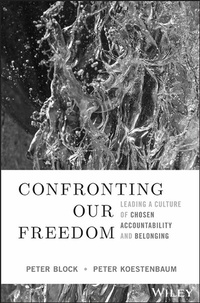
Confronting Our Freedom
Description

In Confronting Our Freedom, a team of dedicated leadership coaches delivers an exciting and engaging new take on management and leadership. Drawing on recent events in the market and in the world, including the Great Resignation, the COVID-19 pandemic, and widespread digital transformation, the authors invite you to reimagine ideas of freedom and accountability in the context of work. You'll explore how freedom of action--for managers and employees--is what gives rise to true accountability, both in the community and in the workplace.
In the book, you'll also find:
* Discussions of the power and structure of freedom, including its implications for our own choices and lives
* Ways to shift the focus of your leadership and management to accountability and freedom
* Strategies for shifting the illusion of clear roles and expectations to one compatible with fully human organizations
A groundbreaking and incisive approach to managing and leading others in virtual, hybrid, and in-person settings, Confronting Our Freedom will be an eye opener for managers, executives, and other business leaders seeking to improve their ability to inspire others to their fullest potential.
More details
Other editions
Additional editions
Persons
PETER KOESTENBAUM is a renowned existential philosopher and the founder and chairman of Philosophy in Business and the Koestenbaum Institute. After a career in academia, he worked as a business consultant and leadership coach for major companies around the world, including Ford, IBM, Novartis, Citibank, Volvo, Amoco, and more. His most recent book-length work includes The Heart of Business: Ethics, Power, and Philosophy and Leadership: The Inner Side of Greatness.
Content
Prologue: Then Was the Moment
The past is not past
What lies ahead
Introduction: The Philosophic Insight
Conversations on freedom and accountability
The view from where we are
Parenting is the origin story of management and leadership
Shifting the historical context
Philosophic insight in the world of organized effort
The existential understanding
I The Power and Structure of Freedom
Rewards
Freedom, reality, choice, and will
Accepting our freedom
The fundamental insight
Implications: The Forms of Freedom
Choice, reality, and will
II The Potential of Anxiety
The fruits of your patience
Solving anxiety
The promise of anxiety
The language of freedom: It is an inside job
Shifting the context to freedom and accountability
Implications: Anxiety as an ally of accountability both central to performance in a time of permanent uncertainty
The permanent condition
Being conscious
III Speaking of Death and Evil
Death is an option
A storm in the shelter
Facing reality. Taking charge of our life.
A summary of usefulness of the reality of death
Final facts
The presence of evil
Denying the reality of evil
Do no harm
Implications: failure, fear, death, and evil
IV Fully Human Organizations
Guilty as chosen and guilty as charged
The Sound of freedom
Reversing the illusion of clear roles and expectations
Not enough
Our expectations
What are we to do?
Real and chosen accountability? Fully human organizations
Epilogue
References and Background Reading
Acknowledgments
About the Authors
Index
About Designed Learning
Introduction: The Philosophic Insight
What we are about to explore is a realm of ideas that are as elusive as they are important. They deal with our way of experiencing our lives, something that is so ingrained and foundational that most of us are unaware of the nature of this experiencing. It is like trying to look at your face without a mirror. Narcissus falling in love with his own image in a pond and not knowing it was him. You go through the day, knowing your face is there, visible to the world, but you alone cannot see it. These ideas can also be thought of as being like peripheral vision: You look at something, say a picture on the wall, and on the edges of your field of vision are images that are definitely there, but difficult to see definitively and clearly. No matter where you look, there are always images on the periphery that you cannot quite tie down. The classic description of the elusiveness of these ideas is that they are so much a part of us that to see them clearly is to be a blind man searching in a dark room for a black cat that is not there.
This is the realm of philosophy. Philosophy not only has to deal with that aspect of life that is difficult to grasp, but it is a discipline that has created its own specialized terms. So much so that if you study philosophy, you spend much of your time on the definition of words you will never use frequently. All the time wondering why these words and what they are trying to describe even matter. There really is a world in a word.
The intention here is to bring a set of ideas-namely philosophy, or more specifically existential philosophy-into the real day-to-day world, especially the world of work and relationships and community. To simply understand this philosophy, let alone make use of these ideas, we would normally be required to understand what is meant by phenomenology, existentialism, consciousness, being, and more. These are difficult concepts to grasp, made more so by the fact that much of what philosophers have written has been written for other philosophers or for students in a philosophy class. We don't need to define these terms. We only need to watch for their occurrence.
"The central tenet of existential philosophy, and this book, is the unequivocal conviction that every person's will is free. Our freedom, in certain areas, is boundless. In this respect, the stance expressed in this book, which is commonly called existentialism, stands in stark opposition to the prevailing winds of doctrine. The belief that dominates western thinking is that we are not completely free, but are a product of our culture, our upbringing, and our genetic composition. If our will is completely free, then it must [be chosen as an alternative to] these other powerful influences."
- Peter Koestenbaum (1971)
Conversations on freedom and accountability
We do want to make the ideas of existential philosophy more easily accessible to us all. This book is written for those of us who see the limitations of our habitual caring more about living well and productively in the world more than we care about understanding the nature of being alive. It is written for those who are caught in our care about actions, not the bases that underlie our actions. It takes us into conversations about ideas such as freedom, anxiety, death, and guilt-ideas that we may talk about in moments of reflection, or often in times of crisis-but usually we try to avoid them or we approach them with great caution. In fact, we spend more energy trying not to think or talk about these questions than we do trying to figure them out. We typically get interested in these ideas and questions only late in life when our future is mostly behind us.
"We do not rejoice over the total freedom that we possess, but, on the contrary, make great efforts to hide it from ourselves."
- Peter Koestenbaum (1971)
We have lumped these conversations under the rubric of "confronting our freedom and choosing accountability." These are concerns we need to talk more about, know more about, and take seriously earlier in life, while we are in the midst of creating the drama of our lives, rather than looking back on it. We have focused on freedom and accountability because our most common ways of thinking about them do not serve us well. We think that freedom is associated with doing what we want, feeling happy much of the time, and in general living an unburdened existence. A false mixture of liberty, license, and entitlement. A vivid example of this is that we think winning the lottery will help set us free. We believe that if we had a different boss, or labored in another workplace, we could more fully experience our freedom. If we had the right mayor or social service support we would be safer, we would find life easier. And we think that much of what we care about can be outsourced. This version of freedom is too narrow and is based more on a marketing illusion than our experience of the real texture of life. Maybe the pandemic and the seeming volatility around us occurs to cause us to be serious about all of this.
We also have a small way of thinking about accountability. We think that people want to escape from being accountable. We believe that accountability is something that must be imposed. We have to hold people accountable, and we devise reward and punishment schemes to do this. We keep clarifying roles, targets, and outcomes as ways to combat challenges.
These beliefs that are so dominant are difficult to question, yet they are the very beliefs that keep us from experiencing what we long for and producing a world we want to inhabit. As long as we believe that our freedom and well-being are dependent on an absence of problems, on our economic situation, and on the actions of those we work for and live with, we are in trouble. We are particularly vulnerable when we believe that great leadership is needed for the world to work.
And as long as we think accountability is reluctantly chosen and thereby requires force to bring it into being, we are unintentionally creating a breeding ground for entitlement. When others try to hold me accountable, I double my efforts to claim what is mine and to be given special treatment. "What's in it for me?" organizes how we manage, the work cultures and processes we create, and a consumer mindset of more and more. In reality, the consumer mindset is given continuous life by designing for customer dissatisfaction.
"For with freedom comes accountability, with accountability comes guilt, and with guilt comes anxiety. Since our freedom leads to anxiety, it is easier to repress it than to bear it proudly."
- Peter Koestenbaum (1971)
The view from where we are
Many of our beliefs are embodied by the generators of modern culture, the marketplace, the modern organization, and our ways of thinking about management, predictability, and leadership. Philosophy is really about a universal form of leadership and the possibility open to each person to shape or create an environment that supports the pursuit of meaning and purpose rather than our current obsession with speed, the ease of connection, financial security, material wealth, and a wise and compassionate soul to run things. Or a world where no one runs things. Self-sovereignty perhaps.
The culture
It is by looking briefly at modern life that we begin the dialogue about how to sustain ourselves in the face of the dominant culture and narrative. To bring philosophy into the foreground of a practical life.
The more immersed we become in a changing culture, the more we need to be reminded of what is timeless and fundamental. We live in a culture that measures progress by commerce, by scientific and technological improvement. Today's technology world sees progress as being about the possibilities of the Digital Age. With this electronic revolution, our notions of time, space, and distance shift. My distance from anywhere in the world is now measured by the inches between me and a screen. Time has become a scarcity, and the on-call notion of 24/7 rules our consciousness. Speed has become a value in and of itself, waiting one minute for an app to download seems an eternity.
"Science has given us a magnificent excuse and a sophisticated rationalization to abrogate the dreadful sense of freedom and the painful anxiety of responsibility."
- Peter Koestenbaum (1971)
Relationships are now heavily automated. I email and Zoom and text what we used to speak. I have an address book where with the touch of a key I broadcast a message to everyone I know. This modernism, as always, is being driven by commerce and convenience as its value proposition. The person from early years is continually transformed from a human being to a consumer, a target market, and the business world now knows more about my taste and preferences than I do. It is packaged as the joy of like-mindedness. As this electronic connection continues to grow, it is accompanied by scientific achievements. We are on the verge of being able to synthetically replace ourselves, and a computer will soon outperform my brain and match what makes me human: my consciousness and capacity to reflect on my own thinking. Intelligence is now artificial. Very handy.
None of this is new. We have lived into devices for leisure and the convenience of electricity for a long time. All of this is the reality of our...
