

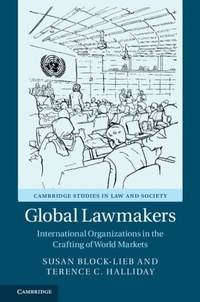
Global Lawmakers
International Organizations in the Crafting of World Markets
Published on 27. November 2017
978-1-316-95351-8 (ISBN)
Description

Global lawmaking by international organizations holds the potential for enormous influence over world trade and national economies. Representatives from states, industries, and professions produce laws for worldwide adoption in an effort to alter state lawmaking and commercial behaviors, whether of giant multi-national corporations or micro, small and medium-sized businesses. Who makes that law and who benefits affects all states and all market players. Global Lawmakers offers the first extensive empirical study of commercial lawmaking within the United Nations. It shows who makes law for the world, how they make it, and who comes out ahead. Using extensive and unique data, the book investigates three episodes of lawmaking between the late 1990s and 2012. Through its original socio-legal orientation, it reveals dynamics of competition, cooperation and competitive cooperation within and between international organizations, including the UN, World Bank, IMF and UNIDROIT, as these IOs craft international laws. Global Lawmakers proposes an original theory of international organizations that seek to construct transnational legal orders within social ecologies of lawmaking. The book concludes with an appraisal of creative global governance by the UN in international commerce over the past fifty years and examines prospective challenges for the twenty-first century.
Reviews / Votes
'A magnificent book on who makes the commercial law of the world, and how. Beautifully written, its pages present an ethnography of transnational legal orders and insurgent orders. Insider accounts divulge how order evolves in circumstances of intersecting financial, trade and transport complexity. Actors in this amazing story make new legal boundaries, blur boundaries, extend boundaries and constrict them. Block-Lieb and Halliday deftly and evocatively explain dynamic ecologies of global lawmaking. Their research excavates the spaces where inventive global governance can indeed prove possible. This work of rich new insight reveals the processes through which governance is crafted. We learn no less than how the infrastructure of global capitalism is built.' John Braithwaite, Distinguished Professor and Founder, School of Regulation and Global Governance (RegNet), Australian National University, Canberra 'We are lucky that this first major social science study of lawmaking by the United Nations Commission on International Trade Law (UNCITRAL) has been produced by scholars of such nuance and breadth. Using ethnographic methods to answer sociological questions, Block-Lieb and Halliday unearth an entire layer of social processes and interactions that inform global law, with major implications for how we understand transnational processes. A masterful illustration of what happens when scholars combine a careful empirical orientation with nimble theory, we learn about the world of global lawmaking and also learn new ways to study it.' Tom Ginsburg, Leo Spitz Professor of International Law, Ludwig and Hilde and Wolf Research Scholar, University of Chicago 'This book compellingly addresses the big question of global lawmaking by analyzing the deceptively mundane and seemingly neutral procedures for creating trade law for the world. Block-Lieb and Halliday show that how law is made has far-reaching consequences for what law is made. Sociologists and political scientists committed to explaining the genesis of international laws and global norms must now reckon not only with the relative political or economic status of states and industry, but also with formal and informal processes of deliberation and drafting, cooperation and competition. By showing us how international negotiations work behind closed doors, the book compels scholars and policymakers alike to reconsider who governs, and by what means. This book offers nothing less than new tools for understanding power at the international arena.' Nitsan Chorev, Harmon Family Professor of Sociology and International and Public Affairs, Brown University, Rhode Island, and author of The World Health Organization between North and South 'This enlightening book by Block-Lieb and Halliday takes a deep dive into the often opaque world of transnational law making. Based on a rare longitudinal study of a rich set of sources, the authors present an exceptionally penetrating analysis into how processes of law-making shape outcomes in transnational governance. This book will be required reading for scholars and practitioners in international relations, global governance, socio-legal research, organization studies and related fields.' Sigrid Quack, Director of the Centre for Global Cooperation Research, Universitaet Duisburg-Essen 'The narrative of UNCITRAL's pursuit of a competitive edge over the past fifty years rests on a highly convincing conceptual approach. Through its original socio-legal orientation, the book reveals the struggles inside UNCITRAL as well as dynamics of competition, cooperation and competitive cooperation among international organisations. As such, it is an important extensive empirical study of commercial law-making within UNCITRAL, and makes a valuable contribution to the theory of international organizations. Its framework as well as its informative and engaging findings will be beneficial for many researchers interested in international organization, the international system, global civil society and global governance in the years to come.' Ondrej Svoboda, International Organizations Law Review '... it is an important extensive empirical study of commercial law-making within UNCITRAL, and makes a valuable contribution to the theory of international organizations. Its framework as well as its informative and engaging findings will be beneficial for many researchers interested in international organization, the international system, global civil society and global governance in the years to come.' Ondrej Svoboda, International Organizations Law ReviewMore details
Series
Language
English
Place of publication
Cambridge
United Kingdom
Publishing group
Cambridge University Press
Target group
Professional and scholarly
Illustrations
Worked examples or Exercises; 17 Tables, black and white; 5 Line drawings, black and white
File size
4,63 MB
ISBN-13
978-1-316-95351-8 (9781316953518)
Copyright in bibliographic data and cover images is held by Nielsen Book Services Limited or by the publishers or by their respective licensors: all rights reserved.
Schweitzer Classification
Other editions
Additional editions
Susan Block-Lieb | Terence C. Halliday
Global Lawmakers
International Organizations in the Crafting of World Markets
Book
10/2017
Cambridge University Press
€56.00
Shipment within 15-20 days
Susan Block-Lieb | Terence C. Halliday
Global Lawmakers
International Organizations in the Crafting of World Markets
Book
10/2017
Cambridge University Press
€122.30
Shipment within 15-20 days
Persons
Susan Block-Lieb is the Cooper Family Professor in Urban Legal Issues at Fordham University, New York, School of Law. Terence C. Halliday is Co-Director at the Center on Law and Globalization, and Research Professor at the American Bar Foundation. He is Honorary Professor at the School of Regulation and Global Governance, the Australian National University, Canberra, and Adjunct Professor of Sociology at Northwestern University, Illinois.
Content
1. Lawmaking ecologies for global markets; 2. Emergence of a lawmaking ecology; 3. Issue ecologies in formation; 4. Delegations and delegates; 5. The work of lawmaking; 6. Creative design in legal technologies; 7. Whose global norms?; 8. The lawmaking of lawmaking; 9. Rivalries; 10. Inventive global governance.
