

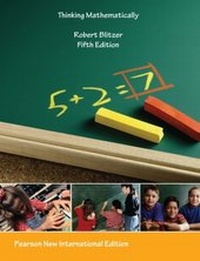
Thinking Mathematically
Description

Blitzer continues to raise the bar with his engaging applications developed to motivate students from diverse majors and backgrounds. Thinking Mathematically, Fifth Edition, draws from the author's unique background in art, psychology, and math to present math in the context of real-world applications.
Students in this course are not math majors, and they may never take a subsequent math course, so they are often nervous about taking the class. Blitzer understands those students' needs and provides helpful tools in every chapter to help them master the material. Voice balloons appear right when students need them, showing what an instructor would say when leading a student through the problem. Study tips, chapter review grids, Chapter Tests, and abundant exercises provide ample review and practice.
The Fifth Edition's MyMathLab® course boasts more than 2,000 assignable exercises, plus a new question type for applications-driven questions that correlate to section openers in the textbook. Chapter Test Prep Videos show students how to work out solutions to the Chapter Tests; the videos are available on DVD, in MyMathLab, and on YouTube(TM).All prices
More details
Other editions
Additional editions
Content
1.1 Inductive and Deductive Reasoning
1.2 Estimation, Graphs, and Mathematical Models
1.3 Problem Solving
2. Set Theory
2.1 Basic Set Concepts
2.2 Subsets
2.3 Venn Diagrams and Set Operations
2.4 Set Operations and Venn Diagrams with Three Sets
2.5 Survey Problems
3. Logic
3.1 Statements, Negations, and Quantified Statements
3.2 Compound Statements and Connectives
3.3 Truth Tables for Negations, Conjunction, and Disjunction
3.4 Truth Tables for the Conditional and the Biconditional
3.5 Equivalent Statements and Variations of Conditional Statements
3.6 Negations of Conditional Statements and De Morgan's Laws
3.7 Arguments and Truth Tables
3.8 Arguments and Euler Diagrams
4. Number Representation and Calculation
4.1 Our Hindu-Arabic System and Early Positional Systems
4.2 Number Bases in Positional Systems
4.3 Computation in Positional Systems
4.4 Looking Back at Early Numeration Systems
5. Number Theory and the Real Number System
5.1 Number Theory, Prime and Composite Numbers
5.2 The Integers; Order of Operations
5.3 The Rational Numbers
5.4 The Irrational Numbers
5.5 Real Numbers and Their Properties
5.6 Exponents and Scientific Notation
5.7 Arithmetic and Geometric Sequences
6. Algebra: Equations and Inequalities
6.1 Algebraic Expressions and Formulas
6.2 Linear Equations in One Variable and Proportions
6.3 Applications of Linear Equations
6.4 Linear Inequalities in One Variable
6.5 Quadratic Equations
7. Algebra: Graphs, Functions, and Linear Systems
7.1 Graphing and Functions
7.2 Linear Functions and Their Graphs
7.3 Systems of Linear Equations in Two Variables
7.4 Linear Inequalities in Two Variables
7.5 Linear Programming
7.6 Modeling Data: Exponential, Logarithmic, and Quadratic Functions
8. Consumer Mathematics and Financial Management
8.1 Percent, Sales Tax, and Income Tax
8.2 Simple Interest
8.3 Compound Interest
8.4 Annuities, Stocks, and Bonds
8.5 Installment Loans, Amortization, and Credit Cards
9. Measurement
9.1 Measuring Length; The Metric System
9.2 Measuring Area and Volume
9.3 Measuring Weight and Temperature
10. Geometry
10.1 Points, Lines, Planes, and Angles
10.2 Triangles
10.3 Polygons, Perimeter, and Tessellations
10.4 Area and Circumference
10.5 Volume
10.6 Right Triangle Trigonometry
10.7 Beyond Euclidean Geometry
11. Counting Methods and Probability Theory
11.1 The Fundamental Counting Principle
11.2 Permutations
11.3 Combinations
11.4 Fundamentals of Probability
11.5 Probability with the Fundamental Counting principle, Permutations, and Combinations
11.6 Events Involving Not and Or; Odds
11.7 Events Involving And; Conditional Probability
11.8 Expected Value
12. Statistics
12.1 Sampling, Frequency Distributions, and Graphs
12.2 Measures of Central Tendency
12.3 Measures of Dispersion
12.4 The Normal Distribution
12.5 Problem Solving with the Normal Distribution
12.6 Scatter Plots, Correlation, and Regression Lines
13. Mathematical Systems
13.1 Mathematical Systems
13.2 Rotational Symmetry, Groups, and Clock Arithmetic
14. Voting and Apportionment
14.1 Voting Methods
14.2 Flaws of Voting Methods
14.3 Apportionment Methods
14.4 Flaws of Apportionment Methods
