

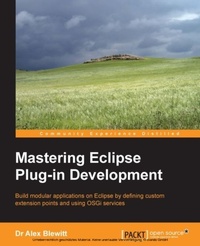
Mastering Eclipse Plug-in Development
Build modular applications on Eclipse by defining custom extension points and using OSGi services
Published on 7. October 2025
362 pages
978-1-78328-780-2 (ISBN)
Description

Key Features
Book DescriptionMastering Eclipse Plug-in Development shows you how to build an extensible application using custom extension points and dynamic OSGi services in Eclipse. Dynamic design patterns such as whiteboard and extender are covered along with specific techniques to deal with native and legacy code. This book dives right into the details and teaches you how to define new JFace wizards and extend Eclipse with custom extension points. Then the book moves quickly on to the details of how to define new commands for the Eclipse console and how to include native code in a plug-in. You will engage with modular application design patterns and Thread Context ClassLoaders before getting the details on how to create as well as manage P2 sites and write help documentation for an Eclipse plug-in.What you will learn
Create a custom extension point to allow other plugins to contribute
Employ Declarative Services and Blueprint for dynamic OSGi contributions
Extend the Common Navigator Framework to provide nested content
Build commands to extend the builtin Gogo shell
Use fragments to contribute native code to plugins
Fix code using the service loader and wrap nonOSGifriendly JARs
Discover how to build modular applications with decoupled design patterns
Who this book is for
Book DescriptionMastering Eclipse Plug-in Development shows you how to build an extensible application using custom extension points and dynamic OSGi services in Eclipse. Dynamic design patterns such as whiteboard and extender are covered along with specific techniques to deal with native and legacy code. This book dives right into the details and teaches you how to define new JFace wizards and extend Eclipse with custom extension points. Then the book moves quickly on to the details of how to define new commands for the Eclipse console and how to include native code in a plug-in. You will engage with modular application design patterns and Thread Context ClassLoaders before getting the details on how to create as well as manage P2 sites and write help documentation for an Eclipse plug-in.What you will learn
Create a custom extension point to allow other plugins to contribute
Employ Declarative Services and Blueprint for dynamic OSGi contributions
Extend the Common Navigator Framework to provide nested content
Build commands to extend the builtin Gogo shell
Use fragments to contribute native code to plugins
Fix code using the service loader and wrap nonOSGifriendly JARs
Discover how to build modular applications with decoupled design patterns
Who this book is for
All prices
More details
Edition
Digital original
Language
English
Place of publication
Birmingham
United Kingdom
Target group
Professional and scholarly
US School Grade: College Graduate Student
Edition type
Digital original
File size
5,28 MB
ISBN-13
978-1-78328-780-2 (9781783287802)
Copyright in bibliographic data and cover images is held by Nielsen Book Services Limited or by the publishers or by their respective licensors: all rights reserved.
Schweitzer Classification
Other editions
Additional editions
Alex Blewitt
Mastering Eclipse Plug-In Development
Book
08/2014
Packt Publishing
€63.60
Shipment within 3-4 weeks
Person
Blewitt Alex :
contacted on 30 aug 16 _____________ Dr Alex Blewitt has over 20 years of experience in Objective-C and has been using Apple frameworks since NeXTstep 3.0. He upgraded his NeXTstation for a TiBook when Apple released Mac OS X in 2001 and has been developing on it ever since. Alex currently works for an investment bank in London, writes for the on-line technology news site InfoQ and has published two other books for Packt publishing. He also has a number of apps on the Apple AppStore through Bandlem Limited. When he's not working on technology, and if the weather is nice, he likes to go flying from the nearby Cranfield airport. Alex writes regularly at his blog, http://alblue.bandlem.com, as well tweeting regularly from Twitter as @alblue. Acknowledgements This book would not have been possible without the ongoing love and support of my wife Amy, who has helped me through both the highs and lows of life. She gave me the freedom to work during the many late nights and weekends that it takes to produce a book and its associated code repository. She truly is the Lem of my life. I'd also like to thank my parents, Ann and Derek, for their encouragement and support during my formative years. It was this work ethic that allowed me to start my technology career as a teenager and to incorporate my first company before I was 25. I'd also like to congratulate them on their 50th wedding anniversary in 2015, and I look forward to reaching that goal with Amy. Thanks are due especially to the reviewer of this version of the book: Antonio Bello, as well as the previous version of this book: Nate Cook, James Robert and Arvid Gerstmann, who provided excellent feedback on the contents of this book during development and caught many errors in both the text and code. Any remaining errors are my own. I'd also like to thank my children Sam and Holly for inspiring me and hope that they too can achieve anything that they set their minds to. Finally, I'd like to thank Ben Moseley and Eren Kotan, both of whom introduced me to NeXT in the first place and set my career going on a twenty year journey to this book. Limited Bandlem :
Dr Alex Blewitt has been developing Java applications since version 1.0 was released in 1996, and has been using the Eclipse platform since its first release as part of the IBM WebSphere Studio product suite. He got involved in the open source community as a tester when Eclipse 2.1 was being released for macOS, and then subsequently as an editor for EclipseZone, including being a finalist for Eclipse Ambassador in 2007. More recently, Alex has been writing for InfoQ, covering Java and specifically Eclipse and OSGi subjects. He is co-founder of the Docklands.LJC, a regional branch of the London Java Community in the Docklands, and a regular speaker at conferences. Alex currently works for an investment bank in London, and is a Director of Bandlem Limited. Alex blogs at https://alblue.bandlem.com and tweets as @alblue on Twitter, and is the author of both Mastering Eclipse 4 Plug-in Development, and Swift Essentials, both by Packt Publishing.
contacted on 30 aug 16 _____________ Dr Alex Blewitt has over 20 years of experience in Objective-C and has been using Apple frameworks since NeXTstep 3.0. He upgraded his NeXTstation for a TiBook when Apple released Mac OS X in 2001 and has been developing on it ever since. Alex currently works for an investment bank in London, writes for the on-line technology news site InfoQ and has published two other books for Packt publishing. He also has a number of apps on the Apple AppStore through Bandlem Limited. When he's not working on technology, and if the weather is nice, he likes to go flying from the nearby Cranfield airport. Alex writes regularly at his blog, http://alblue.bandlem.com, as well tweeting regularly from Twitter as @alblue. Acknowledgements This book would not have been possible without the ongoing love and support of my wife Amy, who has helped me through both the highs and lows of life. She gave me the freedom to work during the many late nights and weekends that it takes to produce a book and its associated code repository. She truly is the Lem of my life. I'd also like to thank my parents, Ann and Derek, for their encouragement and support during my formative years. It was this work ethic that allowed me to start my technology career as a teenager and to incorporate my first company before I was 25. I'd also like to congratulate them on their 50th wedding anniversary in 2015, and I look forward to reaching that goal with Amy. Thanks are due especially to the reviewer of this version of the book: Antonio Bello, as well as the previous version of this book: Nate Cook, James Robert and Arvid Gerstmann, who provided excellent feedback on the contents of this book during development and caught many errors in both the text and code. Any remaining errors are my own. I'd also like to thank my children Sam and Holly for inspiring me and hope that they too can achieve anything that they set their minds to. Finally, I'd like to thank Ben Moseley and Eren Kotan, both of whom introduced me to NeXT in the first place and set my career going on a twenty year journey to this book. Limited Bandlem :
Dr Alex Blewitt has been developing Java applications since version 1.0 was released in 1996, and has been using the Eclipse platform since its first release as part of the IBM WebSphere Studio product suite. He got involved in the open source community as a tester when Eclipse 2.1 was being released for macOS, and then subsequently as an editor for EclipseZone, including being a finalist for Eclipse Ambassador in 2007. More recently, Alex has been writing for InfoQ, covering Java and specifically Eclipse and OSGi subjects. He is co-founder of the Docklands.LJC, a regional branch of the London Java Community in the Docklands, and a regular speaker at conferences. Alex currently works for an investment bank in London, and is a Director of Bandlem Limited. Alex blogs at https://alblue.bandlem.com and tweets as @alblue on Twitter, and is the author of both Mastering Eclipse 4 Plug-in Development, and Swift Essentials, both by Packt Publishing.
Content
Table of Contents
Plugging in to JFace and the common navigator framework
Extending Eclipse with custom extension points
Using OSGi Services to dynamically wire applications
Defining commands for the Gogo shell
Native code and fragments
Understanding service loaders and thread context classloaders
Modular application design patterns
Communicating within an application using OSGi Events
Advanced P2 interaction
Writing Eclipse help documentation
Plugging in to JFace and the common navigator framework
Extending Eclipse with custom extension points
Using OSGi Services to dynamically wire applications
Defining commands for the Gogo shell
Native code and fragments
Understanding service loaders and thread context classloaders
Modular application design patterns
Communicating within an application using OSGi Events
Advanced P2 interaction
Writing Eclipse help documentation

