

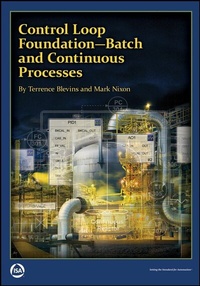
Control Loop Foundation - Batch and Continuous Processes
Description

Control Loop Foundation: Batch and Continuous Processes reviews the fundamental principles of industrial process control in a clear and practical way. Designed for engineers, technicians and operators new to the field, this book explains how modern control systems monitor and regulate processes like temperature, flow, pressure and level using real-world plant examples, diagrams and hands-on web-based workshops. It covers measurement devices, final control elements (such as valves and drives), field wiring and communications, operator graphics, process characterization, single-loop PID control, tuning and an introduction to advanced model-predictive control.
The authors focus on practical skills rather than complex math. The chapters teach readers how to interpret standard plant documents (plot plans, PIDs, loop diagrams), and tune and test controllers and design operator interfaces for safety and efficiency. Interactive web exercises allow readers to run simulated processes, perform step tests and practice tuning controllers. This book also discusses control system goals, including economics, safety and environmental compliance and offers practical examples, such as boiler draft control and ammonia synthesis, to emphasize the importance of good control.
More details
Other editions
Additional editions
Person
Terrence "Terry" Blevins has been actively involved in the application and design of process control systems throughout his career. For more than 15 years, he worked as a systems engineer and group manager in the design and startup of advanced control solutions for the pulp and paper industry. Terry was instrumental in the establishment of Emerson Process Management's Advanced Control Program. From 1998-2005, Terry was the team lead for the development of DeltaV advanced control products. He is the Fieldbus Foundation(TM) team lead for the development and maintenance of the Function Block Specification and editor of the SIS Architecture and Model Specifications. In this capacity, Terry is involved in the movement of Fieldbus Foundation function block work into international standards. Terry is the U.S. expert to the IEC SC65E WG7 function block committee that is responsible for the IEC 61804 function block standards. He is a voting member and chairman of ISA104-EDDL (Electronic Device Description Language) committee and is the technical advisor to the United States Technical Advisory Group (USTAG) for the IEC65E subcommittee. He is also a member of the USNC TAG (IEC/SC65 and IEC/TC65). Terry authored "An Overview of the ISA/IEC Fieldbus," Section 11, Standards Overview, Fifth Edition of the Process/Industrial Instruments and Controls Handbook and coauthored four sections in the Fourth Edition of the Instrumentation Engineer's Handbook, Process Control and Optimization. He coauthored the ISA bestselling book Advanced Control Unleashed. He has 36 patents and has written over 65 papers on process control system design and applications. Terry received a Bachelor of Science in Electrical Engineering from the University of Louisville in 1971 and a Master of Science in Electrical Engineering from Purdue University in 1973. In 2004, he was inducted into Control Magazine's Process Automation Hall of Fame. Presently, Terry is a principal technologist in the future architecture team of DeltaV Product Engineering at Emerson Process Management.
Mark Nixon has been involved in the design and development of control systems throughout his career. Mark started his career as a systems engineer working on projects in oil & gas, refining, chemicals, and pulp & paper. He moved from Canada to Austin, TX in 1998 where he has held a variety of positions in both research and development. From 1995-2005, Mark was lead architect for DeltaV. In 2006, he joined the wireless team, taking a very active role in the development of the ixWirelessHART specifications and the development of the IEC 62591 standardization. Mark's current research includes control using WirelessHART devices, data analytics for batch process, use of wireless technology the process industry, mobile users, operator interfaces, and advanced graphics. He is currently active in the Center for Operator Performance (http://www.operatorperformance.org), WirelessHART, ISA-88 standard, Foundation Fieldbus standards (http:// www.fieldbus.org/), and ISA-101 standard. He has written numerous papers and currently holds more than 45 patents. He coauthored WirelessHART: Real-Time Mesh Network for Industrial Automation and has made contributions to the Industrial Instruments and Controls Handbook and Essentials of Modern Measurements and Final Elements in the Process Industry. Mark received his Bachelor of Science in Electrical Engineering from the University of Waterloo in 1982.
Content
1
Introduction
This book originally started as a special class for new engineers within one of Emerson Process Management's engineering divisions, but has since grown in both scope and depth of material that is addressed. There are many aspects of process control systems, and the book is structured to allow engineers, managers, technicians, and others that are new to process control to get up to speed more quickly on process control and related areas. Experienced control engineers will benefit from the application examples and workshops on process control design and implementation of multi-loop control strategies.>
The material is presented in a manner that is independent of the control system manufacturer.
The background material included in the first part of the book will be helpful to a new engineer who is just starting in this field and perhaps has never worked in a plant environment. Much of the material presented on the practical aspects of control system design and process applications is typically not included in process control taught at the university level.
Many of the topics that are addressed in the book are areas that the authors have learned through hands-on experience gained while working in the design and commissioning of process control systems. Also, we have benefited from the insight of many people working in process control. This is a good way to learn, but it's maybe not always the best or most efficient way to become proficient in these areas. Our goal, then, is to address concepts and terminology that an engineer needs when working in the process industry. We hope that this information will provide helpful insight as you look at a specific control system and how it's used, and how best to use this equipment while addressing the different application requirements. Whether you are working as a process control engineer in a manufacturing plant, working in a controls group in an engineering department, or working in an instrumentation department within a manufacturing plant, we hope the information provided here will help you in your work and will set a solid foundation that allows you to confidently address new control applications in the future.
A lot has changed in the process industry over the last 30 some-odd years since we first started work as process control engineers. When we first started working with process control systems, as an engineer you often had an opportunity to see the whole project-working with the plant, developing the controls strategy, documentation, and user interface, and then commissioning the system. In some cases, this involved modifying the control system software and hardware required to support the control strategy. This opportunity existed because at that time, the control groups were often small and were focused on supporting plant operations. In some cases, you'd be given a plane ticket, travel to the plant site, discuss the application's requirements, come back to the office to develop the process control strategy and user interface, and then return to the plant to commission the control system. The ultimate measure of success was whether the plant was happy with the system's performance and with the benefits realized as a result of improved plant efficiency or throughput. As an engineer, you also had the personal satisfaction of providing the operators with better tools to manage and improve plant performance.
Today, many control system design organizations are much bigger; thus, it is possible for a person working on some aspects of a control system not to be involved in operator training or the commissioning of the control system. This is unfortunate since in that case you don't have an opportunity to see the full picture of how things fit together or to get direct and immediate feedback on how well a new or updated control system performed and whether it was necessary to make changes in the field to meet plant operators' or management's operational requirements. So, the application examples in each chapter are designed to help you gain an appreciation for all aspects of the design, implementation, and commissioning of a control system.
The book's background material is organized so that new concepts build on material presented in previous sections. As you read the book, we suggest you cover the material in the order it is presented. If you have worked with control systems in the past, then the first part of the book may cover material you already know. Even so, it would be a good idea to at least review those chapters. Many of the terms introduced in the first portion of the book are defined to establish a basis for understanding, which will be required to appreciate and apply the material on control system design and implementation presented in later sections of the book. Also, this background material is intended to promote an appreciation for the way in which many of the terms and concepts that form the foundation of industrial process control have evolved over time and through the efforts of many people involved in control system design and implementation. An understanding of these terms and why they have been traditionally described in a certain way can be helpful when considering the best way to meet the requirements of a new process. Also, with this understanding, it should become clear that the control system can and should be designed independent of the equipment manufacturer and the technology used.
We also take the approach that you may not have worked in a process plant environment and that you may be unfamiliar with the field devices that the control system interfaces with, how these devices work, and the limitations of these devices. Thus, the background material in the first part of the book covers concepts and terminology that you'll find helpful in working with these field devices. For example, some chapters are dedicated to an overview of wiring and the field devices that are typically used in industry. The field devices (measuring devices and actuators) selected to instrument a process can impact control system performance, including the accuracy and speed with which changes in the process can be sensed and corrected. In addition, the wiring of the control system varies depending on whether a field device uses analog or digital technology.
Throughout the book, we show examples of drawings and other documents that are typical of what is used in industry to support control system design and maintenance. If you are involved in control system design, then it will be necessary for you to create documents that outline the basic control requirements and detail the measurement, calculation, and control strategy that will be used to address these requirements. Within the process industry, the engineering firm that initially designs a plant or the engineering department of a company that commissions new plant construction establishes the standards for control system documentation. In nearly all cases, the basic types of documents used in the process industry are fairly well standardized, even though there may be some variation at the detail level. Process examples are included to illustrate how these documents are used during the design and maintenance of the control system. An understanding of control system documentation is helpful when you are talking to someone about process control since such discussions often involve pulling out and reviewing some of these documents. Thus, it is important to understand why these documents are created, what information each document should communicate, and how to understand the symbols and terminology used in these documents.
Having established a background on field devices and control system documentation, we then address techniques that may be used to describe the dynamic behavior of a process. In the chapter on process characterization, we introduce terminology to describe both the static and dynamic responses of a process. This material sets a foundation for the remaining chapters on control design. How process behavior impacts control system design and commissioning will become clear as we address control system design.
At various points in the chapters on process characterization and control system design, you will have an opportunity to apply these concepts by using example workshops. These workshops are provided on a website and thus may be accessed without special tools or special software. The only thing that is required is access to a high-speed Internet connection and the web browser installed on your personal computer. In the Appendix, we provide detailed directions on how to access the website that supports these workshops. A video that shows the workshop solution is contained on the website. In addition, after some chapters there are questions that you may want to review and answer to judge how well you understand and remember the material. These questions are structured to be fun as well as informative. As you consider the appropriate answer to a question, feel free to go back through the chapter if you are uncertain of the answer. The objective of these study questions is to reinforce the learning process.
In looking at control system design, it is important to keep in mind the plant's requirements and how the control system will be used in the plant. For example, what are the production and quality objectives that must be met? If you don't have a clear picture of the goals to be achieved, it will be difficult to choose the measurement and control techniques that should be employed in the control system design. As part of the material presented...
