

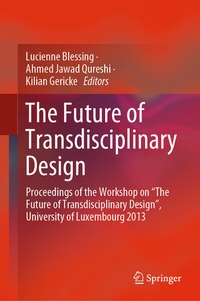
The Future of Transdisciplinary Design
Description

This book presents the state-of-the-art research in the field of transdisciplinary design, and highlights the challenges and issues from the perspectives of processes, people and products in transdisciplinary product design and development. It collates research papers resulting from the 'Workshop on the Future of Transdisciplinary Design' written by leading researchers in engineering design and product development. The papers provide examples and case studies from existing practices, as well as future perspectives towards the development of the complex and ever-changing domains of engineering design and product development, with an emphasis on transdisciplinarity.
'The Future of Transdisciplinary Design' contains a selection of research papers in the following areas related to transdisciplinary design:
-Approaches
-Tools and methods
-Management and collaboration
-Distributed and culturally diverse teams
-Modeling, representing and managing information
-Education and training
A transdisciplinary design process is a design process involving the integrated use of knowledge, methods and tools from various disciplines. Design of product/services increasingly requires cross-disciplinary collaboration, and integration of specialized knowledge from different disciplines is necessary to tackle complex and large scale design problems. This book provides a valuable reference to researchers, professionals and PhD students in the field of engineering design and product development. Design practitioners and those involved in product development in the manufacturing industry will equally benefit from the research presented as well as future advances in this research.
More details
Other editions
Additional editions
Persons
Lucienne studied in Delft (MSc) and Twente (PhD), was lecturer at University of Twente (Netherlands);Senior Research Associate at Cambridge University Engineering Design Centre; Vice-president for Research and International Relations and Professorin Engineering Design and Methodology at Technical University Berlin; vice-president for Research and Professor in Engineering Design and Methodology at University of Luxembourg; interim Director of University of the Greater Region (a consortium of 6 universities in Germany, France, Belgium and Luxembourg).Lucienne has 30 years of teaching experience in product development and design research, supervised over 30 PhD students, was Editor-in-Chief (Europe) of Research in Engineering Design (Springer), translated Pahl and Beitz' Engineering Design with Ken Wallace, and co-founded the Design Society and served on its Management and Advisory Boards for 18 years.
Research interests: Empirical studies into design;Design theory, methods and methodologies; System design; User experience; Design research methodology, Transdisciplinarity.
Ahmed Qureshi, Department of Mechanical Engineering, University of Alberta
Ahmed is an Assistant Professor at the Department of Mechanical Engineering at the University of Alberta and leads the Additive Design and Manufacturing Systems (ADaMS) Lab. He holds a Master and Ph.D. in engineering design from Arts et MetiersParisTech, France. His research interests include additive manufacturing, product design, engineering design, engineering education, design for X, design optimization, and manufacturing systems design. Ahmed has been actively involved in research in engineering design education and has been involved in a number of initiatives of program restructuring, curriculum, and course development, and improving the student learning experience in a rapidly evolving technical higher education industry through the use of cross-disciplinary tools and technologies.Ahmed's expertise lies in the area of design and development of metal, polymer, and polymer composite additive manufacturing (AM) systems, AM for microfluidics, and design and manufacturing systems automation.His research has made a number of breakthrough improvements in the area of additive manufacturing systems design, specifically in the area of next-generation material jetting for engineered functional materials, design of ferromagnetic composite materials for 3D printing, and development of Ni-WC metal-ceramic 3D printing materials and manufacturing systems for Canadian Oil sands, and robotic wire-fed arc-based 3D printing systems.Qureshi is also an ambassador for technology in engineering education as well as the extended reality (XR) for the Cognitive Projections initiative of the Faculty of Rehabilitation at the University of Alberta.
Kilian Gericke, Professor, Chair of Product Development, University of Rostock, Germany
Kilian is a design researcher with a background in mechanical engineering. He studied Mechanical Engineering in Berlin, Germany. From 2010 until 2019 he worked at the University of Luxembourg in the engineering design and methodology group. Since April 2019 he holds the chair of Product Development at the University of Rostock, Germany.Kilian's research is in the area of product development with a focus on design methodology and design process management, i.e. design process planning, design process improvement, and systematic support of designers (design methods, guidelines, design principles) during the early stages of product development with a particular interest in function modelling.He is interested in the effects of new concepts such as Product Service Systems (PSS), Cyber Physical Systems, and of new manufacturing technologies such as Additive Manufacturing (3D printing) on the design process and in the development of new design methods that support designers in this context.He is co-editor of the book "Pahl/Beitz Engineering Design" and co-author of the revised VDI 2221 guideline.
Content
- Intro
- The Future of Transdisciplinary Design
- Workshop Committee
- Scientific Committee
- Preface
- References
- Contents
- Transdisciplinary Design Approaches
- Opening up Design Methodology
- 1 Introduction
- 2 Current State and Critiques of Design Methodology
- 2.1 Consolidation is Required
- 2.2 Critique of Current Design Methodologies
- 3 Transferring Design Methodology into Practice
- 3.1 The Missing Link
- 3.2 Approaches to the Transfer of Design Methodology
- 4 Developments in Design Methodology
- 4.1 Context Dependent Adaptation of Design Methodology
- 4.2 Mindset Approach
- 5 Opening up Design Methodology
- 5.1 From Disjoint Research Communities vs. Design Practice to an Open Design Community
- 5.2 From Static to Dynamic
- 5.3 From Empirical Proof of Value to Community Shared Benefits
- 5.4 From Generic to Context Dependent
- 6 Conclusion
- References
- Design as a Common Denominator
- 1 Introduction
- 2 Case Study: Urban Development and Aerial Infrastructures
- 2.1 The Evolution of the Aerial Distribution System
- 2.2 The Contextual Environment
- 2.3 Problem Solving and the Dynamics of Multidisciplinary Teams
- 3 The Shortcomings of Disciplinarity
- 4 The Ambiguous Nature of Design
- 5 Transdisciplinarity: Feasible or Utopian?
- 6 Conclusion
- References
- Ineffective Collaboration in Multi-Disciplinary Teams
- 1 Introduction
- 2 Terminology Approach
- 3 Rationale
- 4 Research
- 5 Barriers to Multi-Disciplinary Collaborations
- 5.1 Communication Barriers
- 5.2 Uncertain Roles and Contributions
- 5.3 Discrepancy Between Self- Perception and External Perception
- 6 Trans-Disciplinary Design
- 7 Conclusions
- References
- Modelling, Representing and Managing Information in Transdisciplinary Design
- Design of Information-Intensive Systems Involving Cognitive Aspects: An Emerging Opportunity for Transdisciplinary Cooperation
- 1 Introduction
- 2 Transdisciplinarity in the Context of Developing IISs
- 3 Cognitive Aspects and Issues of IISs
- 4 Simulating Cognitive Loads and Processing Times
- 5 Realizing Awareness of Mental Models in IISs
- 6 Discussion and Conclusions
- References
- Visually Augmented Analysis of Socio-Technical Networks in Engineering Systems Design Research
- 1 Introduction
- 2 Background/Related Works
- 2.1 Complex Networks
- 2.2 Complex Networks in Engineering Systems Design Research
- 2.3 Organic Visualisation of Complexity and Dynamics
- 3 OrganicViz Visual Analysis Tool
- 4 Case Studies
- 4.1 Information Evolution Traceability
- 4.2 Complex Behaviour Patterns in Information Seeking Activities
- 4.3 After-Sales Services for Supporting Open Innovation
- 5 Discussion and Conclusions
- References
- Selecting Models from Biology and Technical Product Development for Biomimetic Transfer
- 1 Introduction
- 2 Literature Review: Using Models for Biomimetic Transfer
- 2.1 Biomimetic Transfer
- 2.2 Model Definitions
- 3 Approach
- 3.1 Engineers' Information Needs in Technical Product Development
- 3.2 Biologists' Information Needs During Research
- 4 Selection of Biological Models
- 4.1 Hypothesis 1
- 4.2 Hypothesis 2
- 5 Discussion
- 6 Conclusion and Outlook
- References
- Transdisciplinary Design Approaches
- Play and Transdisciplinary Understanding
- 1 Introduction
- 2 Transdisciplinarity and Complexity
- 3 Play in a Transdisciplinary Context
- 4 Serious Play
- 5 Methodology
- 6 Case Study on Exploration of the Guiding Principles Through Play
- 7 Reflections
- 7.1 Empirical Observations and Aggregation of Insights
- 7.2 The Facilitation of Collective Exploration
- 7.3 The Collective Concentration and Focusing
- 7.4 The Emergence of a Shared and Sufficient Language
- 7.5 The Emergence of Collective Understanding
- 7.6 The Emergence of Individual and Collective Commitment
- 8 Conclusions
- References
- The Elusive Character of Design Ideas
- 1 Introduction
- 2 Exploration
- 3 Relating and Naming
- 3.1 Richness, Complexity and Reduction
- 3.2 Saturday Special Edition
- 4 An Explorative Study
- 5 Analysis and Interpretation
- 5.1 Building a Shared Understanding
- 5.2 Design Vision
- 6 Conclusions and Recommendations
- References
- The Evolution of Systems Thinking in Interaction Across Disciplinary Boundaries-Cases from Space Industry
- 1 Introduction
- 1.1 Multi-Disciplinary Interaction Modelled as Boundary Management
- 1.2 Learning as Evolution of Knowledge and Thinking
- 2 Approach
- 3 Findings and Discussion
- 3.1 Multi-Disciplinary Quality of Interaction and Its Influence on Learning Systems Thinking
- 3.2 Awareness of Diversity and Orientation Towards Extra-Disciplinary Interactors
- 3.3 Reference Repertoire as a Measure of Systems Thinking
- 3.4 A Strategy to Foster the Multi-Disciplinary Quality of Interaction
- 4 Conclusion
- References
- Tools and Methods in Transdisciplinary Design
- The Benefits of an Enhanced Design Methodology Applied to Innovative Product Development
- 1 Introduction
- 2 Approach
- 2.1 Building the First Models
- 2.2 Experimental Context
- 2.3 Benefits
- 3 Conclusion
- References
- Transdisciplinary Research-Buildings as Service-Oriented Product-Service Systems
- 1 Introduction
- 2 Buildings as PSS Mindset
- 3 Service-Oriented PSS
- 4 Discussion
- 5 Conclusion
- References
- A Transdisciplinary Approach to Model User-Product Interaction: How the Collaboration Between Human Sciences and Engineering Design Could Improve Product Development for Physically Impaired People
- 1 Introduction
- 2 Human Centred Design-A Chance for Transdisciplinarity
- 3 Biomechanical Modeling to Evaluate User-Product Interaction
- 3.1 Fundamentals of Biomechanical Simulation
- 3.2 Human Motor Control and a Technical Implementation
- 3.3 Human Models with Performance Restrictions
- 4 Case Study: Design of a Bicycle Frame
- 4.1 Objective
- 4.2 Model
- 4.3 Results and Discussion
- 5 Conclusion and Outlook
- References
- Management and Collaboration in Transdisciplinary Design
- Transdisciplinary Design: The Environment for Bridging Research Across and Beyond Design as a Discipline
- 1 Introduction
- 2 Review of the Literature
- 3 Hints from Multidisciplinary and Transdisciplinary Design Environments
- 4 Discussion
- 5 Conclusion
- References
- A Comparison of Two Transdisciplinary Human-Centered Design Approaches for Poverty Alleviation
- 1 Introduction
- 1.1 Pioneering Organizations in HCD for Social Impact
- 1.2 Methods and Study Projects
- 2 The Design Process
- 2.1 The Project Brief
- 2.2 Inspiration
- 2.3 Ideation
- 2.4 Implementation
- 3 Analysis of Project Case Studies
- 4 Discussion and Future Research
- References
- The Concept of Product Experience in Industrial Goods Development
- 1 Introduction
- 2 Theoretical Framework
- 2.1 Transdisciplinarity
- 2.2 Industrial Goods
- 2.3 Product Experience
- 2.4 Industrial Goods Experience Categories
- 3 Empirical Study
- 4 Discussion
- References
- Team Diversity in Transdisciplinary Design
- Overconstrained and Underconstrained Creativity: Changing the Rhetoric to Negotiate the Boundaries of Design
- 1 Introduction: Requirements for Effective Collaboration
- 2 Creativity in Design
- 3 Transdisciplinary Design
- 4 A Comparative Approach to Studying Design
- 5 Collaboration, Understanding and Respect
- 6 How Constraints Shape Design Behaviour
- 7 Contrasting Design Processes Seen in Terms of Constraints
- 8 Conceptions of Design and Creativity as Barriers to Transdiciplinary Collaboration
- 9 Conclusion
- References
- Project-Based Design and Transdisciplinarity: Rethinking Approaches to Spatial Design Education
- 1 Introduction
- 2 Transdisciplinarity and Complexity
- 3 Real-Life Project: A Case Study
- 4 Problem-Based Learning (PBL) Methodology
- 5 Project-Based Design Case Study-The Designers Clinic and SpeeDesign
- 6 Discussion
- References
- Global Designers and Local Community: Bridging the Gap Through Information and Communication Technologies
- 1 Background
- 1.1 Introduction
- 1.2 Top-Down and Bottom-Up Approaches for Bridging Cultural Gaps with US Native American Nation
- 1.3 Literature Review-Technology to Support Comprehending Conceptions
- 2 Approach
- 2.1 Design Competition as a Design Experiment
- 2.2 The Competition Process
- 2.3 The Treatment: Technology Provided to Support Transdisciplinary Design
- 2.4 Data Collected
- 3 Findings
- 3.1 Who Are the Participants and What Do They Know About the Place and the Users?
- 3.2 What Did the Participants Ask About the Place?
- 3.3 Media
- 3.4 "Meeting the Place" -A Transdisciplinary Evaluation of Design
- 4 Conclusions
- Bibliography
