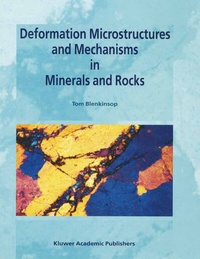
Deformation Microstructures and Mechanisms in Minerals and Rocks
Description

Audience: This book is essential to all practising structural and tectonic geologists who use thin sections, and is an invaluable research tool for advanced undergraduates, postgraduates, lecturers and researchers in structural geology and tectonics.
Reviews / Votes
`The techniques of modern structural geology are highly influenced by analoque and numerical modeling of deformation. Due to the increasing power of computers, these modeling results highly influenced our understanding of deformation mechanisms, rheology of rocks and structures resulting from deformation of rocks. Whereas many articles have been published about the various techniques of modeling, few illustrative books deal with the most important question especially for field geologists: How can we apply this better understanding of deformation related processes when we look at natural rocks especially thin sections. A first advance to fill the gap has been taken by Passchier and Trouw (1996) in their excellent book about "microtectonics." At the first glance the book of Blenkinsop (2000) seems to be a very similar approach. However, this is not the case: Whereas "Microtectonics" focuses on microstructures and shear sense criteria mainly created by ductile deformation, "Deformation Microstructures and Mechanisms in Mineral and Rocks"concentrates cataclastic deformation, diffusive mass transfer, magmatic and submagmatic deformation as well as shock induced microstructures. The book of Blenkinsop is very clearly structured and has many illustrative figures as well as an colour plate appendix with 48 beautiful examples of microstructures in thin sections. In order to use this book for teaching it would be a great idea to include in a following edition a CD with the digital files of all these illustrative pictures.
As a lecturer of an advanced structural geology course I initially through to use one of the two books as textbook. After reading both books in detail I have now the problem that I find both very useful because they focus on different topics of the formation and interpretation of microstructures. I will strongly recommend advanced students studying structural geology to buy the book of Blenkisop.'
ProfessorBernard Grasemann, University of Vienna, Austria
'This book is a competent and useful description of deformation microstructures and mechanisms in minerals and rocks as studied by optical microscopy.... The final chapter , "From microstructures to mountains: deformation microstructures, mechanisms and tectonics", is perhaps somewhat anomalous in that it is significantly more quantitative and integrative and introduces the reader to how observations on the microscopic scale can be used to understand much larger-scale processes. As the latter is still freqquently unappreciated by many geologists, this chapter provides a useful and valuable conclusion to the book and shouldprepare the reader for the prospect of further study using more sophistictaed techniques and methods.'
Geoffrey E. Lloyd / OUP, Journal of Petrology, 43: 10, 2002
More details
Other editions
Additional editions