

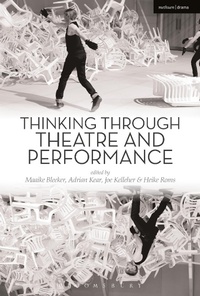
Thinking Through Theatre and Performance
1st Edition
Published on 7. February 2019
336 pages
978-1-4725-7962-1 (ISBN)
Description

Thinking Through Theatre and Performance presents a bold and innovative approach to the study of theatre and performance. Instead of topics, genres, histories or theories, the book starts with the questions that theatre and performance are uniquely capable of asking: How does theatre function as a place for seeing and hearing? How do not only bodies and voices but also objects and media perform? How do memories, emotions and ideas continue to do their work when the performance is over? And how can theatre and performance intervene in social, political and environmental structures and frameworks?
Written by leading international scholars, each chapter of this volume is built around a key performance example, and detailed discussions introduce the methodologies and theories that help us understand how these performances are practices of enquiry into the world.
Thinking through Theatre and Performance is essential for those involved in making, enjoying, critiquing and studying theatre, and will appeal to anyone who is interested in the questions that theatre and performance ask of themselves and of us.
Written by leading international scholars, each chapter of this volume is built around a key performance example, and detailed discussions introduce the methodologies and theories that help us understand how these performances are practices of enquiry into the world.
Thinking through Theatre and Performance is essential for those involved in making, enjoying, critiquing and studying theatre, and will appeal to anyone who is interested in the questions that theatre and performance ask of themselves and of us.
More details
Series
Edition
1. Auflage
Language
English
Place of publication
London
United Kingdom
Publishing group
Bloomsbury Publishing PLC
Target group
College/higher education
Illustrations
30 bw illus
ISBN-13
978-1-4725-7962-1 (9781472579621)
Copyright in bibliographic data and cover images is held by Nielsen Book Services Limited or by the publishers or by their respective licensors: all rights reserved.
Schweitzer Classification
Other editions
Additional editions
Maaike Bleeker | Adrian Kear | Joe Kelleher
Thinking Through Theatre and Performance
Book
02/2019
Methuen Drama
€55.89
Shipment within 15-20 days
Persons
Maaike Bleeker is a Professor of Theatre Studies at Utrecht University, Netherlands. She has also worked as a dramaturge and costume designer. Her publications include Visuality in the Theatre (2008) and several (co)edited volumes, including Anatomy Live. Performance and the Operating Theatre (2008); Performance & Phenomenology (2015); and Transmission in Motion. The Technologizing of Dance (2016).
Adrian Kear is Director of Programme Development, Performance Arts at the University of the Arts London, UK. His books include: Theatre and Event: Staging the European Century (2013); and the co-edited volumes International Politics and Performance: Critical Aesthetics and Creative Practice (with Jenny Edkins, 2013); On Appearance (with Richard Gough, 2008); and Psychoanalysis and Performance (with Patrick Campbell, 2001).
Joe Kelleher is Professor of Theatre and Performance at Roehampton University, London, UK. His books include: The Illuminated Theatre: Studies on the Suffering of Images (2015); Theatre & Politics (2009); The Theatre of Socìetas Raffaello Sanzio (co-authored with Claudia and Romeo Castellucci, Chiara Guidi and Nicholas Ridout, 2007); and Contemporary Theatres in Europe: A Critical Companion (co-edited with Nicholas Ridout, 2006).
Heike Roms is Professor in Theatre and Performance at the University of Exeter, UK. Her books include: Silent Explosion (2015) and, co-edited with Jon McKenzie and C.J.W.-L. Wee, Contesting Performance - Global Sites of Research (2010). Her research into the history and historiography of early performance art won the David Bradby TaPRA Award for Outstanding Research in 2011.
Adrian Kear is Director of Programme Development, Performance Arts at the University of the Arts London, UK. His books include: Theatre and Event: Staging the European Century (2013); and the co-edited volumes International Politics and Performance: Critical Aesthetics and Creative Practice (with Jenny Edkins, 2013); On Appearance (with Richard Gough, 2008); and Psychoanalysis and Performance (with Patrick Campbell, 2001).
Joe Kelleher is Professor of Theatre and Performance at Roehampton University, London, UK. His books include: The Illuminated Theatre: Studies on the Suffering of Images (2015); Theatre & Politics (2009); The Theatre of Socìetas Raffaello Sanzio (co-authored with Claudia and Romeo Castellucci, Chiara Guidi and Nicholas Ridout, 2007); and Contemporary Theatres in Europe: A Critical Companion (co-edited with Nicholas Ridout, 2006).
Heike Roms is Professor in Theatre and Performance at the University of Exeter, UK. Her books include: Silent Explosion (2015) and, co-edited with Jon McKenzie and C.J.W.-L. Wee, Contesting Performance - Global Sites of Research (2010). Her research into the history and historiography of early performance art won the David Bradby TaPRA Award for Outstanding Research in 2011.
Content
Introduction, by Maaike Bleeker, Adrian Kear, Joe Kelleher and Heike Roms
Part 1: Watching
1. Why study drama? by Joe Kelleher (University of Roehampton, London, UK)
2. What do performances do to spectators? by Maaike Bleeker (Utrecht University, Netherlands)
3. How can the theatre be fully accessible? by Colette Conroy (University of Hull, UK)
4. How does stage performance think through cultural convention? by Sean Metzger (UCLA, USA)
5. How does theatre represent economic systems? by Louise Owen (Birkbeck, University of London, UK)
Part 2: Performing
6. What is Black dance? What can it do? by Thomas F. DeFrantz (Duke University, USA)
7. How does scenography think? by Liesbeth Groot Nibbelink (Utrecht University, Netherlands)
8. How does theatre think through things? by Mike Pearson (Aberystwyth University, UK)
9. How does theatre think through incorporating media? by Steve Dixon (LASALLE College of the Arts in Singapore)
10. How does the trained body think? by Broderick D.V. Chow (Brunel University London, UK)
11. How does theatre think through work? by Theron Schmidt (University of New South Wales, Sydney, Australia)
Part 3: Traces
12. What is an intercultural exchange? by Miguel Escobar Varela (National University of Singapore)
13. What is the impact of theatre and performance? by Sruti Bala (University of Amsterdam, Netherlands)
14. Does staging historical trauma reenact it? by Tavia Nyong'o (Yale University, USA)
15. How does theatre think through politics? by Jazmin Badong Llana (De La Salle University, Philippines)
16. How and why are performances documented? by Heike Roms (University of Exeter, UK)
Part 4: Interventions
17. How can performance disrupt institutional spaces? by Dominic Johnson (Queen Mary University of London, UK)
18. How does theatre think through ecology? by Carl Lavery (University of Glasgow, UK)
19. How does choreography think 'through' society? by Bojana Cvejic (Oslo National Academy of the Arts, Norway)
20. How does theatricality legitimize the law? by Sophie Nield (Royal Holloway, University of London, UK)
21. How does theatre think through theatricality? by Adrian Kear (University of the Arts London, UK)
Index
Part 1: Watching
1. Why study drama? by Joe Kelleher (University of Roehampton, London, UK)
2. What do performances do to spectators? by Maaike Bleeker (Utrecht University, Netherlands)
3. How can the theatre be fully accessible? by Colette Conroy (University of Hull, UK)
4. How does stage performance think through cultural convention? by Sean Metzger (UCLA, USA)
5. How does theatre represent economic systems? by Louise Owen (Birkbeck, University of London, UK)
Part 2: Performing
6. What is Black dance? What can it do? by Thomas F. DeFrantz (Duke University, USA)
7. How does scenography think? by Liesbeth Groot Nibbelink (Utrecht University, Netherlands)
8. How does theatre think through things? by Mike Pearson (Aberystwyth University, UK)
9. How does theatre think through incorporating media? by Steve Dixon (LASALLE College of the Arts in Singapore)
10. How does the trained body think? by Broderick D.V. Chow (Brunel University London, UK)
11. How does theatre think through work? by Theron Schmidt (University of New South Wales, Sydney, Australia)
Part 3: Traces
12. What is an intercultural exchange? by Miguel Escobar Varela (National University of Singapore)
13. What is the impact of theatre and performance? by Sruti Bala (University of Amsterdam, Netherlands)
14. Does staging historical trauma reenact it? by Tavia Nyong'o (Yale University, USA)
15. How does theatre think through politics? by Jazmin Badong Llana (De La Salle University, Philippines)
16. How and why are performances documented? by Heike Roms (University of Exeter, UK)
Part 4: Interventions
17. How can performance disrupt institutional spaces? by Dominic Johnson (Queen Mary University of London, UK)
18. How does theatre think through ecology? by Carl Lavery (University of Glasgow, UK)
19. How does choreography think 'through' society? by Bojana Cvejic (Oslo National Academy of the Arts, Norway)
20. How does theatricality legitimize the law? by Sophie Nield (Royal Holloway, University of London, UK)
21. How does theatre think through theatricality? by Adrian Kear (University of the Arts London, UK)
Index
