

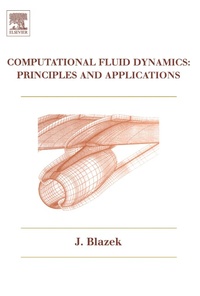
Computational Fluid Dynamics: Principles and Applications
Published on 11. May 2001
460 pages
978-0-08-054554-7 (ISBN)
Description

Computational Fluid Dynamics: Principles and Applications
More details
Other editions
Additional editions

Book
05/2001
Elsevier
€198.08
Withdrawn from sale
Person
Jiri Blazek received his MSc in Aerospace Engineering from the Institute of Technology in Aachen, Germany in 1989. He continued his research at the German Aerospace Center, DLR, and in 1995 obtained his PhD in Aerospace Engineering, focusing on CFD methods for high-speed flows, from the University of Braunschweig, Germany. Following this, Dr. Blazek worked as a research scientist at ABB Turbosystems in Baden, Switzerland, moving to ABB Corporate Research Ltd. (now ALSTOM Power Ltd.) as researcher and project leader for CFD code development in the fields of gas and steam turbines. He was appointed as senior research scientist at the Center for Simulation of Advanced Rockets, University of Illinois at Urbana-Champaign, USA and in 2005 founded his own consultancy and software development firm, CFD Consulting and Analysis, in Sankt Augustin, Germany. Dr. Blazek's main research interests include: CFD code development - especially in the area of unstructured grids, aircraft and turbomachinery aerodynamics; shape optimization; and data visualization.
Content
- Front Cover
- Computational Fluid Dynamics: Principles and Applications
- Copyright Page
- Contents
- Acknowledgements
- List of Symbols
- Abbreviations
- Chapter 1. Introduction
- Chapter 2. Governing Equations
- 2.1 The Flow and its Mathematical Description
- 2.2 Conservation Laws
- 2.3 Viscous Stresses
- 2.4 Complete System of the Navier-Stokes Equations
- Bibliography
- Chapter 3. Principles of Solution of the Governing Equations
- 3.1 Spatial Discretisation
- 3.2 Temporal Discretisation
- 3.3 Turbulence Modelling
- 3.4 Initial and Boundary Conditions
- Bibliography
- Chapter 4. Spatial Discretisation. Structured Finite Volume Schemes
- 4.1 Geometrical Quantities of a Control Volume
- 4.2 General Discretisation Methodologies
- 4.3 Discretisation of Convective Fluxes
- 4.4 Discretisation of Viscous Fluxes
- Bibliography
- Chapter 5. Spatial Discretisation: Unstructured Finite Volume Schemes
- 5.1 Geometrical Quantities of a Control Volume
- 5.2 General Discretisation Methodologies
- 5.3 Discretisation of Convective Fluxes
- 5.4 Discretisation of Viscous Fluxes
- Bibliography
- Chapter 6. Temporal Discretisation
- 6.1 Exphcit Time-Stepping Schemes
- 6.2 Implicit Time-Stepping Schemes
- 6.3 Methodologies for Unsteady Flows
- Bibliography
- Chapter 7. Turbulence Modelling
- 7.1 Basic Equations of Turbulence
- 7.2 First-Order Closures
- 7.3 Large-Eddy Simulation
- Bibliography
- Chapter 8. Boundary Conditions
- 8.1 Concept of Dummy Cells
- 8.2 Solid Wall
- 8.3 Farfield
- 8.4 Inlet/Outlet Boundary
- 8.5 Symmetry Plane
- 8.6 Coordinate Cut
- 8.7 Periodic Boundaries
- 8.8 Interface Between Grid Blocks
- 8.9 Flow Gradients at Boundaries of Unstructured Grids
- Bibliography
- Chapter 9. Acceleration Techniques
- 9.1 Local Time-Stepping
- 9.2 Enthalpy Damping
- 9.3 Residual Smoothing
- 9.4 Multigrid
- 9.5 Preconditioning for Low Mach Numbers
- Bibliography
- Chapter 10. Consistency, Accuracy and Stability
- 10.1 Consistency Requirements
- 10.2 Accuracy of Discretisation
- 10.3 Von Neumann Stability Analysis
- Bibliography
- Chapter 11. Principles of Grid Generation
- 11.1 Structured Grids
- 11.2 Unstructured Grids
- Bibliography
- Chapter 12. Description of the Source Codes
- 12.1 Programs for Stability Analysis
- 12.2 Structured 1-D Grid Generator
- 12.3 Structured 2-D Grid Generators
- 12.4 Structured to Unstructured Grid Converter
- 12.5 Quasi 1-D Euler Solver
- 12.6 Structured 2-D Euler Solver
- 12.7 Unstructured 2-D Euler Solver
- Bibliography
- A. Appendix
- A.1 Governing Equations in Differential Form
- A.2 Mathematical Character of the Governing Equations
- A.3 Navier-Stokes Equations in Rotating Frame of Reference
- A.4 Navier-Stokes Equations Formulated for Moving Grids
- A.5 Thin Shear Layer Approximation
- A.6 Parabolised Navier-Stokes Equations
- A.7 Convective Flux Jacobian
- A.8 Viscous Flux Jacobian
- A.9 Transformation from Conservative to Characteristic Variables
- A.10 GMRES Algorithm
- A.11 Tensor Notation
- Bibliography
- Index
