

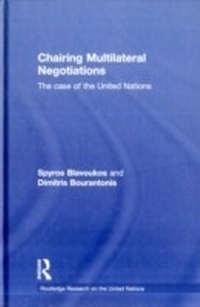
Chairing Multilateral Negotiations
The Case of the United Nations
1st Edition
Published on 23. June 2011
200 pages
978-1-136-70371-3 (ISBN)
Description

This book examines the important role of the chairmanship office in multilateral negotiations within the UN setting. Although chairmanship is a generic feature of international politics, negotiations, and decision-making, it has been scarcely researched. The neutrality and impartiality assumptions that have been long associated with the chair have veiled the chair's potential in moulding negotiation outcomes.
The authors seek to develop an analytical framework for the systematic study of the chairmanship office and its potential impact on multilateral negotiations. It elaborates on its origins, the parameters and conditions of chair's effectiveness, and the performance of the chair's functions. Focusing on the UN, this work seeks to go beyond existing accounts, offering further insights and extending the discussion beyond the Security Council. Without ignoring the pivotal importance of the Security Council, the book broadens the scope of analysis to other significant UN bodies and institutions including ad hoc Working Groups and several Conferences set up for specific international issues.
Evaluating material from a wide range of sources and providing a deeper understanding of UN political dynamics, this work will appeal to scholars of the UN system, international organisations and global governance.
The authors seek to develop an analytical framework for the systematic study of the chairmanship office and its potential impact on multilateral negotiations. It elaborates on its origins, the parameters and conditions of chair's effectiveness, and the performance of the chair's functions. Focusing on the UN, this work seeks to go beyond existing accounts, offering further insights and extending the discussion beyond the Security Council. Without ignoring the pivotal importance of the Security Council, the book broadens the scope of analysis to other significant UN bodies and institutions including ad hoc Working Groups and several Conferences set up for specific international issues.
Evaluating material from a wide range of sources and providing a deeper understanding of UN political dynamics, this work will appeal to scholars of the UN system, international organisations and global governance.
Reviews / Votes
'A highly commendable book for students and researchers alike, as itprovides a systematically theory-driven analysis of a topic that has been
under-researched until today, but that deserves the attention that it
gets in this work. Indeed, the book shows why and when the role of chairs
should not be underestimated in the U.N. and potentially beyond.' - Bart Kerremans, Professor of International Relations, University of Leuven, Belgium
'This is a welcome and important study of chairs' involvement in the UN negotiation processes. It is especially relevant for an era where multilateralism has thankfully proven to be in the ascendancy once again.' - Oliver Richmond, Professor of International Relations, University of St Andrews, UK
'How multilateral negotiations within in international organizations are chaired is an important, yet neglected, topic. Blavoukos and Bourantonis have provided a great service for scholars and practitioners of diplomacy and international relations with this thoughtful and comprehensive investigation of how the chair performs in a variety of cases taken from the UN.' - Paul Sharp, Professor of Political Science, University of Minnesota, Duluth, USA
More details
Series
Language
English
Place of publication
London
United Kingdom
Publishing group
Taylor & Francis Ltd
Target group
College/higher education
Product notice
Reflowable
Illustrations
1 s/w Tabelle
1 Tables, black and white
File size
0,89 MB
ISBN-13
978-1-136-70371-3 (9781136703713)
Copyright in bibliographic data and cover images is held by Nielsen Book Services Limited or by the publishers or by their respective licensors: all rights reserved.
Schweitzer Classification
Other editions
Additional editions
Spyros Blavoukos | Dimitris Bourantonis
Chairing Multilateral Negotiations
The Case of the United Nations
Book
09/2013
1st Edition
Routledge
€78.20
Shipment within 15-20 days
Spyros Blavoukos | Dimitris Bourantonis
Chairing Multilateral Negotiations
The Case of the United Nations
Book
06/2011
1st Edition
Routledge
€231.40
Shipment within 15-20 days
Persons
Spyros Blavoukos is a Lecturer in the Department of International and European Economic Studies at Athens University of Economics and Business
Dimitris Bourantonis is an Associate Professor of International Relations at Athens University of Economics and Business. His previous books include The History and Politics of UN Security Council Reform (Routledge, 2006) and The UN's Role in Nuclear Disarmament Negotiations, (Dartmouth, 1993).
Dimitris Bourantonis is an Associate Professor of International Relations at Athens University of Economics and Business. His previous books include The History and Politics of UN Security Council Reform (Routledge, 2006) and The UN's Role in Nuclear Disarmament Negotiations, (Dartmouth, 1993).
Content
1. Introduction 2. Analyzing the Chairmanship Office: Functions and Parameters of Effectiveness 3. The British Chair in the UN Security Council (1992) 4. The Presidency of the UN General Assembly and the Case of South Africa (1974) 5. The Chair of the Open-Ended Working Group on UNSC Reform 6. Chairing Committee I of UNCLOS III (1973-82) 7. The Presidency of the Sixth Conference of the Parties to the UN Framework Convention on Climate Change 8. The Eighteen Nation Disarmament Committee (ENDC) and its Co-chairmanship Office 9. Conclusions
