

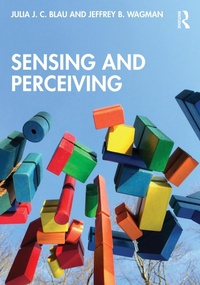
Sensing and Perceiving
1st Edition
Will be published approx. on 12. June 2026
498 pages
978-1-040-51190-9 (ISBN)
Description

Sensing and Perceiving offers a comprehensive and highly accessible overview addressing two centuries-old questions: how are animals aware of the surrounding world, and how does this awareness enable everyday behaviors? Authors Julia J. C. Blau and Jeffrey B. Wagman provide a thorough description of the biological systems involved in these processes and examine both traditional and ecological approaches to understanding how these processes occur.
The book features a conversational and humorous writing style with everyday examples that introduce novice readers to sensing and perceiving processes. Key benefits include clear explanations of different theoretical assumptions, research questions asked, and conclusions drawn by the various approaches. The authors demonstrate how sensing and perceiving are actions we perform rather than passive experiences that happen to us, reflected in the book's unique title.
Sensing and Perceiving serves as an essential guide for students and professionals in sensation and perception, cognition, and biological psychology. This comprehensive textbook provides crucial foundational knowledge for undergraduate and postgraduate students exploring perceptual sciences, while offering valuable insights for researchers and practitioners in psychology, neuroscience, and related fields seeking to understand the active nature of sensory and perceptual processes.
The book features a conversational and humorous writing style with everyday examples that introduce novice readers to sensing and perceiving processes. Key benefits include clear explanations of different theoretical assumptions, research questions asked, and conclusions drawn by the various approaches. The authors demonstrate how sensing and perceiving are actions we perform rather than passive experiences that happen to us, reflected in the book's unique title.
Sensing and Perceiving serves as an essential guide for students and professionals in sensation and perception, cognition, and biological psychology. This comprehensive textbook provides crucial foundational knowledge for undergraduate and postgraduate students exploring perceptual sciences, while offering valuable insights for researchers and practitioners in psychology, neuroscience, and related fields seeking to understand the active nature of sensory and perceptual processes.
Reviews / Votes
"I am excited to use this textbook in my Sensation and Perception class. Information is presented in an engaged, familiar manner, and the authors use consistent characters and examples across chapters, which makes the text very easy to read. This writing style will allow students to understand traditional approaches and ecological approaches to perception equally, something that no other text does. This is a top-notch presentation of modern approaches to understanding perception. Even more, Blau and Wagman argue that sensing and perceiving are things that we do and not just things that happen to us, which is both novel and sure to spark student interest. The combination of coverage, writing style, and high-level execution makes this a textbook that will deepen any reader's appreciation for perception."Brian Day, Associate Professor of Psychology, Butler University.
"This textbook is a breath of fresh air for sensation and perception courses that provides a rigorous exploration of the ways organisms get to know the environment through their senses. And, even better, this is combined with an account of an ecological alternative to the mainstream views in the field. It is the perfect source to gather fundamental knowledge of sensation and perception as well as to understand the main theoretical positions and experimental results in their study. This book is a gamechanger both for students and professors interested in how we see, hear, and touch the world."
Vicente Raja, Ramon y Cajal Research Fellow, Department of Philosophy, Universidad de Murcia (Spain)
More details
Series
Edition
1. Auflage
Language
English
Place of publication
London
United Kingdom
Publishing group
Taylor & Francis Ltd
Target group
College/higher education
Illustrations
50 Line drawings, color; 12 Line drawings, black and white; 250 Halftones, color; 13 Halftones, black and white; 300 Illustrations, color; 25 Illustrations, black and white
File size
151,70 MB
ISBN-13
978-1-040-51190-9 (9781040511909)
Copyright in bibliographic data and cover images is held by Nielsen Book Services Limited or by the publishers or by their respective licensors: all rights reserved.
Schweitzer Classification
Other editions
Additional editions
Julia J. C. Blau | Jeffrey B. Wagman
Sensing and Perceiving
Book
approx. 06/2026
1st Edition
Routledge
€92.00
Not yet published
Julia J. C. Blau | Jeffrey B. Wagman
Sensing and Perceiving
Book
approx. 06/2026
1st Edition
Routledge
€191.50
Not yet published
Persons
Julia J. C. Blau is Associate Professor in the Psychological Sciences at Central Connecticut State University, New Britain, CT, USA. She is a member of the board of directors of the International Society for Ecological Psychology, an associate editor of the journal of Ecological Psychology, and she co-edits the series Resources for Ecological Psychology at Routledge.
Jeffrey B. Wagman is Professor of Psychology at Illinois State University, Normal, IL, USA. He is a member of the board of directors of the International Society for Ecological Psychology, an associate editor of the journal of Ecological Psychology, and he co-edits the series Resources for Ecological Psychology at Routledge.
Jeffrey B. Wagman is Professor of Psychology at Illinois State University, Normal, IL, USA. He is a member of the board of directors of the International Society for Ecological Psychology, an associate editor of the journal of Ecological Psychology, and he co-edits the series Resources for Ecological Psychology at Routledge.
Content
Preface. Acknowledgement. Part One. Biological Systems. Chapter 1. Philosophy, History, and Introduction to the Biological Approach. Chapter 2. Light and the Eye. Chapter 3. From the Retina to the Brain. Chapter 4. Color. Chapter 5. The Ear: Auditory and Vestibular Systems. Chapter 6. Somatosensory Systems. Chapter 7. Chemical Senses: Gustation and Olfaction. Part Two. The Traditional Approach. Chapter 8. Limitations of the Biological Approach and Introduction to the Traditional Approach. Chapter 9. Visual Perception of Depth and Size. Chapter 10. Visual Perception and Recognition of Objects. Chapter 11. Visual Perception of Motion. Chapter 12. Auditory Perception. Part Three. The Ecological Approach. Chapter 13. Limitations of the Traditional Approach and Introduction to the Ecological Approach. Chapter 14. Perceiving Events and Affordances. Chapter 15. Ecological Optics and Seeing. Chapter 16. Seeing Where to Go and How to Get There. Chapter 17. Ecological Acoustics and Hearing. Chapter 18. Ecological Haptics and Touching. Chapter 19. But what about...? References.
