

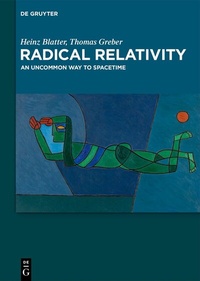
Radical Relativity
Description

Special relativity is at the foundation of any physical theory. Though, its consequences leave us with unexpected results in kinematics, dynamics and, to a lesser extent, in electrodynamics.
We introduce the theory of relativity including geometry and chronology, from the view of a local observer who encounters aberration and Doppler shift. The description of motion in Minkowski spacetime requires a careful distinction between different operational concepts of measuring time and space intervals, leading e.g. to the distinction of different velocities for the same process. The consequences in Newtonian dynamics, such as the obsolete relativistic mass, or in Maxwellian electrodynamics, the emergence of magnetic fields, are discussed in the light of experimental evidence. The final chapter discusses predictions for relativistic space flight.
The material in "Radical Relativity" is a careful exposition of all the concepts and phrases that change with different paradigms. It is an unusual approach to spacetime that opens up new insights and deeper understanding.
More details
Other editions
Additional editions
Persons
_Heinz Blatter is Professor at ETH Zurich since 1999. He completed his studies in physics with a
diploma thesis (equiv. to MSc) on "Spin correlation in Fermions" at the Department of Physics, ETH,
Zurich in 1972. The work for his doctoral thesis at ETH Zurich on the thermodynamics of polar
glaciers included field work in 1974/75 in the Canadian high arctic. His current research interests are
the numerical modelling of the physics of Alpine glaciers, with a focus on their future evolution, and
ice sheets, with a focus on glacial cycles.
_Thomas Greber obtained his PhD at ETH Zürich on Two Aspects concerning 4f impurities on metals in
1990. From 1991 to 1994 he worked at the Fritz-Haber-Institut in Berlin on non-adiabatic gas surface
reactions. Since 2004 he is Professor at the Physik-Institut of the University of Zürich. His main
interests in research are sp2 hybridized single layer hexagonal boron nitride and molecules like
magnetic endofullerenes on surfaces that he investigates with photoemission, scanning tunneling
microscopy and squid magnetometry. http://www.physik.uzh.ch/~greber/
Content
- Intro
- Preface
- Contents
- Prologue
- 1 The concept of Spacetime
- 2 Theory
- 3 Consequences of the special theory of relativity
- 4 Special Relativity Revisited
- 5 Limits of the special theory of relativity
- 6 Experimental evidences
- 7 Space travel
- Epilogue
- Bibliography
- Index
